

Users no longer tolerate static products. They expect every interaction, every recommendation, prompt, or feature, to feel like it was designed just for them, at that moment.
Whether it’s a streaming app surfacing the perfect series before the credits roll, or a retail platform adapting its layout to match browsing behavior, AI is transforming digital product experiences and product teams. This shift represents both an enormous opportunity and a growing source of pressure.
The mandate is clear: deliver dynamic and proactive digital products that adapt to user behavior in real time and use data inside the product to drive real-time personalization and experimentation versus static, one-size-fits-all interfaces. The question is how.
The high stakes of real-time context
There’s a reason every CPO and Chief Digital Officer is chasing the same goal: user context converts.
When your product understands who a user is and what they’re doing in the moment, it can respond in ways that directly moves the metrics that matter most: engagement, retention, and lifetime value.
Think about what happens when a product can:
- Recognize hesitation at checkout and trigger an in-app nudge that means something and isn’t generic
- Detect when a loyal user’s behavior begins to drift toward churn and serve a timely retention offer.
- Adjust recommendations mid-session to align with a new pattern of intent.
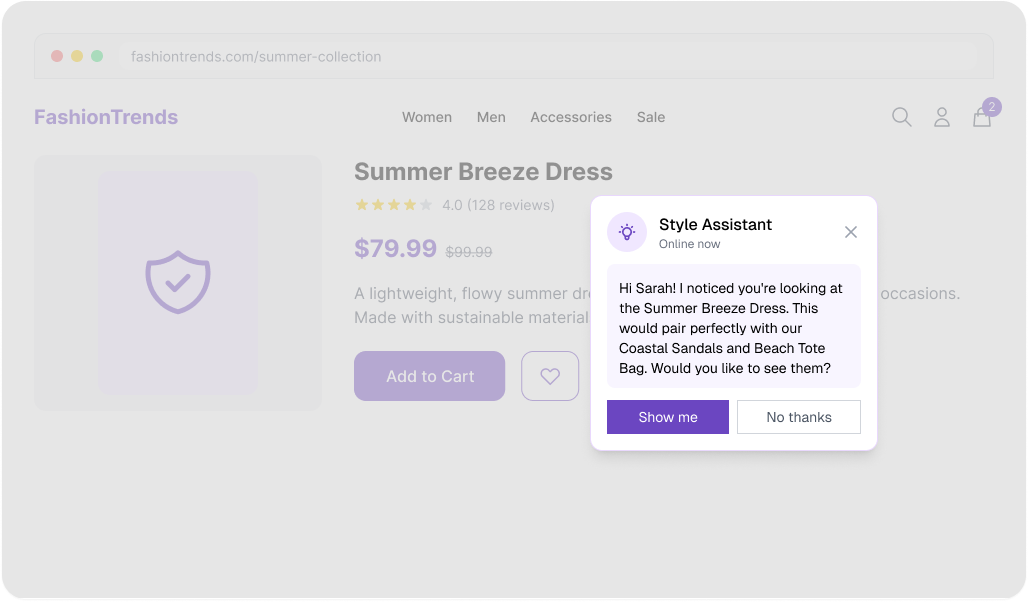
These micro-interventions compound into massive business outcomes. According to Netflix’s own estimates, its recommendation engine saves the company more than $1 billion per year by reducing subscriber churn. Spotify has reported that users who engage with its personalized Discover Weekly playlists stream twice as long as those who don’t.
These aren’t marketing wins; they’re product wins. And they all come down to one thing: the ability to harness historical user context, paired with real-time behavior.
Why traditional personalization falls short
Most teams already know personalization matters. But building and maintaining it is where things start to break down.
Many organizations still rely on data pipelines that were designed for only analytics, not for also powering live customer experiences. Product managers analyze product usage patterns and optimize via iteration cycles in the roadmap instead of leveraging the data being created in the moment.
The typical journey looks like this: events flow from app to warehouse → data scientists create segments → engineers push code to production → product teams A/B test feature impact and digest results weeks later. It’s static and reactive with no real-time loop.
For the companies that try to rebuild Netflix-style systems from scratch, it’s often an uphill battle with up to 24 months of engineering work to get started, connecting Kafka streams to feature stores and low-latency APIs. Then begins the ongoing maintenance that leaves little time for evolution in product or innovation.
In the meantime, user expectations keep climbing.
A turning point for product infrastructure
Product organizations are beginning to treat real-time personalization not as an add-on, but as foundational infrastructure.
They're moving away from one-off recommendation engines or simple serving layers, and instead, toward unified systems that integrate behavioral event tracking, feature computation (both streaming and batch), low-latency serving, and decisioning layers – all working together seamlessly.
These teams aren't asking "What model should we use?" anymore. They're asking: "How do we eliminate months of infrastructure work so we can ship adaptive experiences faster?"
This is where real-time intelligence systems, like Snowplow Signals, are changing the game. Instead of abstracting away data or control, Signals provides a fully managed intelligence layer that engineers can control.
It integrates seamlessly with your existing ML & AI stack, delivering up-to-date user context to models and applications in milliseconds. Data scientists and engineers maintain control over recommendation logic and governance, while eliminating the need to build and maintain custom stream processors, feature stores, or low-latency APIs.
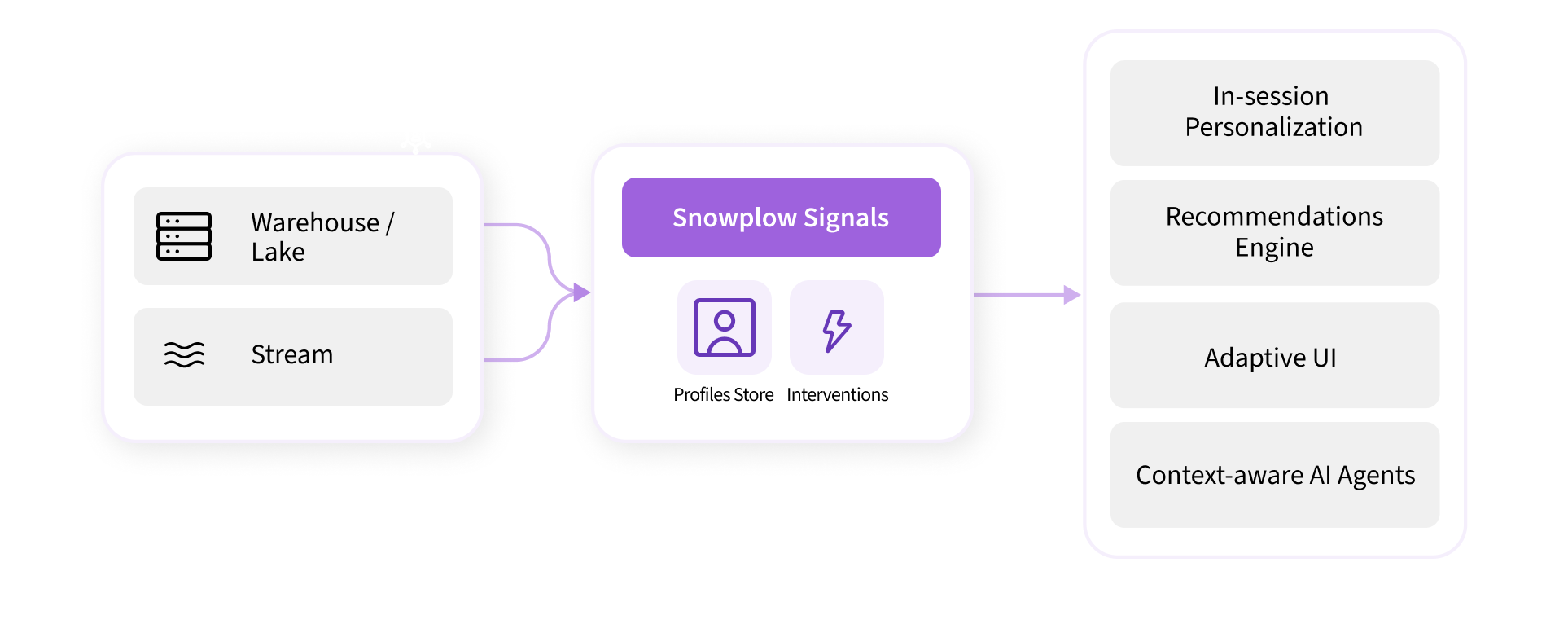
The result? Teams move from concept to production in weeks, not years, shipping adaptive experiences that combine in-session behavioral signals with historical context, enabling real-time product personalization that responds to users in the moment.
From reactive analytics to proactive experiences
Data warehouses and analytics platforms provide essential historical context for understanding user behavior patterns over time. But real-time recommendation systems need both historical depth and live behavioral signals; infrastructure that combines warehouse-derived features with real-time streaming computation to serve complete user context to models within milliseconds.
This shift toward unified batch and streaming infrastructure is what separates today's high-performing product organizations. They're building systems that leverage complete user history while responding to in-session behavior in the moment.
Imagine a product that:
- Detects when a new user completes their first key action and instantly surfaces advanced features to deepen engagement
- Serves contextual prompts to users who show signs of confusion, recognizing patterns of hesitation in real time
- Updates personalization logic as models evolve, without re-engineering streaming pipelines and serving infrastructure
This isn't the future; it's what top product teams are already building.
Product leadership in the age of AI
As a product leader, you're under pressure to ship AI-powered personalization features that drive engagement and retention. But the challenge isn't choosing the right model; it's getting real-time user context into those models fast enough to create adaptive experiences your users will notice.
If you've asked engineering to build real-time recommendation infrastructure, you've likely heard the timeline: “it will take us years to build custom streaming pipelines, feature stores, and serving APIs.” By the time it's ready, your product priorities have shifted, your models have evolved, your competitors have already launched, and your users have already gone elsewhere.
Here's how leading product teams are breaking this cycle:
- Treat infrastructure as a solved problem, not a project. Work with managed real-time intelligence systems that integrate with your existing stack, so you can iterate on personalization logic in weeks instead of waiting quarters for custom builds.
- Demand both historical and real-time context. Your recommendation systems need warehouse-derived features (purchase history, preferences) combined with in-session signals (current browsing, searches) to deliver truly adaptive experiences.
- Prioritize speed of iteration. Choose infrastructure that lets your team version, test, and deploy personalization changes without asking teams to rebuild pipelines every time.
The teams that win will be the ones that can continuously test, learn, and adapt their product experiences faster than anyone else.
The ROI equation product teams can’t ignore
Product leaders often ask: What’s the measurable value of personalization?
The answer is visible across three areas:
- Revenue efficiency: Hyper-personalized experiences maximize return on acquisition spend by improving conversion at key drop-off points.
- Retention lift: Timely, relevant interventions reduce churn without relying on generic incentives.
- LTV expansion: Intelligent recommendations increase upsell conversions and deepen customer engagement.
But there’s a fourth area as well. One that’s harder to quantify yet increasingly decisive: engineering efficiency.
When personalization infrastructure is built, maintained, and unified, teams spend eliminate months of scoping and build time and then maintaining, to more time shipping differentiated experiences. They can deploy code faster, test faster, and iterate directly in production without having to think about the baseline infrastructure.
That’s how companies transform personalization from a one-off initiative into an ongoing engine of product velocity.
Examples in motion
Across industries, the same pattern is emerging.
- Streaming platforms use real-time behavioral signals to adapt content recommendations within a single session, blending historical taste with current mood.
- Gaming companies tailor onboarding flows based on play style, turning early friction points into engagement accelerators.
- Fitness and wellness apps detect drop-off intent early and intervene before disengagement sets in.
- Responsible gaming platforms monitor patterns like spending velocity to trigger protective prompts at just the right moment, balancing user experience with regulation.
Each of these use cases stems from the same underlying principle: precision powered by real-time customer intelligence.
And in each case, the result isn’t just higher engagement; it’s deeper user trust.
Building the real-time foundation for AI
As AI capabilities advance, the line between personalization and intelligence is blurring. The same behavioral signals that power adaptive UIs will also feed the models behind predictive features, conversational agents, and dynamic pricing engines. One unified system of user context serves all of them.
Your competitive advantage isn't access to better models; it's the behavioral data you already have about your users. While competitors rely on generic training data, you have real-time signals from actual customer interactions: what they click, search, abandon, and purchase.
The question is whether your infrastructure can turn that proprietary knowledge into actionable context fast enough to matter.
Leading enterprises are re-architecting around a single goal: ensuring every model, every experiment, and every in-app interaction runs on the same high-quality behavioral data foundation. When your recommendation systems, ML models, and product features all draw from unified real-time user context, you can iterate faster, personalize better, and scale AI initiatives without rebuilding infrastructure for each new use case.
That unified data foundation is what enables both rapid experimentation, personalization, and sustainable AI scalability.
The next era of digital product leadership
The world’s most successful digital products aren’t winning because of bigger budgets or flashier interfaces. They’re winning because they understand their users better, and act faster on that understanding than anyone else.
They’ve recognized that customer context is no longer a reporting layer to inform static and reactive digital products for all users; but instead, it’s a revenue engine, enabling dynamic and proactive digital products that are context-aware and adaptive to each unique user.
Product leaders who embrace this shift, who leverage data inside the product, will drive real-time personalization and experimentation, enabling instant product adaption and in-session experiences. Those who don’t will keep iterating in hindsight while their competitors experiment and build in real time.

If you’re defining your 2026 roadmap around AI-driven products and adaptive experiences, now’s the moment to act.
Download The Real-Time Product Personalization Guide to see how leading teams are turning customer context into real-time revenue – in weeks, not years.
Sponsored by:



Become a PLA Insider
Thank you for subscribing
Get exclusive insights, frameworks, and strategies from product leaders driving real business impact.
An email has been successfully sent to confirm your subscription.
 Follow us on LinkedIn