








Ever wondered what it takes to be a Chief Product Officer (CPO)? In the world of product, the CPO role is becoming an increasingly crucial leadership position. But what is the job description of a chief Chief Product Officer? And what are the essential responsibilities and skills required to attain, and excel in, this position? Join us as we dive into the role of the Chief Product Officer.
Chief Product Officer (CPO) definition
A Chief Product Officer (CPO) is the most senior product executive in a company. The CPO owns the product vision, product strategy, and the overall direction of the product portfolio. They typically report directly to the CEO and, in many companies, work closely with the board.
The CPO connects product decisions to business outcomes. That means aligning roadmap priorities with company goals, guiding the product management team, and ensuring teams build products that meet customer needs and support growth.
In smaller businesses, product leadership may sit with a founder, product manager, or head of product. But as a company scales, launches multiple products, or builds more complex teams, the CPO becomes the executive responsible for long-term product direction and cross-functional alignment.
"For me as Chief Product Officer, I oversee the creation, growth, life cycle, and profitability of a highly diverse product portfolio.
"What that really means is I help bring products to market that in turn help life science organizations make better and more informed decisions across the drug life cycle — from the earliest stages in the drug pipeline to ultimately getting those treatments into the hands of the right patients and the right providers."
– Chris Kaneda, CPO at Northella
CPO vs other product and C-suite roles
The CPO role is often confused with other senior leadership titles. Here's how it compares.
CPO vs CTO
The CPO owns the product vision, product strategy, and customer value of what the company builds. The Chief Technology Officer owns the technology strategy, engineering systems, and technical execution behind it. Both roles work closely together, but the CPO focuses on product outcomes while the CTO focuses on technical delivery and architecture.
In some organizations, these roles can be combined as the Chief Product and Technology Officer (CPTO).
"Being a Chief Product and Technology Officer, you might have certain biases towards one discipline or another. It's very important to be conscious about those biases and really focus to build that culture and trust — use the understanding of those disciplines to make them work better together rather than trying to side with one or the other. Breaking the silo and creating that co-ownership — that is something the CPTO role could accomplish."
– Janko Bazhdavela, Former Chief Product Officer, The Infatuation
CPO vs Head of Product
A Head of Product is often a senior product leader in an earlier-stage or smaller company. The role tends to be more hands-on and execution-focused. A CPO operates at the executive level, sets long-term direction, oversees a broader product portfolio, and helps shape company strategy alongside the CEO and other C-suite leaders.
CPO vs CEO
The CEO leads the entire business. The CPO leads the product organization and reports to the CEO. In product-led businesses, the CPO is one of the most influential executives in deciding what the company builds, why it matters, and how it drives growth.
 Rebecca Stewart
What are the responsibilities of a Chief Product Officer?
Strategic planning
The CPO gets the reigns when it comes to strategic planning. They’re in charge of defining the overall goals and are tasked with how to achieve them. Typically, this means looking at market trends, finding new product offerings, and structuring the product vision and design based on that.
Strategy comes in line with building the product roadmap to guide different teams to collaborate efficiently. The best roadmap is built around market analysis, industry trends, and finding new opportunities to make informed decisions on business positioning. Resource allocation should be a top priority for CPOs to stay within their means. Communicating with stakeholders will help align priorities, budgets, and talent across the different departments.
Part of building strategy is understanding the potential risks a product could run into and mitigating those beforehand. Think of contingency plans to reduce risk and create a more comprehensive roadmap minimizing chances of failure. Identifying Key Performance Indicators (KPIs) can provide data to continually improve the success of the product and provide course correction insights if things begin to veer off. It’s much like driving a car and always keeping your hands on the wheel.
It’s important for CPOs to remain flexible in their roadmap and adapt when markets change. The best can adopt new practices when they come along and know how to network with peers for optimal collaboration. Strategy isn’t written in stone, so CPOs who continuously learn and improve can push their roadmap for the best success.
 Cindy Camacho
Product development and team management
From conceptualization all the way to launch, the CPO is in charge of bringing the product to life. They’ll oversee research, design, and testing, working with everyone from engineers to markets and the sales team. That’s a lot of people to keep track of! But the CPO needs to work closely with the executive team to make sure business goals are being met.
UX designers and CPOs can collaborate to design a seamless user experience. The best experience is tailored, user-centric, and should be heavily tested for usability. Feedback is the name of the game here, so CPOs should work with the UX team to meet customer needs. A fearless CPO isn’t afraid to change what isn’t working, but an even better CPO knows how to communicate this effectively without hindering the UX team to do impossible tasks. It’s all about balance here.
Agile isn’t just a buzzword. The 2024 Product Management Salary Report found that 33.9% of product pros work in three-to-five-person squads — the classic agile setup that lets you slice work into small increments, learn fast, and pivot without red tape. That’s why seasoned CPOs lean on agile to keep momentum high.
When it comes to innovation in the development process, a good CPO fosters creativity through experimentation, exploration of technologies, and opportunities. With new technologies always on the horizon, a CPO who pushes the boundaries to meet needs will always be ahead of the curve. They provide leadership, guidance, and mentorship to their team to ensure that they are aligned with the company's overall goals.
 Kseniya Strelnikova
Customer research
One of the primary ways a CPO manages customer research is by leading a team responsible for gathering and analyzing data on customer preferences, behaviors, and pain points. This data-driven approach helps the CPO gain insights into market trends, identify customer needs, and make informed decisions regarding product development and improvements.
A good CPO collaborates closely with the customer support and success teams to gather direct feedback and insights from customers. By maintaining open lines of communication and actively listening to customers, the CPO can gauge customer satisfaction levels and identify areas where improvements are needed.
By effectively managing customer research and satisfaction, the CPO plays a pivotal role in ensuring that the company's products are not only innovative but also resonate with the target audience, leading to increased customer loyalty and business success. CPOs need to understand how pricing, packaging, and where the product will sit in the market will affect customer satisfaction.
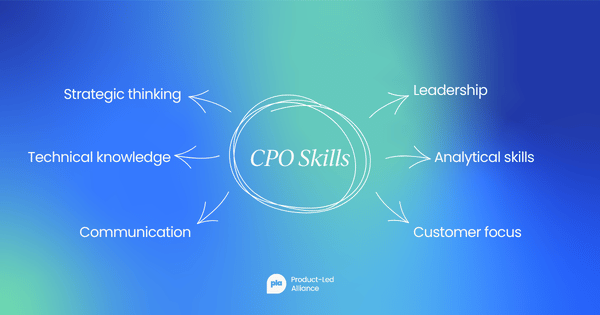
What skills are needed to become a Chief Product Officer?
1. Strategic Thinking: The best CPOs have a strong ability to think strategically and develop a long-term product vision. They are able to analyze market trends, identify gaps in the market, and develop a plan to fill those gaps.
2. Technical Knowledge: The CPO should have a strong technical background, with a deep understanding of product design, development, and testing. This allows them to communicate effectively with cross-functional teams and ensure that the product is aligned with the company's goals.
3. Communication: The CPO should be an effective communicator, able to convey complex ideas in a clear and concise manner. They should be able to communicate effectively with cross-functional teams, customers, and stakeholders.
4. Leadership: The CPO should be an effective leader, able to provide guidance, mentorship, and support to their team. They should be able to motivate their team to achieve their goals and align them with the company's overall objectives.
5. Analytical Skills: The CPO should have strong analytical skills, able to analyze market trends, customer feedback, and product performance data. They should be able to use this information to make data-driven decisions that align with the company's overall goals.
6. Customer Focus: The CPO should be customer-focused, with a deep understanding of customer needs and preferences. They should be able to develop products that meet the needs of the target market and incorporate customer feedback into future product development.
How to become a Chief Product Officer
There's no single route to becoming a Chief Product Officer, but most CPOs progress through senior product management roles over time. A common career path looks something like this: Product Manager to Senior Product Manager to Director of Product to VP of Product, and eventually into the CPO role.
Most candidates bring 10 to 15 years of experience across product strategy, product delivery, and team leadership. Cross-functional exposure matters too. If you've worked closely with engineering, design, marketing, and go-to-market teams, you're building the kind of breadth that CPO roles demand.
Educational backgrounds vary. Many CPOs hold degrees in business, engineering, computer science, or related fields, and some have MBAs or other advanced qualifications. That said, proven product leadership carries more weight than any single credential.
Compensation reflects that impact. 2024 data pegs average salary of a Chief Product Officer between $188,400 and $472,000, and total packages can soar well beyond that once equity is factored in — especially in venture-backed or public tech firms.
Chief Product Officer progression
CPOs can serve as executives in large corporations, leading product teams and collaborating with other C-suite members to align product development with overall business goals. In startups and smaller companies, CPOs often play a more hands-on role, directly managing product development, marketing, and user experience.
Additionally, CPOs can find opportunities as consultants, advising businesses on product-related matters and optimizing their offerings. As the digital landscape evolves, CPOs are increasingly sought-after in technology-driven fields, such as software development, e-commerce, and digital services.
With their ability to envision and execute innovative product strategies, CPOs are invaluable assets across industries, driving growth and ensuring companies remain competitive in today's dynamic market.
More often, CPOs are moving into CEO positions as the role requires increasing commercial awareness and ownership. Michelle Sterzovsky, Vice President of Product at Greenlight, says it best:
"CPOs can be very influential to a company's performance. Product leaders are increasingly having P&L and general management responsibility, and the CPO to CEO role is more and more common. AI is only accelerating this shift."
Conclusion
The Chief Product Officer is a critical position in today's business landscape. This executive-level position is responsible for overseeing all aspects of a company's product development, from conception to launch. The CPO is responsible for developing a comprehensive product strategy, overseeing product development, conducting customer research, managing the product lifecycle, and managing a team of product managers, designers, and engineers.
The key skills of a successful CPO include strategic thinking, technical knowledge, communication, leadership, analytical skills, and customer focus. Companies that invest in a strong CPO are better equipped to develop products that meet customer needs, outcompete their rivals, and achieve long-term success.
FAQs
What does a Chief Product Officer do?
A Chief Product Officer owns the product vision, product strategy, and overall product lifecycle. They lead the product organization and make sure product decisions support customer needs and business goals.
Is a Chief Product Officer higher than a CEO?
Yes. The CEO leads the entire company, while the CPO leads the product function and typically reports to the CEO. The CPO is a senior executive, but operates within the broader leadership structure.
How much does a Chief Product Officer earn?
CPO compensation varies by company size, industry, and equity package. Some estimates come in at $188,400–472,000. In many technology companies, total pay can be significant relative to other executive roles because it often includes salary, bonus, and equity.


Become a PLA Insider
Thank you for subscribing
Get exclusive insights, frameworks, and strategies from product leaders driving real business impact.
An email has been successfully sent to confirm your subscription.
 Follow us on LinkedIn