

Prioritization is supposed to be one of the core strengths of product management.
In reality, for many teams, it’s a constant uphill battle. Roadmaps expand. Leadership changes. Revenue pressure mounts. New “urgent” opportunities appear. And what felt aligned last quarter suddenly feels negotiable.
In our State of Product Management 2026 report, we looked closely at how teams prioritize – who owns decisions, what systems they use, what disrupts them, and how confident they are in measuring impact.
A clear pattern emerged:
The problem isn’t setting priorities. It’s that they’re too easy to undo.
1. Unclear decision ownership
Decision ownership is the first pressure point.
Our findings show final approval on prioritization most often sits with product leadership (31.2%). In fully product-led organizations, that rises to 41.2%.
That’s a healthy signal. Clear ownership reduces noise and speeds up decisions.
But the broader picture is more fragile:
- 19.3% say the CEO has final approval
- 6.1% say the founder
- 7.4% report no clear decision-maker at all
During the transition from project-based to product-led, lack of a clear decision-maker jumps to 16.2%.
This transition phase is where prioritization often destabilizes.
Roles evolve. Processes change. Teams are told they’re becoming “product-led.” But decision rights haven’t fully shifted. Authority becomes blurred, and when ownership is unclear, prioritization slows down and becomes more political.
Instead of debating trade-offs, teams debate who gets to decide.
The challenge: Without clear decision rights, prioritization is vulnerable to hierarchy, escalation, and persuasion.
To combat this: clarify and communicate decision ownership – especially during organizational transitions. Even if decisions are collaborative, final accountability must be explicit. Resilient prioritization starts with clear authority.
 Gaby Paul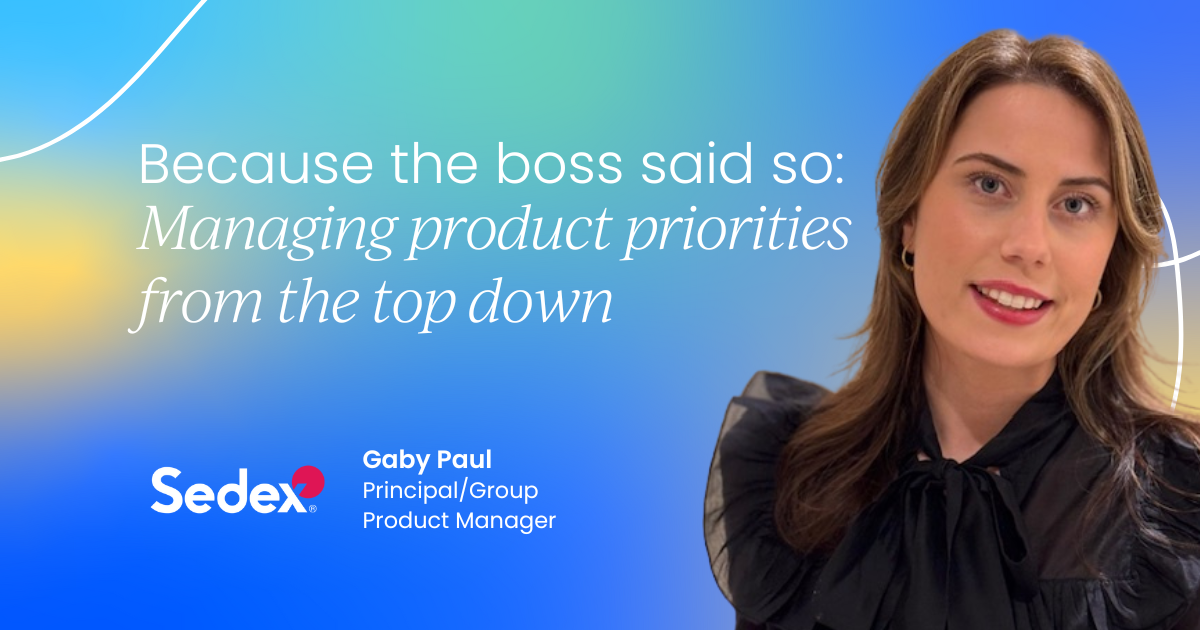
2. Product teams don’t use prioritization systems
When we asked how prioritization works in practice:
- 25.8% say PMs propose priorities, and leadership typically supports them
- 25% say leadership sets priorities and the team executes
- 12.3% describe a collaborative PM/Engineering/Design model
- Only 5.7% use structured frameworks like OKRs or formal scoring models
At the same time, teams say they prioritize based on:
- Customer impact or value (58.2%)
- Business impact or ROI (48.8%)
- Strategic importance (38.9%)
These are sensible criteria. The problem isn’t what teams value – it’s how consistently they weigh those factors.
Without a shared, visible system for evaluating trade-offs, prioritization relies heavily on context and individual judgment, and judgment is easier to challenge when pressure increases.
This raises an important question for product leaders: Do you have a prioritization problem, or a systems problem?
When prioritization criteria aren’t formalized, decisions feel subjective, which makes them easier to reopen.
Instead, make the criteria explicit and repeatable. That doesn’t require rigid scoring models in every case, but it does require:
- Clear strategic themes
- Agreed trade-off rules
- Transparent weighting of impact vs. effort vs. risk
- A shared language for evaluating initiatives
Systems help to standardize the debate around trade-offs and prevent the constant re-prioritization cycle.
 John Cutler
3. Short-term pressure overrides long-term strategy
Even when priorities are agreed, they rarely stay fixed.
On average, teams rate how often priorities change after agreement at 3.3 out of 5.
When asked what overrides prioritization frameworks, the top drivers are:
- Leadership escalations or new directives (60.2%)
- Sales or customer escalations (38.5%)
- Revenue or commercial pressure (38.1%)
- High-value new opportunities (36.1%)
This reinforces a consistent theme: urgency enters the system and displaces alignment.
It’s not usually that the original prioritization was flawed. It’s that new information or pressure isn’t absorbed into the system – it overrides it.
Over time, this creates a culture of renegotiation. Roadmaps become provisional, and strategy becomes elastic.
Reprioritization itself isn’t the problem: we all know markets change, customers escalate, and opportunities emerge. The issue is when reprioritization becomes the default.
When every escalation can reset the roadmap, teams struggle to execute long-term strategy.
A solution to this is to introduce guardrails around change:
- Define what qualifies as a legitimate override
- Create a formal intake process for escalations
- Batch prioritization changes to specific review cycles
- Make trade-offs explicit when something new is added
If something moves up, something else must move down.
Resilient prioritization isn’t rigid – it’s intentional.
 Amanda Myres
4. Data gaps slow decisions and weaken confidence
When teams describe what consumes the most time in prioritization, three themes dominate:
- Gathering and reconciling fragmented data
- Aligning stakeholders and securing approvals
- Revisiting trade-offs under shifting scope
One in five (19.2%) respondents spends more than 26% of their time on feature prioritization. That’s a significant portion of product capacity spent under uncertainty.
And confidence in measuring business impact averages just 3 out of 5.
When asked how success is measured, teams most often point to:
- Customer satisfaction (38.1%)
- Active usage (34.4%)
- Revenue influenced by product improvements (29.1%)
These are valuable indicators. But they don’t always create a clear, causal link between a specific initiative and business outcomes.
Fewer teams rely on:
- Outcome attainment (20.1%)
- Time-to-value (19.3%)
- Formal scoring frameworks (13.5%)
When outcomes aren’t tightly defined and shared, prioritization debates become harder to resolve objectively.
If impact is fuzzy, it’s likely that urgency will win.
Weak outcome visibility makes trade-offs subjective – and subjective trade-offs are easier to overturn.
Instead, tie roadmap items directly to measurable, shared outcomes:
- Define expected impact before work begins
- Make outcome metrics visible across teams
- Review the impact consistently after release
- Use learnings to inform future prioritization
When impact is clear, decisions become more durable.
 Rebecca Madro
The reprioritization trap
Taken together, the data points to a recurring pattern:
- Decision ownership is clearer in mature organizations, but unstable in transition.
- Structured prioritization systems are rarer than expected.
- Leadership and revenue pressures frequently override agreed priorities.
- Confidence in measuring impact is moderate at best.
This creates a trap.
Teams invest time aligning on strategy and roadmap decisions. But without durable systems and visible outcomes, those decisions are fragile.
Under pressure, they bend. When they bend repeatedly, strategy fragments. And when strategy fragments, execution slows.
The issue isn’t the change itself; it’s the instability.
Moving from reactive to resilient prioritization
Escaping the reprioritization trap doesn’t mean eliminating change. It means strengthening the system around it.
A few practical shifts stand out:
1. Clarify decision rights
Especially during product-led transitions, ambiguity around ownership creates friction.
Collaboration is healthy. Input from sales, customer success, engineering, and leadership is essential, but collaboration without clear accountability slows decisions and increases political escalation.
When decision ownership is unclear:
- Escalations bypass agreed processes
- Roadmap discussions become negotiation forums
- PMs spend more time aligning than executing
Senior leaders play a critical role here. They must explicitly define:
- Who proposes priorities
- Who contributes input
- Who has final approval
- How disagreements are resolved
Clear ownership doesn’t eliminate debate; instead, it ensures prioritization discussions stay focused on trade-offs – not authority.
Without clarity, prioritization becomes influence-driven. With clarity, it becomes decision-driven.
2. Formalize prioritization criteria
Most teams already consider customer value, business impact, and strategic importance. The problem is the inconsistency in how those factors are weighed.
When criteria are implicit, decisions feel subjective, and subjective decisions are easy to reopen under pressure.
Formalizing prioritization required defining a shared logic that product managers and leaders can follow.
For example:
- What qualifies as “strategic”?
- How do you weigh short-term revenue vs. long-term differentiation?
- When does customer impact outweigh effort cost?
- What trade-offs are you willing — and unwilling — to make?
Even lightweight frameworks create:
- A common language for trade-offs
- Transparency across stakeholders
- A reference point when new requests emerge
When a new escalation appears, the question shifts from “Should we do this?” to “How does this score against our agreed criteria?”
That shift makes prioritization more durable.
 Adrien Deyhim
3. Protect focus with guardrails
Reprioritization isn’t inherently bad. The danger is uncontrolled reprioritization.
Without guardrails, every escalation feels exceptional – and exceptional cases become routine.
Leaders can introduce stability by defining:
- What qualifies as a legitimate override
- How escalations enter the system
- When roadmap changes can occur (e.g., monthly or quarterly review cycles)
- What gets deprioritized when something new is added
The most powerful discipline is this: If something moves up, something else moves down.
Making trade-offs explicit forces visibility. It prevents silent scope expansion, and it reinforces that product team capacity is finite.
Guardrails protect your team’s time and ensure change is strategic.
4. Anchor work to measurable outcomes
Many prioritization debates stem from one root issue: unclear impact.
When expected outcomes aren’t tightly defined, it becomes difficult to evaluate trade-offs objectively. In that vacuum, urgency and influence win.
Resilient prioritization requires stronger outcome visibility:
- Define the expected business or customer impact before work begins
- Align initiatives to specific metrics or OKRs
- Track performance post-release
- Use impact data to inform future prioritization
When teams can clearly articulate the outcome you’re targeting, if you achieved it, and what was learned, prioritization becomes grounded in evidence, rather than opinion.
Visible impact builds confidence. And confidence makes future decisions more stable.
Final thoughts
When ownership is clear, criteria are shared, and outcomes are measurable, reprioritization becomes deliberate instead of reactive.
Without those foundations, product strategy will continue to bend under pressure – even in teams full of capable, thoughtful people.
And that’s where the real work of product leadership sits:
Building a system where those choices can hold.
Looking for more data on prioritization in 2026?
Discover 100+ pages of exclusive insights from 250 product leaders from companies like eBay, Oracle, and more in our 2026 State of Product Management report.


Become a PLA Insider
Thank you for subscribing
Get exclusive insights, frameworks, and strategies from product leaders driving real business impact.
An email has been successfully sent to confirm your subscription.
 Follow us on LinkedIn