







What is an outcome-based roadmap?
Outcome-based (also known as outcome-driven) roadmaps are strategic plans focused on results and goals (rather than specific features).
This approach allows your team to solve complex product problems, instead of ticking off a feature list. It stresses how things look if your team succeeds, how your customers will feel, and what your users can now achieve.
By taking this approach, you can avoid being stuck delivering on a list of features, and instead, your whole team can own the problem.
Outcome-driven planning pays off in the real world. In our 2026 State of Product Management survey, 47.5 % of product pros say the biggest perk is the extra ownership and autonomy it gives their team. And 87.3 % tell us that cross-team data sharing is now mission-critical: clear proof that focusing on outcomes both empowers teams and accelerates knowledge exchange.
Pressure to ship features clouds judgment. In fact, 26.6 % of teams admit that output deadlines are the main reason their roadmap drifts away from real customer needs, evidence that building a balanced roadmap matters more than ever. Swap that mindset for outcomes, and you know when the actual problem is solved, not just when another release goes live.
When you gain clarity on outcomes, you’ll be able to realize a wider range of possibilities and gain better context for specific items on your product roadmap and specific prioritization techniques. At the same time, you’ll also be able to ensure the product strategy is still well communicated and consistently adhered to.
To provide a better understanding of the power of outcome-based product roadmaps, we sat down with Roman Pichler, Founder of Pichler Consulting and advocate for outcome-driven approaches.
Here’s what he had to say:
“Many product people I work with still use traditional feature-based roadmaps and are fairly new to the concept of outcome or goal-oriented roadmaps.
“The whole point is rather than focusing on output and deliverables, i.e, “what needs to be done?” try asking, “why do we want to enhance the product? What is the specific value that we want to create?” “What are the specific outcomes and goals we'd like to achieve?”
“That might be to acquire more users or customers, to increase engagement, to improve conversion, and to start generating revenue, etc. I think part of the reason why feature-based roadmaps are still dominant is that it’s hard to shrug off that traditional way of doing it.
“There's an interesting correlation between product roadmapping and the level of empowerment that product people have. I find that when product people aren't fully empowered, they're often given a feature-based roadmap and told to deliver.”
 Rebecca Stewart
✅ Pros of outcome-based roadmaps
1. Strategic alignment around business goals
Outcome-based roadmaps connect day-to-day work to strategic goals and broader business objectives. Because teams align on desired outcomes, product, marketing, sales, and support can make tradeoffs faster and work from a shared definition of success.
Shared clarity is more than a feel-good slogan. 86% of product-ops leaders rank effective cross functional collaboration as their top mandate, and over half already track team-satisfaction scores to prove the morale boost that follows. When everyone sees (and owns) the same goals, results follow.
2. Flexibility when priorities change
An outcome roadmap gives teams room to adapt the solution while staying focused on the result they need to achieve. When customer feedback, market shifts, or new opportunities emerge, you can plan and execute a product pivot without losing strategic alignment or derailing the broader plan.
3. Measurable outcomes that show impact
Success gets evaluated through measurable outcomes like improved activation, reduced churn, or stronger conversion rates, so choosing the right metrics is critical.
Fully product-led teams give their impact tracking a solid four out of five, while project-based peers settle for 3.2. That twenty-five-percent jump shows how an outcome-based roadmap makes it simpler to connect every initiative to company goals and report progress with confidence.
4. Encourages a user-centric approach
By tying product work to real customer problems, these roadmaps foster empathy and focus. Instead of mindlessly shipping features, you’re solving problems, delivering value, and improving experiences for your users.
⚠️ Cons of outcome-based roadmaps
1. Requires strategic clarity and executive buy-in
Outcome-based roadmaps only work when leadership has defined clear strategic priorities and can get buy-in from stakeholders. Without that foundation and visible executive support, teams often drift back into feature-first planning habits.
2. Can be resource-intensive to maintain
Defining outcomes, gathering insights, measuring impact – it all takes time, effort, and often specialized skills. Smaller teams or resource-constrained organizations may find it tough to sustain this level of strategic rigor without the right support.
3. Turning outcomes into actionable work can be difficult
Teams often understand the desired outcome but struggle to translate it into experiments, initiatives, and measurable next steps. This tends to be most common when the team is new to product discovery or outcome-led planning.
4. Managing stakeholder expectations takes ongoing communication
Some stakeholders are more comfortable with fixed features and timelines than with flexible, outcome-led plans, another reason why storytelling aligns project stakeholders. To make this model work, you'll need regular updates, clear success measures, and strong communication around why priorities may shift.
5. May not suit every project or environment
Not all projects benefit from this flexible, problem-first approach.
In highly regulated industries or fixed-scope contracts, detailed features and rigid timelines are often non-negotiable. Outcome-based roadmaps may not offer the predictability those scenarios require.
 Adrien Deyhim
Outcome-based vs feature-based roadmap
Teams often use the terms feature-based, output-based, and outcome-based interchangeably, but they're not the same.
A feature-based roadmap tells stakeholders what the team plans to build. An output roadmap is slightly broader, focusing on work delivered, but it still emphasizes shipping over results.
An outcome-based roadmap starts with what the business wants to achieve: increasing activation, improving retention, reducing churn. That's what creates a stronger link between roadmap decisions, product strategy, and measurable outcomes.
So, what’s the real difference between these two approaches – and why are more teams making the switch?
For years, the feature-driven roadmap has been the default. It’s straightforward, familiar, and gives stakeholders a sense of what’s coming down the pipeline. But that simplicity can be deceiving.
Feature-based roadmaps are often:
- Overloaded with deliverables: Full of features that don’t always connect back to clear goals or customer value.
- Rigid and outdated quickly: They rarely evolve when customer needs or business priorities shift.
- Centered on output, not impact: Success becomes defined by shipping features, rather than solving problems.
This often leaves product teams ticking off items on a list, without knowing if they’re actually moving the needle.
As Becky Flint, CEO of Dragonboat, puts it:
“Feature roadmapping adopts a predefined prioritization method, not responsive to the goals and needs of the company or market...”
“A roadmap based primarily on customer requests is an example of a feature roadmap because it often leads to focusing on the superficial level of customer needs and wants, and you create features to solve them on an incremental level.”
In other words, you might be building what customers ask for – but not necessarily what they need most.
Outcome-driven roadmaps turn this on its head. Instead of asking “what should we build?”, they begin with “what are we trying to achieve?”
This approach allows:
- Clear alignment with business and user goals,
- Flexibility as things evolve, and
- Stronger team autonomy.
Outcome-based roadmaps make it easier to measure impact because success is tied to real-world change, like users completing a task or trial-to-paid conversions increasing.
Need another reason to move beyond feature lists? Only 20.1 % of product teams even measure whether customers reach the intended outcome. If you cannot see the impact, you cannot improve it, which is exactly why output-heavy roadmaps leave value on the table. Outcome-based roadmaps keep teams focused on business goals and customer value, not just activity.
 Rebecca Madro
How to build an outcome-based product roadmap
So, you’ve decided to commit to focusing on outcomes. But how do you begin putting an outcome-based product roadmap together?
Any outcomes you define need to be measurable and recognizable to your stakeholders and customers as something genuinely valuable. Focusing on an outcome like "the customer seeing more marketing emails" doesn't move the needle for anyone.
Here are the key steps to build one that works.
1. Align product vision, strategy, and objectives
A strong roadmap starts with a clear product direction. It should connect your product vision to strategic goals, customer needs, and the business outcomes your company wants to achieve.
When shaping that direction, consider:
- What you want to achieve in the short and long term
- Customer insights and market trends
- Competitive intelligence
- Your business model and unique differentiators
Once your product vision is clear, break it into objectives that represent meaningful desired outcomes for both customers and the business.
2. Define measurable outcomes with OKRs and key results
Outcome-led planning depends on measurable outcomes, not broad ambition alone. A strong objective describes the result you want, while key results define how you'll measure progress.
For example, an objective like "improve onboarding for mid-market customers" becomes much stronger when paired with key results like "increase activation from 42% to 60% by end of Q2" or "reduce time to first value by 20%." Use product OKRs to drive your strategy, they create the structure and accountability that keep teams focused on impact.
 Soham Sharma
3. Prioritize opportunities through product discovery
Once outcomes are defined, prioritize the initiatives most likely to move those metrics. Use customer research, usage data, market input, and stakeholder context to decide where product discovery should focus first.
Stay solution-agnostic for as long as possible. Teams need room to test assumptions before committing to delivery, so the roadmap reflects the most promising path to impact rather than a fixed list of outputs. Customer feedback is valuable here, but keep in mind their suggestions may not address the actual underlying problem.
Check out our product prioritization frameworks by becoming a PLA member. Having a framework in place will help you assess the various inputs more effectively.
4. Communicate the roadmap in outcome terms
The roadmap should show:
- The outcome each initiative supports
- The key results or measurable outcomes being tracked
- The discovery and delivery horizon
- Major dependencies or risks
- Why each priority matters now
Use broad timeframes like a month or quarter, and give stakeholders enough context to understand the logic behind the plan. This keeps the roadmap useful for communication without turning it into a rigid delivery promise.
 Rebecca Madro
5. Review progress through continuous evaluation
Outcome-based roadmaps need regular review to see whether the work is actually improving the metrics that matter. Continuous evaluation helps teams decide whether to scale an initiative, refine it, or stop it entirely.
This is also where team empowerment becomes practical. When the outcome is clear and progress is visible, teams can make better day-to-day decisions while staying aligned to the same strategic goals.
Outcome-based roadmap examples
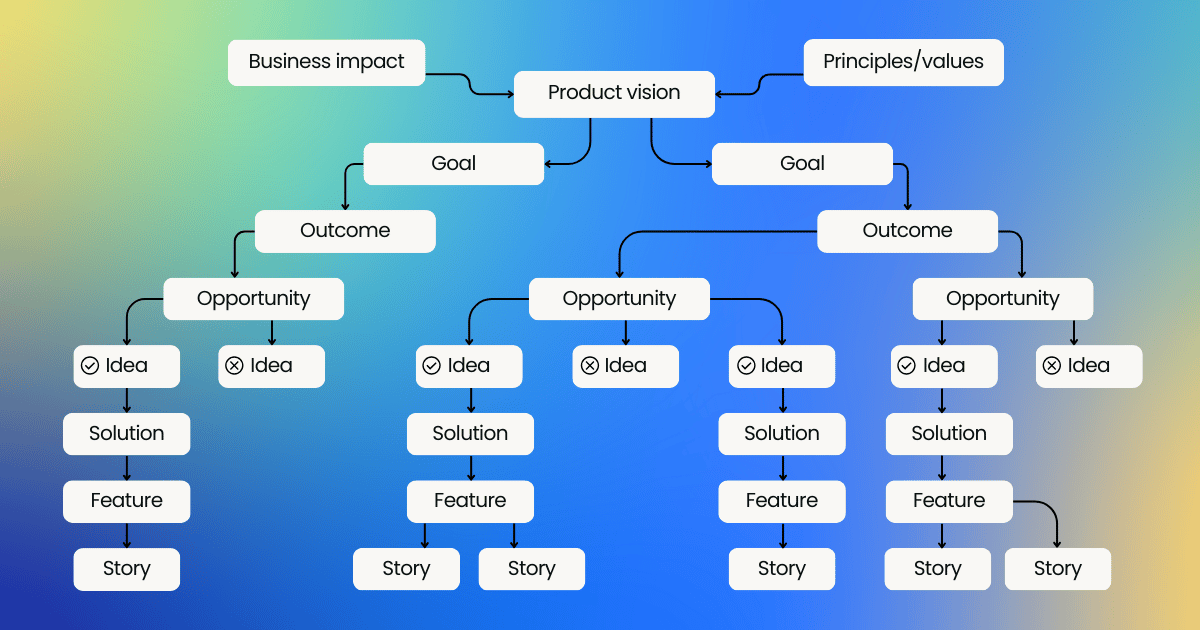
Roadmap hierarchy
An outcome-based roadmap hierarchy is (you guessed it) structured as a hierarchy – outlining business strategy and product vision, then moving down the chain to goals, opportunities, and ideas. At the lowest levels, this roadmap is broken into features and stories.
This approach emphasizes how tasks and activities align with strategic goals, allowing your product team to link their day-to-day tasks with the overarching product vision.
Timeline roadmap
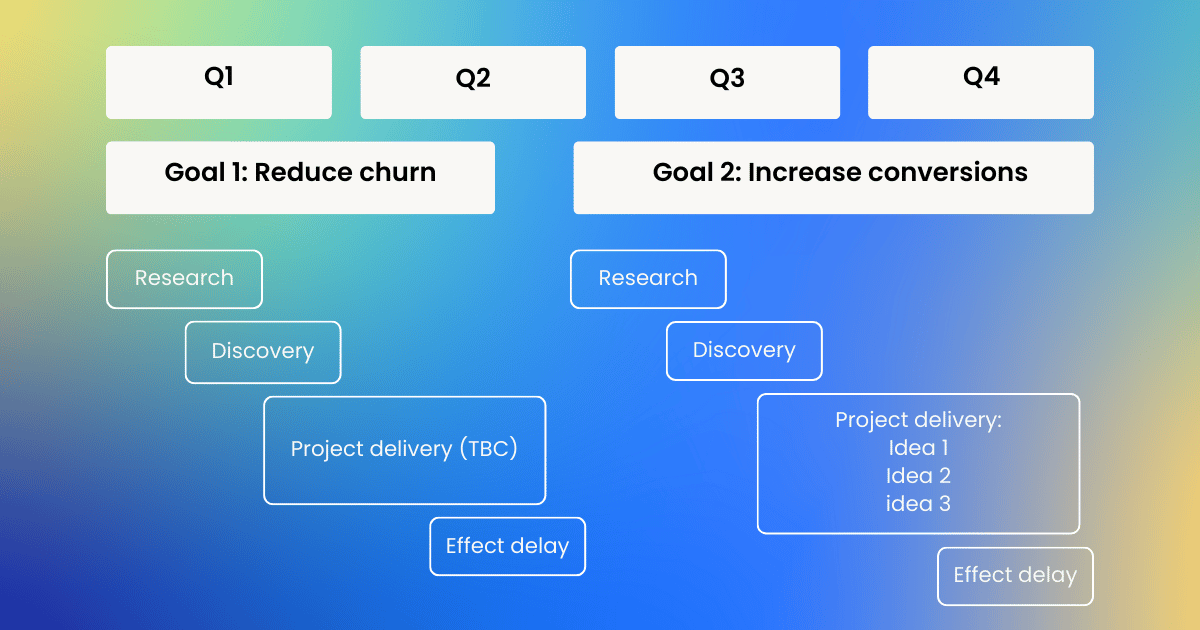
A goal-driven timeline roadmap outlines a set of goals and the timelines set out for research, discovery, and delivery.
To increase flexibility over the product development process, delivery plans are kept as placeholders until your team selects a direction during discovery. This allows your team to research and solve the problem without bias towards a particular solution.
Release-specific roadmap
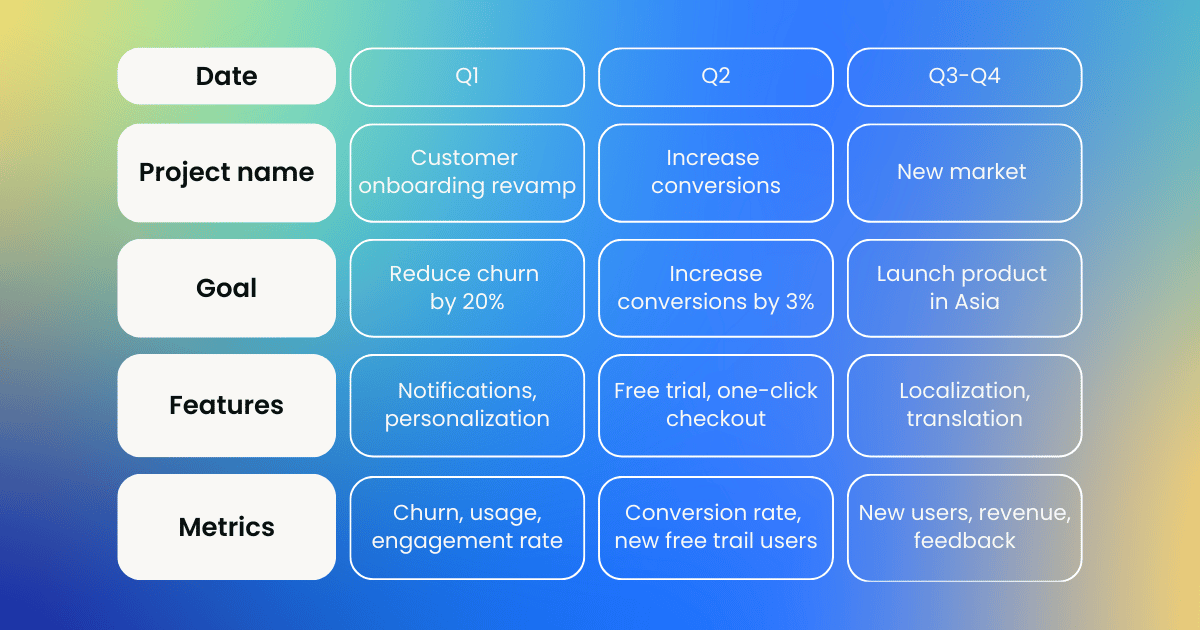
A simple outcome-driven roadmap presents release-specific information alongside the business goal it relates to and the key metrics tied to the project.
This allows your product team an at-a-glance understanding of upcoming projects and their impact on the overall product strategy.
The release-specific roadmap also emphasises accountability and continuous improvement.
Example of an outcome-based goal
A feature-based goal might say, "Launch a new onboarding checklist in Q2." An outcome-based goal is more specific and measurable: "Increase 30-day activation for new signups from 42% to 60% by the end of Q2."
The outcome defines the desired result, not the solution. Your team can then use product discovery to decide whether a checklist, in-app guidance, email nudges, or another initiative best delivers those measurable outcomes. The key results stay fixed; the path to get there stays flexible.
Are you making the switch from feature-based roadmaps to outcome-driven roadmaps? What advice would you give? Let us know, by continuing the conversation on our Slack community.
Frequently asked questions
What is the difference between an outcome and an output roadmap?
An output roadmap tracks the work a team plans to deliver, such as features, releases, or updates. An outcome-based roadmap tracks the measurable impact that work should create, like higher activation, better retention, or increased revenue.
What is an outcome-based strategy?
An outcome-based strategy defines success by the results achieved, not just the work completed. It focuses teams on measurable changes in customer behavior or business performance.
What is an example of an outcome-based goal?
A strong outcome-based goal is specific and measurable, such as "reduce customer churn from 8% to 5% in two quarters." It describes the impact you want to create rather than the feature you plan to ship.


Become a PLA Insider
Thank you for subscribing
Get exclusive insights, frameworks, and strategies from product leaders driving real business impact.
An email has been successfully sent to confirm your subscription.
 Follow us on LinkedIn