
So you have a great idea, with real customer signal behind it, and have genuine energy to build something meaningful. But before you know it, you’re…
Stuck finding the strategy doc leadership shared three months ago, and digging through Slack threads to piece together what was decided in a meeting you weren't in.
…Then you're hunting for customer feedback that’s spread across Zendesk, Gong recordings, and someone's Notion page. And by the time you’ve gathered enough context to actually write the brief, half a day is gone.
I call this: ‘work about work’. And after years of watching product teams operate at scale, I think we've been far too quick to accept it as an unavoidable part of the job.
The coordination tax we've all just... accepted
This isn't a new problem; the bigger an organization gets, the more coordination it needs to function. Roadmap shareouts, leadership presentations, prioritization stack rankings, weekly status updates. All of it exists for a reason.
But somewhere along the way, the coordination became the job.
We've built connective tissue out of process – documentation requirements, approval workflows, alignment rituals – and it's expensive. Not just in time, but in the quality of decisions being made. PMs spend so much time gathering context and coordinating that there's barely enough left to think.
The frustrating part? The tools are all there. Strategy in Confluence. Customer feedback across survey tools, sales calls, and ticketing systems. Roadmap in Productboard. Tickets in Jira. But none of these systems talk to each other in a way that's useful – not without a PM acting as the human translator in the middle.
That's the real problem. We've optimized for organizational structure, rather than the flow of information. And product managers (PMs) are paying the price. Every. Single. Day.
So… What's broken?
The problem is that all the connections happen through manual human effort.
A PM reads a strategy doc and has to interpret how it applies to their slice of the product. They manually synthesize customer feedback from multiple sources. They write up briefs in specific formats. They run alignment meetings to surface dependencies. They present to leadership to get approval.
Every single connection point requires a human to be the translator, the synthesizer, and the coordinator.
And the decisions that do get made? Often based on incomplete information – not because the data doesn't exist, but because no one had the time (or the ability) to pull it all together properly.
I've seen this play out in organizations of every size, and it all comes back to systems. The good news is: it's solvable.
 Martin Felcman
What if the connective tissue was intelligence, not process?
This is the shift I want product ops leaders to seriously consider: instead of designing processes to connect strategy, execution, and customer insight – what if AI agents did it instead?
Let me make that concrete, because it sounds abstract until you see it.
Today, if two teams are unknowingly building things that depend on each other, someone eventually figures it out in a meeting. Hopefully before too much rework happens.
In an AI-native product org, an agent proactively flags: “Based on current backlogs, the visualization, analytics, and internal tools teams all have dependencies on the data team this quarter. Based on the product strategy, the internal tools team should consider swapping features 1 and 5 in their backlog.”
No meeting required. No coordination overhead. The intelligence surfaces the connection before it becomes a problem.
Or take strategic alignment. Today, a PM reads a leadership manifesto and hopes they've interpreted it correctly. With AI agents, they get a proactive nudge: “Your proposed feature aligns with OKR 2.3, but based on our enterprise focus, you should consider prioritizing SSO.”
The structure and rigor don't disappear. But the manual work of connecting the dots? That gets handled automatically. PMs go from spending hours in meetings and following processes to spending minutes asking questions and making decisions.
That's the shift I'm excited about.
 Productboard
AI as the operating system for product teams
Here's an analogy I keep coming back to. Think about how an operating system works on your computer – it handles all the background tasks so applications can focus on their core function.
AI agents do the same thing for product teams.
They handle the background work of product management:
- Gathering context from multiple systems
- Checking alignment with strategy
- Surfacing relevant past decisions
- Flagging when resources are running low
- Maintaining documentation
All of it. So PMs can focus on what they're actually there to do – make great product decisions.
A PM can ask “What did we learn from the last pricing experiment?” and get an instant summary instead of hunting through Slack and Notion for 45 minutes. When they're writing a feature spec, the agent proactively surfaces relevant customer quotes, competitive intel, and strategic considerations they might have missed.
The agent becomes the layer that connects all the tools, data, and people – just like an OS connects all your applications. And crucially, it doesn't just make PMs faster. It makes them better.
 Productboard
Better decisions, not just faster ones
Speed is the obvious win. But I think the bigger opportunity is decision quality – and it comes down to context.
AI agents have perfect memory when context windows are properly managed. They can process more information than any human. Where a PM might be working from the last few customer conversations and a strategy doc they read last week, an AI agent can instantly pull from huge quantities of relevant customer conversations, past decisions, competitive moves, and every strategic priorities – and synthesize it specifically for the decision at hand.
The agent isn’t making better decisions than humans; it’s providing access to dramatically more relevant context at the precise moment of decision.
Fewer blind spots. Better informed trade-offs. No context or tool switching. And something I think is transformative: democratizing access to product sense.
Every PM in your organization gets the kind of rich contextual awareness that used to only come with years of institutional knowledge.
 Ashay Satav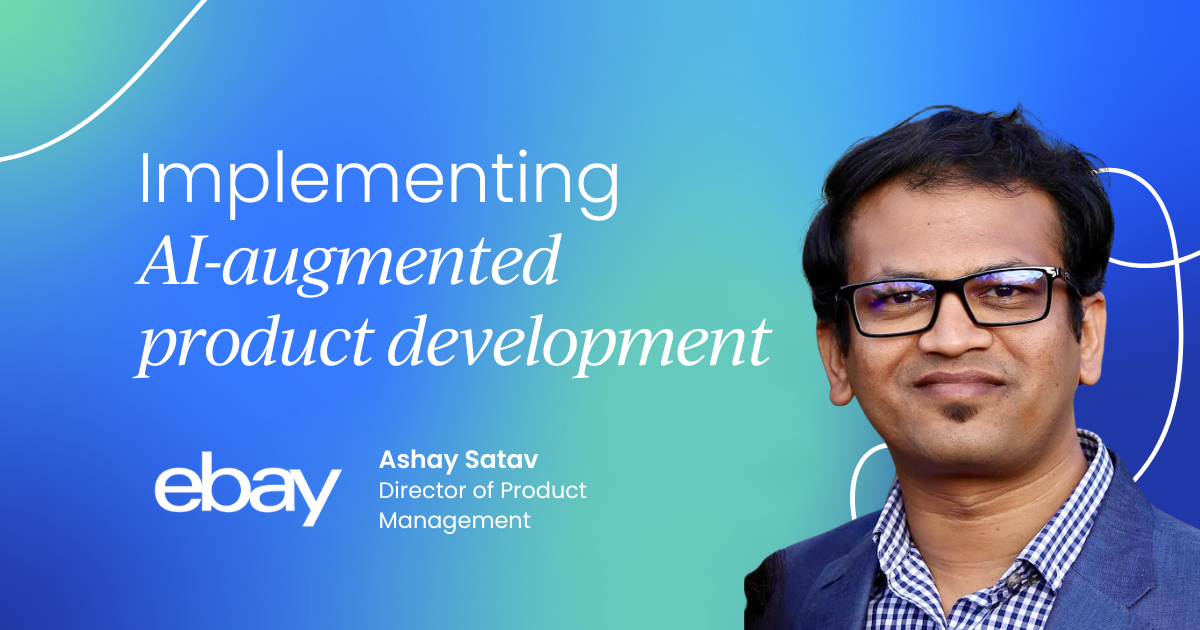
Where humans still own the room
I want to be clear about something: none of this is about removing PMs from the picture. Anything involving judgment, trade-offs, or values should stay human. Full stop.
AI agents can tell you what customers are asking for, and they can show you how a proposed feature maps to your strategy. But they can't decide whether to prioritize enterprise features over consumer delight, they can't navigate stakeholder dynamics, and they can't make the call on whether to sunset a beloved feature.
The way I think about it:
- Agents handle everything about gathering, synthesizing, and connecting information
- Humans handle everything about judgment, prioritization, and accountability
The goal isn't to remove humans from decision-making. It's to remove the tedious work that prevents them from focusing on the decisions that actually matter.
The risks worth taking seriously
I don't want to make this sound like a utopian vision with no trade-offs. There are two risks I’m wary of:
The first is over-reliance without verification. If an agent surfaces “customers want feature X,” you still need to interrogate the nuance. How many customers? Which segments? What's a genuine pain point versus a nice-to-have? AI output is simply a starting point.
The second is garbage in, garbage out. If your product strategy is outdated or your customer feedback is missing critical sources, the agent is going to make connections based on bad data. This actually raises the bar for product ops – the system needs cleaner data, more current strategy docs, and better context architecture.
The upside is that this pressure tends to create better organizational hygiene overall. But it requires real investment up front and continued maintenance. Luckily, agents can also help manage the maintenance of the system.
 Productboard
Where to start (without boiling the ocean)
If you're a product ops leader who's intrigued but not sure where to begin, my advice is simple: start by auditing where your PMs are spending time on ‘work about work.’
Ask them directly: what takes hours that feels like it should take minutes?
The most common answers I hear are synthesizing customer feedback, finding relevant past decisions, and drafting initial briefs. Pick the highest-pain point and run a pilot there.
If customer feedback synthesis is the problem, try having an AI agent pull and synthesize feedback for one initiative. The time acceleration and quality improvements are obvious, but the data governance requirements, context window limitations, and data completeness gaps start to become more apparent quickly.
You iterate your way into a process that works for your organization. Then move on to the next process.
Start small. Measure the impact on both speed and decision quality. Then expand. The key is picking something concrete and measurable, not trying to transform everything at once.
The shift that's already happening
A year from now, the idea that a PM would spend 30+ minutes hunting through Salesforce, Slack, and Notion to find customer feedback will seem absurd. Moving between Jira, Productboard, Figma, Slack, Google Docs, and Amplitude just to write a single spec will be a distant memory.
The tools will still exist. But the friction of moving between them will disappear.
And with that shift, product ops itself transforms: from process enforcer to architect of intelligent systems. From the coordination layer to the acceleration engine.
We're already seeing this with teams using Productboard Spark. Cutting the time from customer insight to product brief from weeks to hours. Making better decisions because they have access to context they'd never have found manually. Context that’s shared and democratized across the entire product organization. This is just the beginning.
Join Jordan in NYC
Jordan will be discussing this topic in detail at Product Operations Summit New York on March 26.
The core message he wants people to walk away with is: “This isn't about replacing product ops or PMs – it's about elevating them. For too long, we've accepted that organizational efficiency requires individual overhead. AI agents break that trade-off. You can have better organizational alignment AND less individual burden.”
👉 Interested? Get your ticket.
Sponsored by:


Become a PLA Insider
Thank you for subscribing
Get exclusive insights, frameworks, and strategies from product leaders driving real business impact.
An email has been successfully sent to confirm your subscription.
 Follow us on LinkedIn