









Every time I talk to a product leader based outside the Middle East and North Africa (MENA) who's trying to build a team here, they ask the same thing: "Is it really that different from London or SF?" And every time, I give them the same honest answer, yes, but not in the ways you expect.
The talent is here. The ambition is here. What's harder is how you build: how you hire, how you onboard, how you hold people together across cultures, time zones, and career expectations that don't always map to Western tech playbooks.
I've built and been part of teams at Careem, at Talabat, and now at Digital Zone. This article is the guide I wish I'd had early on: specific, honest, and MENA-first.
Step 1: Before you hire anyone, define what you're building
The most common mistake I see tech leads make in MENA is hiring for speed rather than clarity. You get headcount approved, you move fast, and six months later you have a team that's pulling in three different directions.
Before you post a single job description, you need to answer four questions:
- What is the core product surface this team owns? Not aspirationally – right now, in the next 12 months.
- What is your tech stack, and is it stable enough to hire around? Hiring senior engineers into an architecture that will be rewritten in 6 months is expensive and demoralizing.
- What is the team's expected delivery cadence? Sprint-based, milestone-based, or continuous? This changes who thrives.
- What does success look like at 30, 90, and 180 days? Write it down. Share it with your first hire on day one.
In MENA, ambiguity costs more than it does elsewhere. Many engineers joining your team will be doing so as a major career bet – relocating families, leaving stable government roles, switching industries. When the mission is unclear, the best people leave first.
Step 2: Understand the talent landscape before you set your hiring bar
MENA is not a monolith. The talent market in Dubai operates completely differently from Amman, Cairo, or Riyadh. Getting this wrong means either setting a bar so high you can't fill roles, or so low you hire the wrong people.
🇦🇪 Hiring in Dubai / UAE
The UAE is highly international, with competitive salaries, a strong supply of mid-to-senior talent, but also high churn.
Engineers here are often shopping for the next opportunity. Hire for culture fit and give people a reason to stay, not just a reason to join.
🇯🇴🇪🇬 Hiring in Jordan and Egypt
Both countries have deep pools of early-to-mid career engineers who are hungry, technically sharp, and often undervalued. If you're building a remote-capable team, this is where some of your best long-term builders will come from.
The tradeoff: you need to invest more in structured mentorship and growth ladders, or you lose them to European and US remote companies that move faster than you.
🇸🇦 Saudi Arabia
Saudi Arabia is rapidly changing. Vision 2030 is driving genuine tech ecosystem growth, but the talent is still maturing. Localisation requirements (Nitaqat) mean you need a deliberate plan if you're building a team primarily for the Saudi market.
⚠️ Watch out for hiring solely on resume pedigree
"Big tech" brand names on a CV matter less in MENA than the ability to operate under resource constraints, ambiguous roadmaps, and compressed timelines. The people who built things at small-to-mid regional companies often outperform on these dimensions.
Step 3: Build a hiring process that respects cultural context
Most Western hiring playbooks don't translate cleanly. A few things that matter specifically in MENA:
1. Relationships over job boards
The best hires come through networks, not postings. Invest in being visible in the product and engineering communities. Show up at meetups. Mentor on platforms like ADPList. The person you mentored six months ago might be exactly who you need, and they'll already trust you.
2. Design interviews around real scenarios, not theory
Scenario-based assessments that reflect your actual product challenges outperform abstract LeetCode-style filtering in regional hiring. The question isn't, "Can this person solve a graph problem?" It's, "How do they think when they have incomplete data, a demanding stakeholder, and a deadline?" Build your interviews around that.
3. Be explicit about compensation structure
In MENA, compensation conversations are often more direct than in Western markets. Many candidates are making decisions around visa sponsorship, housing allowances, flight tickets, and school fees, not just base salary. Be transparent early.
- Post roles with compensation bands, it filters faster and builds trust.
- Include visa and relocation details in the first recruiter call, not the offer stage.
- Structure technical assessments to take 90 minutes or less – respect people's time.
- Have a clear answer for "What does growth look like here?" before you start interviewing.
Step 4: Onboard with intention – the first 90 days are everything
In most MENA tech companies, onboarding is either non-existent or a one-day "here's your laptop, here's the Slack" exercise. This is one of the highest-leverage places you can differentiate as a team builder.
- Days 1–30: Learn – Shadow existing team members. Read architecture docs. No output pressure. Attend all team rituals. Ask every "dumb" question on record in Slack so the answers are searchable.
- Days 31–60: Contribute – Pick up a bounded, low-stakes task. Deliver it end-to-end. Get into the feedback loop. Begin to form opinions about what's working and what isn't.
- Days 61–90: Take responsibility for a meaningful workstream – Present findings or a plan to the team. This is where you find out how they think at scale, not just how they execute.
- Day 90: Review – Have a structured conversation: what did they learn, what surprised them, what do they want to own next? This conversation shapes the next 6 months.
The 90-day review conversation is not a performance review. It's a listening session. The insights your newest hire has about your team's blind spots are often the most valuable inputs you'll get all year.
Step 5: Build operating rhythms that account for MENA's unique calendar
MENA tech teams operate across a calendar that looks nothing like a Western product org's assumptions. Ramadan significantly changes working hours and team capacity for a full month. Eid holidays compress sprint planning windows. The weekend in many MENA countries is Friday-Saturday, which means your Friday releases hit while half your team is offline.
- Build your annual roadmap with Ramadan, Eid Al Fitr, and Eid Al Adha explicitly marked as reduced-capacity periods.
- Avoid major launches in the first and last weeks of Ramadan, when teams are recalibrating and retailers are flooded.
- If you have team members in Jordan or Egypt, their weekends don't align with the UAE. Synchronous collaboration windows need to be explicit and protected.
- Plan for attrition spikes in Q1 every year, many regional employees use January as a reset point.
Step 6: Retain by growing, not by paying more
Retention in MENA's tech market has a specific failure mode: companies over-index on compensation and under-invest in growth infrastructure. The engineers who leave aren't always leaving for more money. They're leaving because they've hit a ceiling. Here’s how to avoid that.
1. Create visible career paths
Document your engineering and product ladders. Share them publicly inside the team. In many MENA companies, this documentation simply doesn't exist; building it puts you immediately in the top 20% of employers in the region.
2. Give people problems, not just tickets
The engineers who stay longest feel like co-owners of a problem space, not executors of a backlog. Give people context on the "why" behind what they're building. Invite them into product discovery.
3. Invest in external visibility
Let your team speak at conferences, write on company blogs, and contribute to open source. Engineers who build public profiles want to protect their reputation at the place they work. And the best new hires will be attracted to teams where they can do the same.
⚠️ Watch out for the "hero" culture trap
Promoting the person who works the longest hours rather than the person who makes the team around them better is unfortunately common in MENA tech. However, it's a sure-fire way to systematically drive out your most collaborative, highest-potential people.
Closing thoughts
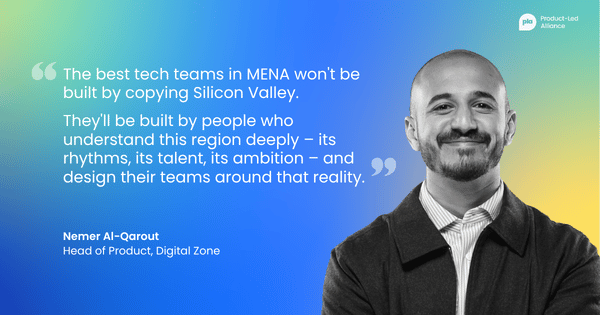
The best tech teams in MENA won't be built by copying Silicon Valley. They'll be built by people who understand this region deeply – its rhythms, its talent, its ambition – and design their teams around that reality.


Become a PLA Insider
Thank you for subscribing
Get exclusive insights, frameworks, and strategies from product leaders driving real business impact.
An email has been successfully sent to confirm your subscription.
 Follow us on LinkedIn