






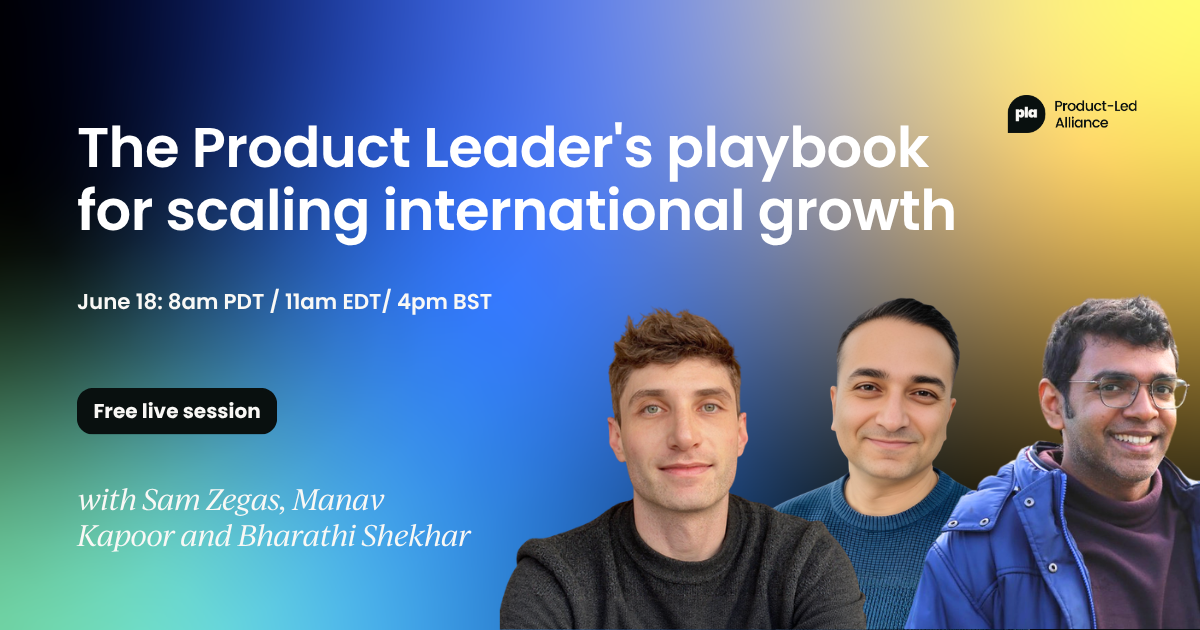
Frameworks for going global without breaking your product, your team, or your process.
The spreadsheet that worked for two languages can't carry you to twenty.
Join us and LILT for a panel of product leaders who've made the jump from the scrappy first four languages through the operational reality of true global coverage.
We'll dig into how they decide which language to add next, what a multilingual translation architecture actually looks like when content lives in five different systems, and how they set tiered quality thresholds without drowning the team in process.
Walk away with frameworks to turn international expansion from an operational headache into a measurable growth lever.
Here's what we're fixing:
- "Our product is ready for new markets, but we don't know how to prioritize where to expand next." Get practical frameworks for prioritizing languages and markets based on revenue potential, demand signals, and operational readiness, so you stop guessing.
- "Localization landed on our product team's plate, and nobody has the bandwidth or expertise to own it." Learn how to structure ownership, set timelines, and stop it from swallowing the PM who inherited it.
- "We're managing translations across five different systems and it's becoming an operational nightmare." Hear how companies scaling to 20+ markets connected their CMS, support platform, code repo, and marketing tools without spinning up a dedicated ops role to hold it together.
- "Leadership keeps asking why we can't just use ChatGPT for translation." Get a clear-eyed view of where AI translation works, where it falls short, and how to set quality thresholds across content types so you can answer that question with confidence.
- "We can't get executive buy-in because localization is still seen as a cost center." Get the language and metrics to reframe it as a growth lever, including examples of how other product leaders have tied localization directly to adoption, retention, and revenue.
What you'll walk away with:
✓ A new mental model: localization as growth strategy, not translation project. See how companies that scale globally treat language expansion like a feature launch tied to revenue targets, adoption metrics, and market entry goals, and get the language to make that case internally.
✓ An ownership framework for teams without a Head of Localization. A practical model for structuring ownership, prioritizing languages, and avoiding the chaos that hits when nobody formally owns it.
✓ A tiered quality framework across content types. Product strings, help docs, marketing, and support each need different quality bars and turnaround times. Learn how to set those thresholds without applying a one-size-fits-all process that burns the team out.
✓ A clear-eyed take on where AI fits (and where it doesn't). Not "use ChatGPT," not "AI gets it wrong." A system view: where AI-only works, where you need human verification, and how to keep consistency across 20+ languages when content lives in five different platforms.
✓ The minimum viable localization stack before you need it at scale. If you're at "four languages on a spreadsheet," this is your blueprint. Wait until you're drowning in 15 languages and four content types and you're looking at manual workflows, brand inconsistency, and content debt that takes years to unwind.
Meet the speakers
Bharathi Shekar, Director of Product, Zeta
Bharathi leads the payments product portfolio for Zeta. An engineer turned product manager & inventor of 17 patents, he has over 20 years of experience leading product and engineering teams. Prior to Zeta, Bharathi held product & engineering roles at Ola Cabs, Yahoo, and Sun Microsystems.

Manav Kapoor, Sr. Product Manager - Technical, Amazon
Manav is a Senior Technical Product Leader at Amazon, focused on AI-driven trust and safety systems at global scale. Previously at Goldman Sachs and Barclays, he has more than 15 years of experience in e-commerce, fintech, and digital banking.

Sam Zegas, VP of Product Strategy & Agentic Operations, LILT
Sam is the VP of Product Strategy & Agentic Operations at LILT, where he leads the strategy behind the company’s AI-powered translation platform. Previously, he worked at companies like Deepgram and Accenture. He holds a dual MBA and MPP from Harvard, along with an undergraduate degree from Harvard University.