





General-purpose AI was trained on the internet. It knows how product funnels work - but it doesn't know your funnel.
It has no access to your event schema, your release history, your power-user cohort definitions, or the edge case your engineering team introduced three sprints ago.
So you're asking a system trained on the internet to answer a question that requires knowing your product intimately.
That's not a prompting problem. That's a context problem.
Building AI systems that actually work for product teams means starting with the context layer, not the model. This session is about what that looks like.
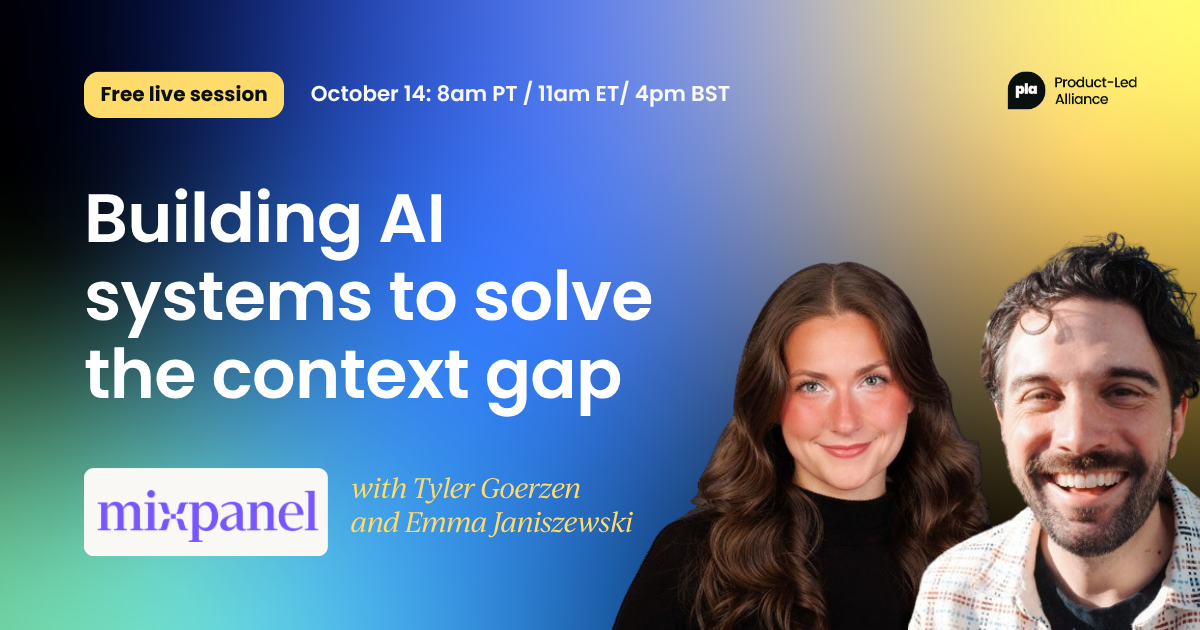
Tyler and Emma will show what a context-aware product AI system looks like in practice: the architecture that makes it work, the workflows it enables, and the specific steps your team can take to start using it today.
Who is this session for?
Product Managers: You've tried AI and hit its limit the moment you needed an answer about your specific product. This session explains why that happens, and shows you what a system built to handle it looks like.
Senior PM: Stakeholders want faster, more confident decisions. General-purpose AI can't close that loop; it doesn't have the context your product data holds. Learn what it takes to build systems that do.
Heads of Product: You're investing in AI tooling across your team. The question isn't whether to use AI, it's how to build systems that give your team answers they can actually act on.
Growth PMs: You're running two-week experiment cycles. The read-out on whether they worked shouldn't require a data team request. A context-aware AI system closes that loop, and this session shows you how.
What we'll cover:
- The state of product development today. Cheaper code, faster iteration, and why knowing what to build still requires the right infrastructure underneath your AI
- What the context gap looks like in practice. The specific class of product questions that general-purpose AI fails on, and why it's a structural problem, not a model quality problem
- How Mixpanel's architecture closes the gap. 17 years of behavioural data infrastructure as the context layer: always on, always in context, built for the shape of product questions
What you'll leave with:
A clear understanding of the context gap and why it limits AI for product decisions. What general-purpose tools are structurally missing and why the fix is an architecture decision, not a better prompt.
A working model of how Mixpanel AI closes the gap. How 17 years of behavioural data architecture becomes the context layer, what that means for the quality of answers your team can get, and when to reach for each component of the system.
A specific next step to build more context-aware AI into your workflow. One concrete starting point -not a feature list to explore - so you leave with a clear action, not just an understanding of the concept.
Meet the experts:
Tyler Goerzen, Senior Product Manager (Growth), Mixpanel
Tyler works in the tools he'll be showing. MCP scheduled digests, agent for root cause analysis, and automated KPI monitoring are part of his actual workflow, not a scripted demo.

Emma Janiszewski, Solutions Engineer, Mixpanel
Emma has watched dozens of teams trying to keep their learning up to speed with their shipping. That vantage point is what she brings to the webinar: a clear read on where product intelligence actually breaks downs, and which AI workflows genuinely fix it versus just add noise.