






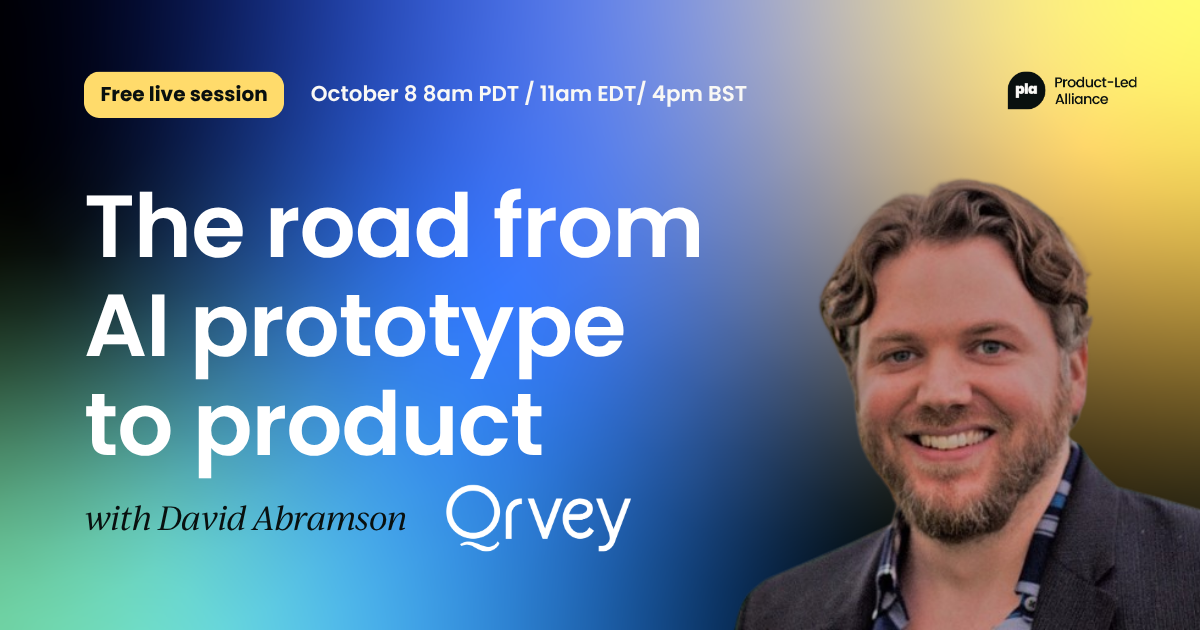
Learn how to make smarter roadmap decisions by spotting when AI is accelerating your team and when it's quietly creating work you didn't plan for.
AI coding tools mean features that took weeks now get prototyped in hours. But a prototype built in an afternoon can still take two quarters to ship. Getting from proof of concept to production is where teams stall.
Join Qrvey and us for a 15-minute Lightning Lecture on where AI validates product ideas fast, and where AI-built features start costing more than they save. Customer-facing analytics is the worked example, walking through the three challenges that separate a good prototype from a good product.
Walk away with a practical framework for making better decisions about AI-generated features before they become tomorrow's technical debt.
Here's what we're fixing:
- "We're looking at AI coding tools for major roadmap initiatives, but we're not sure where they fit." Get clear on the work AI accelerates and the work it only appears to, so you can scope initiatives with evidence.
- "My team can prototype in a day, but production still takes a quarter." Understand what's taking up your time, and which parts AI was never going to solve for you.
- "We're deciding whether to build a customer-facing capability with AI or invest in something production-ready." Hear how to run that call against security, scale, and self-service requirements before you commit to it.
- "I need something I can use in Monday's roadmap discussion, not a theory." Leave with a framework you can apply to live decisions the same week, not a model you have to translate first.
- "Everything we ship with AI feels like debt we'll pay for later." Learn the specific mistakes that turn AI-built features into maintenance burdens, and how teams avoid them without slowing down.
- "The issue is product teams are not aware they are creating technical debt when they ship something AI-built." We could change the question to: "Is this really going to save us time?" or "What are the long term implications for our team if we ship this?" or "Can we actually maintain this?
What you'll walk away with:
✓ A clear line between where AI coding tools speed you up and where they don't. Not "AI is great," not "AI isn't ready." A working distinction you can hold up against any initiative on your roadmap.
✓ The test for prototype versus customer-ready. What separates a demo that impresses your leadership team from a feature your customers can rely on, and how to spot the gap before you've committed to a ship date.
✓ The three production roadblocks every SaaS team hits. Security, scale, and customer self-service. Why each one delays delivery and how to get ahead of them.
✓ A framework for deciding what AI builds and what engineering owns. A practical way to split the work so you get the speed without handing your engineers a codebase nobody wants to maintain.
✓ The mistakes that stop AI-built features from becoming real product capabilities. The common patterns, drawn from teams who've already made them, so you don't have to.
Meet the speaker:
David Abramson, CTO, Qrvey
David leads technology for Qrvey. He has over 20 years of product management experience, from inception through general availability, bringing data-driven applications, analytics, and business intelligence products to market. Prior to Qrvey, David was Director of Product Management at Logi Analytics.