
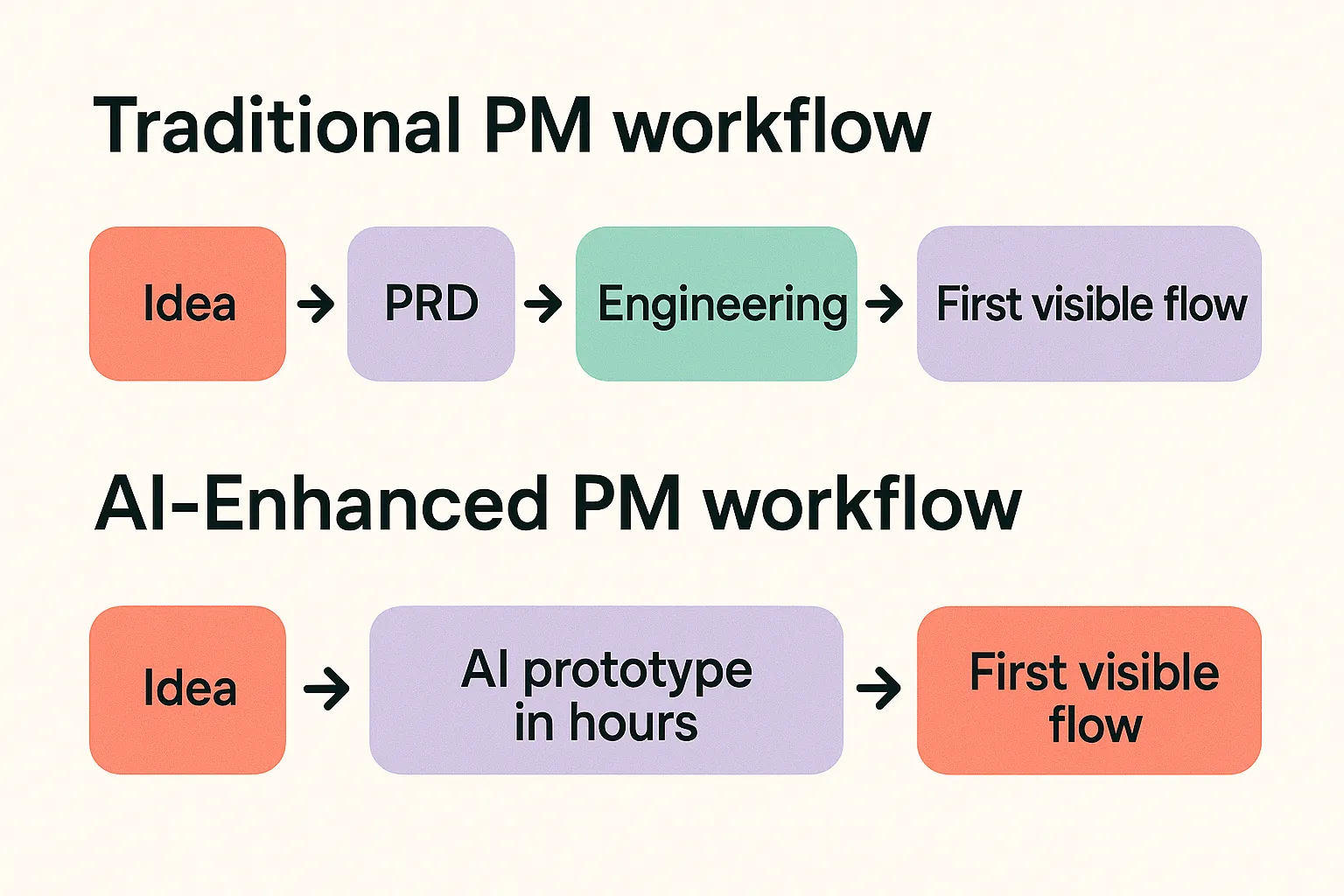
AI has radically changed the speed at which product teams can explore new ideas. What once required designers to spend days or engineers to allocate weeks can now often be prototyped by a product manager in a single afternoon.
Whether you’re at a startup or a large tech company, the PM who can demonstrate an idea, rather than explain it, will accelerate decision-making and achieve much more precise alignment.
This article is not about validating ideas faster through experiments. It focuses on using AI prototypes to make abstract product decisions tangible before validation even begins.
Fast AI prototyping isn't about duplicating the work of design or engineering. It's about bridging the tricky gap between intent and experience. A simple, interactive prototype helps everyone clarify assumptions, spot feasibility problems early, and determine whether an idea is even worth pursuing. Even when rough, these prototypes provide a shared reference point that traditional slide decks or documents cannot replicate.
Some PMs call this emerging workflow “vibe coding” – using accessible AI tools to quickly generate UI patterns, simulate system behavior, and build rough user flows. The term might be playful, but the results are entirely practical. Prototypes make abstract ideas tangible, ground stakeholder discussions, and give the entire team something real to evaluate.
This article explores why AI prototyping is quickly becoming a crucial skill for PMs, how it complements established processes, and, ultimately, how it helps teams make more confident decisions faster.
Why AI prototyping matters for product managers
Traditional documentation – product requirements documents (PRDs), diagrams, and Figma flows – remains essential for communicating strategy. However, they can leave far too much room for interpretation, especially when you are dealing with ambiguous, complex, or entirely new AI-driven concepts. Prototyping doesn't replace these methods – it radically enhances them.
Several industry shifts have made AI prototyping essential for product managers. As timelines compress and systems become more complex, explaining ideas is no longer enough. Teams need something concrete to react to early, before assumptions harden into plans.
- Faster, cheaper exploration: AI tools allow you to generate screens rapidly, flows, and placeholder content. PMs can create realistic sequences, whether it's a conversational thread or a complex onboarding step, without needing to wait for design or engineering capacity.
- More precise roadmaps: New capabilities, particularly complex features involving conversational AI or multi-step agent workflows, are much easier to evaluate when stakeholders can actually see a prototype. This makes feasibility, complexity, and expected user behavior instantly more tangible.
- Better alignment with technical teams: Engineers gain a much deeper understanding of new concepts when they see a working simulation. They can better assess the underlying logic, predict latency issues, identify tricky edge cases, and plan for robust error handling.
- Setting realistic expectations: Prototypes clarify constraints early in the process. Instead of vague promises, you can demonstrate:
- "This won't be in v1; the dependency on X makes it too complex."
- "This screen requires latency under 500ms for a good UX."
- "This specific path involves a crucial compliance and legal review."
Prototypes build trust by balancing the necessary strategic reasoning with a concrete preview of the user experience.
The changing PM skill set
For years, PMs excelled by clearly articulating ideas, writing strong specs, framing trade-offs, and communicating intent. Today, the ability to demonstrate experiences has become equally important. Increasingly, this is a leadership skill rather than a technical one, because it shapes how decisions get made across the organization.
Three industry shifts are driving this transformation:
- AI can simulate believable interactions. Large language models (LLMs) can generate realistic explanations, suggestions, or clarifications that closely resemble actual system behavior. This enables truly meaningful product discussions long before any production code is written.
- UI generation is faster than ever. Accessible tools like Lovable, Bolt.dev, and Replit are transforming natural-language prompts into interface layouts or semi-functional demos. This fundamentally reduces reliance on early, resource-intensive design cycles.
- Teams expect higher fidelity early. Due to accelerated timelines, cross-functional teams benefit immensely when PMs can express ideas visually. Designers receive clearer starting points, engineers understand assumptions sooner, and leadership gets a tangible vision for review.
This new skill set doesn't replace traditional PM responsibilities; it amplifies them, supporting faster, more transparent decision-making across the entire product lifecycle.
How top 1% PMs use AI prototyping
Effective PMs approach prototyping with very clear goals. They treat it as a surgical tool, not a blunt instrument. Here’s what they do:
- Focus on key interactions: Instead of trying to map an entire flow, they prototype one critical moment, where intent is fulfilled, a significant decision is made, or a core behavior needs to be validated.
- Explore variations quickly: AI tools enable rapid experimentation. PMs ask: “What happens if the data is incomplete? How do we reduce friction here? What if the system needs more confirmation?” They test multiple design options in minutes.
- Narrate constraints openly: During reviews, PMs highlight feasibility issues, stating: “This approach depends heavily on the accuracy of the underlying data,” or “This alternative reduces engineering complexity but sacrifices personalization.”
- Introduce metrics early: Even rough prototypes should tie the interaction to a measurable outcome: “This step should improve user activation by 10%,” or “We’ll measure user hesitation time here.”
- Include realistic failure states: Because AI is probabilistic, PMs simulate uncertainty. They show what happens when: “The system might lack confidence,” or “Data may be missing.” This grounds discussions in reality and builds credibility with engineering partners.
Why prototypes complement documentation
Prototyping doesn't replace your PRDs, user stories, or design artifacts. Instead, it serves as a powerful bridge between abstract ideation and formal documentation. It:
- Drastically reduces interpretation gaps early.
- Helps evaluate technical feasibility before committing significant resources.
- Provides clearer, concrete input for user research and stakeholder reviews.
- Offers a practical, shared way to discuss implementation alternatives.
- Enables engineering teams to respond more accurately to system assumptions.
Prototypes translate intentions into tangible experiences that the entire team can align around.
A practical AI prototyping workflow for PMs
Below is a lightweight, step-by-step workflow designed to minimise rework and keep your focus on clarity rather than polish.
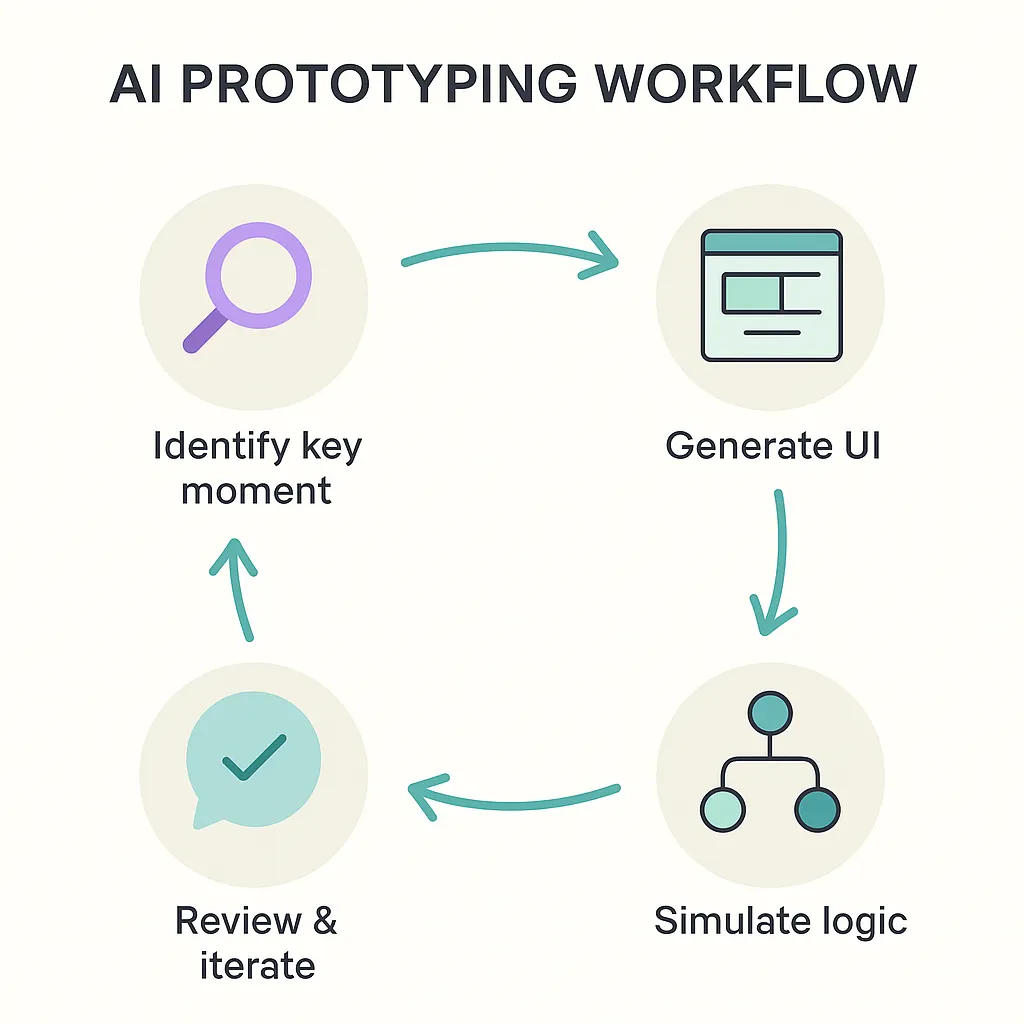
1. Identify the moment that matters
Choose a single interaction that perfectly captures the value proposition or decision point. This is crucial for keeping the scope manageable and the focus sharp.
2. Generate UI quickly
The specific tool matters less than the speed and clarity it enables at this stage, but here are some great platforms to get your started:
- Lovable: For generating rapid, interconnected AI-linked flows.
- Bolt.dev: For when you need a more precise, structured interface layout. A simple prompt that describes the scenario, the user's intent, and the expected outcome is often enough to provide a starting point.
3. Simulate logic without building systems
You only need behavior that feels representative. Use:
- n8n for setting up basic branching and conditional logic.
- Mock API responses for dynamic content loading.
- Static JSON files for predictable data paths.
This supports early conversations without implying that engineering work has already begun.
4. Make the interaction feel alive
Even a single well-placed LLM call (via the OpenAI API or an in-tool prompt) can effectively demonstrate reasoning, explanation, or realistic conversational behavior, which is essential for evaluating AI-related concepts.
5. Prototype the happy path and a failure path
Always include a single failure mode in your demo: uncertainty, missing data, or user confirmation required. Showing complexity upfront helps teams understand real-world constraints and builds instant credibility with engineering partners.
6. Prepare a concise narrative
Instead of explaining your idea for five minutes, start the review with a tight script: “I’ll show a quick flow that represents the core experience. Afterward, I will outline the assumptions, constraints, and metrics.” This anchors attention on the experience first, then the rationale.
Common mistakes in AI prototyping
Avoid these common pitfalls to maximize your team’s time and avoid misalignment:
- Overbuilding: If the prototype takes more than a few hours, the scope is likely too broad. Keep it rough.
- Ignoring failure states: AI behavior is probabilistic; failing to show uncertainty sets unrealistic expectations.
- Treating AI output as final: Clarify that generated content is a placeholder and that the final result will differ.
- Skipping constraints: Always highlight technical or compliance boundaries to avoid overpromising to stakeholders.
- Over-polishing: Early prototypes should prioritize clarity and learning over pixel-perfection.
- Leaving out measurable outcomes: Always tie prototypes to specific product goals to ground discussions in business value.
Prototyping as a core PM skill
Ultimately, AI prototyping isn’t a replacement for product discovery, documentation, or collaboration. It is, instead, a new superpower that helps PMs learn faster, communicate ideas more effectively, and make critical early decisions with greater confidence.
Startups use it to validate ideas before committing scarce resources. Large organizations leverage it to shape roadmaps and soundly evaluate complex new features. All PMs benefit from experimenting with interactions early, before concepts harden into rigid requirements.
As AI accelerates product exploration, the PMs who thrive will be those who can turn ambiguity into something teams can see, discuss, and challenge early. In this environment, prototyping is no longer just a method of working. It is a practical way to learn faster, align earlier, and lead better product decisions.


Become a PLA Insider
Thank you for subscribing
Get exclusive insights, frameworks, and strategies from product leaders driving real business impact.
An email has been successfully sent to confirm your subscription.
 Follow us on LinkedIn