





The early success of an enterprise product often comes from solving one narrow, expensive problem well. A document automation feature reduces hours of manual preparation, a workflow tool brings consistency to an approval process, or an AI capability helps teams review and act on information more efficiently.
Success creates pressure to expand. Customers ask for more workflows, sales identifies adjacent markets, and leadership starts thinking about how one product could support a broader portfolio. That’s often when a product starts being called a platform before the architecture, operating model, and product discipline are actually there.
A platform has to do more than support more features. It needs to serve multiple products, customer types, integrations, business processes, and regions while still giving users a coherent experience.
The roadmap needs a larger product thesis
A focused product usually has a clear use case. Once you’re building a platform, the roadmap gets more complicated because you’re balancing:
- Existing customer needs
- New market opportunities
- Technical debt
- Major prospect requirements
- AI initiatives
- Shared infrastructures
Every request can look important on its own, which is why you need a larger product thesis to guide decisions.
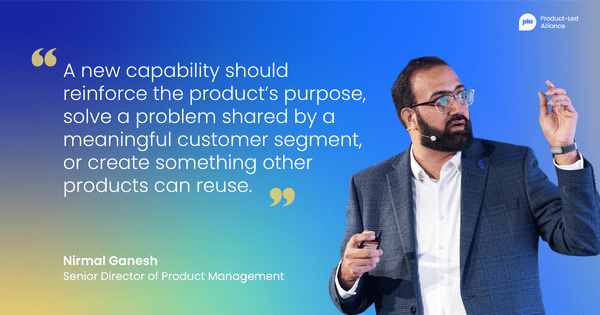
A new capability should reinforce the product’s purpose, solve a problem shared by a meaningful customer segment, or create something other products can reuse. Without those boundaries, the roadmap can become a reflection of whichever customer, executive, or sales opportunity has the most influence.
McKinsey’s research on product-and-platform operating models emphasizes organizing durable teams around products and the underlying platforms that enable them. That structure matters because teams remain responsible for adoption, performance, integration, maintenance, and future development rather than treating delivery as the end of the work.
Customer requests can also reveal broader product needs. I saw this with a customer in a highly regulated industry that needed a specialized multi-path review and approval process. We could have hard-coded the workflow, but that would have solved one customer’s problem while creating long-term maintenance debt. Instead, we built a generalized workflow orchestration layer with configurable routing, roles, permissions, conditions, escalations, and auditability.
That created some short-term pressure, but other products later reused the same component. Instead of rebuilding approval logic for every customer, variability became configuration rather than custom code. That’s an important platform decision: solve the immediate need, but also look for the reusable capability underneath it.
Adoption is an operating challenge
You can launch an enterprise product successfully and still watch users continue working through email, spreadsheets, and legacy systems.
When that happens, the problem may not be a missing feature. It could be:
- Excessive configuration
- Poor data access
- Workflow disruption
- Unclear ownership
- Weak integration
That’s why integration is a product strategy issue, not simply an engineering task. APIs, permissions, data models, and workflow triggers determine whether your product becomes part of the customer’s operating process or just another layer of work.
AI makes this even more important. Users need to understand what information the system is using, when human review is required, how exceptions are handled, and who remains accountable.
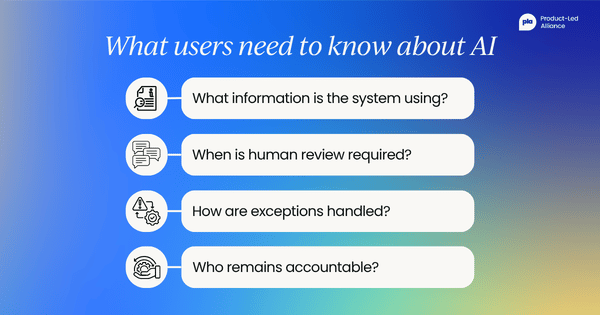
The NIST AI Risk Management Framework provides a useful structure for thinking about AI throughout design, development, deployment, and evaluation, particularly around areas such as data access, testing, monitoring, transparency, human review, and accountability.
During one product launch I led, activation and user growth looked strong, but teams were still completing the real work through email and spreadsheets and using the platform mainly as an archive. We simplified configuration, integrated identity and content access, automated more of the workflow, and made audit trails and exception handling visible.
When AI was added, confidence scores and human review helped users understand how recommendations should be used. That led to stronger workflow completion, fewer offline workarounds, and broader adoption.
Platforms need shared foundations
A multi-product ecosystem becomes difficult to scale when every product has its own architecture, integrations, permissions, and administrative controls.
At first, individual teams may move faster. Over time, though, you start seeing:
- Inconsistent customer experiences
- Duplicate engineering work
- Harder-to-maintain integrations
- Conflicting permission models
- More dependencies between releases
At that point, you need shared foundations.
Martin Fowler’s discussion of platforms as products makes an important distinction: shared services, tools, APIs, knowledge, and support need to be treated as products themselves if internal teams are going to use them effectively.
For us, that meant putting areas such as identity, permissions, workflow services, integration frameworks, and AI governance under explicit platform ownership.
Cross-functional leadership also becomes more important as the ecosystem grows. Product, engineering, sales, customer success, implementation, security, legal, and operations all see different parts of the scaling problem.
Your job as a product leader is to turn those perspectives into decisions while maintaining clarity around who owns the customer outcome, who owns shared platform capabilities, and how short-term revenue is balanced against long-term scalability.
McKinsey’s analysis of large-scale product and platform transformations similarly highlights the importance of aligned business and technology leadership, persistent product teams, and investment models that support continuing ownership.
Final thoughts
Scaling a successful product into a platform is about making choices that reduce complexity as the business grows. You need a clear product thesis, reusable foundations, strong ownership, and the discipline to distinguish between customer needs that reveal scalable opportunities and custom requests that create long-term debt.
A useful test is simple: does each new product, workflow, integration, or market make the ecosystem easier or harder to support? If growth consistently creates more fragmentation and duplication, you may be expanding the portfolio without actually building a platform.
About the author
Nirmal Ganesh is a senior product management leader who drives global strategy for intelligent workflow and automation products, including the integration of AI into core enterprise processes. With a proven track record of scaling multi-product portfolios, he specializes in build-versus-buy strategies, Intelligent Document Processing, agentic workflows, and digital transformation.


Become a PLA Insider
Thank you for subscribing
Get exclusive insights, frameworks, and strategies from product leaders driving real business impact.
An email has been successfully sent to confirm your subscription.
 Follow us on LinkedIn