







Created by:
 Amelia Wilson
If you've ever had a sales rep tell you "we're losing deals because we don't have this integration" or a customer success manager flag a renewal at risk for the same reason, you already know how quickly integration requests can take over your roadmap.
The problem isn't that integrations aren't important. They are. The average company uses 106 SaaS apps, and 84% of businesses consider integrations a key part of their software purchasing decisions. The problem is that every request feels urgent, and without a consistent way to evaluate them, prioritization becomes reactive, driven by whoever made the most noise last week.
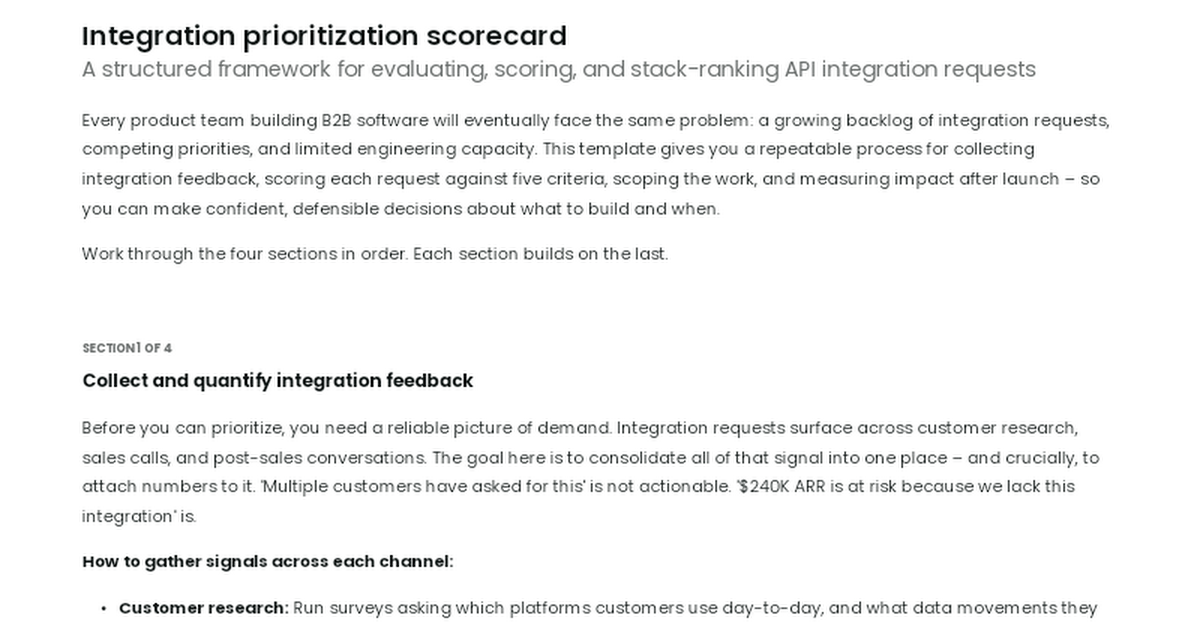
Based on insights from Gil Feig, Co-Founder & CTO at Merge, this template gives you a repeatable process for cutting through that noise. You'll collect and quantify integration demand from across your organization, score each request against five criteria, scope the work before it goes to engineering, and measure impact after launch.
What is an integration prioritization scorecard?
An integration prioritization scorecard is a decision-making tool that helps you evaluate integration requests consistently, so you're not making gut-feel calls or bowing to the loudest customer.
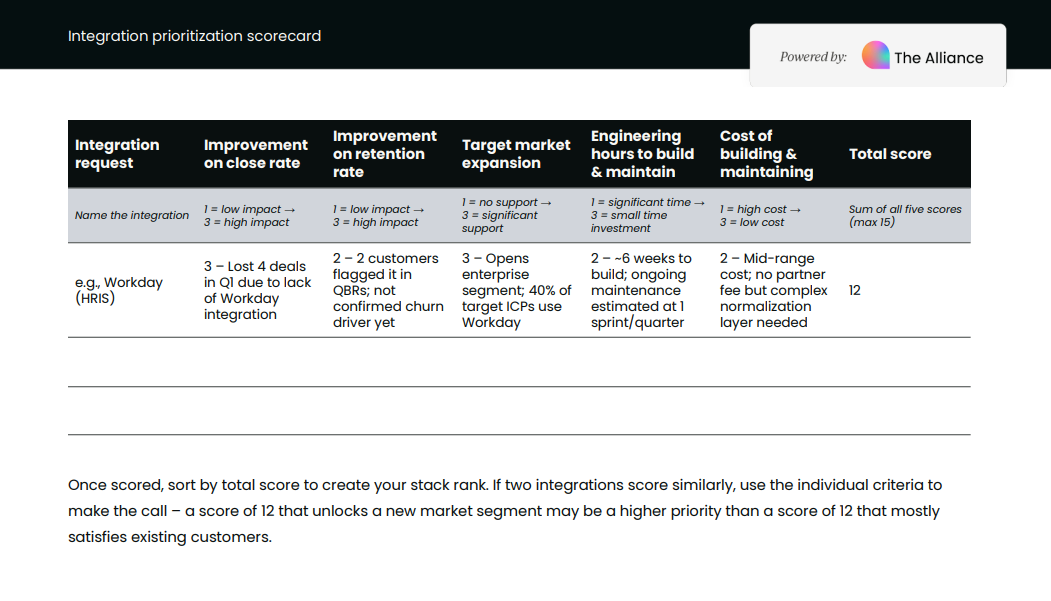
The scorecard works by rating each integration request against five criteria:
- Its potential impact on close rate
- Its impact on retention
- The market expansion opportunity it creates
- The engineering time required to build and maintain it
- The overall cost of doing so
Each criterion is scored on a 1–3 scale, and the total score gives you an objective basis for stack-ranking your integration backlog.
This template expands the core scorecard into a full four-part workflow – from collecting feedback across your pre-sales and post-sales teams, through scoping the work correctly, to tracking whether the integration actually delivered what you expected.
Who is it for?
This template is built for product managers and product leaders at B2B SaaS companies who are responsible for integration strategy, or who regularly field integration requests from sales, customer success, or customers directly.
It's particularly useful if you're dealing with more requests than your team can realistically handle, or if integration decisions tend to get made based on the loudest voice in the room rather than a consistent framework.
You don't need a dedicated integrations team or deep technical knowledge to use it; it's designed to be completed collaboratively, pulling in data from sales calls, customer conversations, and engineering estimates.
How to use the template
The template is structured as a four-section workflow. Work through the sections in order; each one builds on the last.
- Collect and quantify feedback: Start by consolidating integration demand from across your organization. Use the feedback table to log requests from customer research, pre-sales conversations, and post-sales signals. The key discipline here is attaching numbers: how many customers or prospects mentioned this integration, and how much ARR is at risk if you don't build it?
- Score and stack-rank: Run each integration request through the five-criteria scorecard. Score each one out of 3, sum the totals, and sort by score. If two integrations land close together, use the individual criteria to break the tie – an integration that unlocks a new market segment may be a higher priority than one that simply makes existing customers happier, even if they score the same overall.
- Scope before you build: Once you've decided what to prioritize, use the scoping worksheet to define the use case precisely. You're not integrating with Workday; you're integrating with a specific set of Workday endpoints to solve a specific customer problem. This section also captures field-level limitations and integration nuances so your support team isn't caught off-guard after launch.
- Measure impact: After launch, return to the template to track whether the integration delivered on its promise. Compare actual ARR impact, retention changes, and NPS signals against what you predicted in the scorecard. Over time, this creates a feedback loop that makes your future prioritization decisions sharper.
Get your integration prioritization scorecard



Become a PLA Insider
Thank you for subscribing
Get exclusive insights, frameworks, and strategies from product leaders driving real business impact.
An email has been successfully sent to confirm your subscription.
 Follow us on LinkedIn