






Product decisions change rapidly. Launch timelines don't. That asymmetry is the core operational challenge – not change itself, but the fact that you're absorbing constant change against a fixed endpoint.
Pricing shifts. Product features get cut or added. GTM positioning pivots. And yet the launch date stays on the calendar, the revenue targets stay in the plan, and the GTM team still needs to be ready.
Most operators feel this acutely and figure it out ad hoc, heroically, every time. There's no shortage of launch frameworks, but almost all of them assume a baseline of stability that enterprise launches rarely have. They tell you how to execute a plan. The plan almost always fails.
I ran this playbook most recently on a product launch where the date was fixed, and almost nothing else was. Pricing strategy changed three times in six weeks. New packaging came into the mix. The revenue tracking system wasn't going to be ready in time. The launch held anyway. Here's the operating model that made that possible.
Flexibility in planning
When product decisions shift, the instinct is to panic, escalate, or delay and wait for certainty before moving forward. But certainty doesn't come on a launch timeline. The way out is to build flexibility into the operating model from the start – not as a contingency, but as a design principle.
That means making three things explicit before the chaos starts: what cannot move, what you're assuming to move forward, and what's going to have to change. Miss any one of them, and every pivot can cause panic. Get them right, and you can absorb weekly changes without losing momentum.
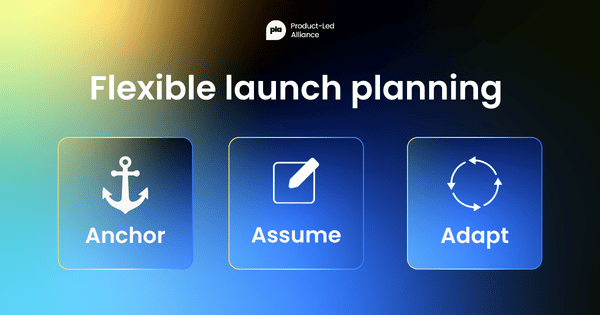
Anchor: Define your non-negotiables
Every launch has a small set of things that genuinely cannot move – the launch date, a key customer commitment, a regulatory deadline. These are your anchors. Everything else, by definition, is flexible.
The mistake most teams make is leaving this implicit. Everyone assumes they know what's fixed. Then a decision comes down that seems to contradict it, and suddenly you're re-thinking the entire plan, and pinging the teams to figure out what to do.
Getting your non-negotiables explicit and cross-functionally aligned early is the single highest-leverage thing you can do before a launch gets complicated. It gives every team a decision filter: does this change touch something fixed, or is it in the fluid zone? If it's fluid, adapt and move. If it touches something fixed, escalate fast.
For us, the anchors were the launch and announcement timeline, and the requirements for GTM. We assumed everything else could change. Weeks before launch, our packaging strategy shifted: what had been one selling motion became two. The only real adjustment this required was figuring out how to enable GTM for two products instead of one, and it didn't touch our timeline at all. The anchors gave us a fixed point to adapt around, even as the format of what they were selling changed completely.
Assume: Make operating assumptions when there isn't a decision
You will never have full information before a launch. The question isn't whether to move with incomplete information; it's how to do it without creating chaos downstream. Make operating assumptions: explicit, documented bets on what you're treating as true so the rest of the team can move. These are deliberate pre-decisions, shared across teams.
The key is building flex into whatever depends on those assumptions. If pricing lands differently than expected, what breaks? What can absorb the change? Teams that pre-align on trigger conditions – "once we have clarity on X, we kick off Y" – move faster and fight less when assumptions get updated. The assumption changes; the operating rhythm doesn't.
Given we knew product decisions were still moving but GTM needed to be ready, we documented a set of operating assumptions: success would be measured in revenue, product would be sold agnostic of packaging, and pre-sales would start prior to launch.
Each of those assumptions fed into a plan structured with open inputs rather than fixed numbers. When the product GTM strategy was approved, we filled in the blanks and quickly adapted to the final direction, without changes to the plan itself.
Adapt: Pressure-test everything
Every launch has a small number of activities that take a long time. These are your long poles – the things on your critical path that nobody is actively worrying about because they're not on fire yet. The job is to find them early and go after them hard.
Pressure-test and question every assumption about timeline and ownership. Ask what it would take to move faster. Redesign the dependency if you can. Build plans B and C before you need them.
This is where the real flexibility gets built. Anchoring your non-negotiables tells you what can't move. Making operating assumptions keeps the team moving. But attacking your long poles is what keeps the launch from getting quietly derailed by a blocker nobody saw coming until it was too late to route around it.
Our long pole was a system to track revenue. Given upstream delays, we identified a risk to its readiness early. We explored all possible options to mitigate delaying the launch, and identified multiple interim solutions including a strategic change, a process change, and a system change. We weighed all options against customer, product, and sales experience, and landed on a stopgap: a process change for a few weeks until the system caught up.
When things are changing, the instinct is to focus on what's visible and urgent. You also need the discipline to focus on what's invisible and slow-moving.
What flexible operations actually requires
None of this is clean. Plans will change weekly. Some assumptions will be wrong. Some things will surprise you anyway. That's not failure – that's the operating condition.
What makes it work is the discipline underneath: overcommunicate relentlessly, keep every team working from the same anchors and assumptions, and document decisions even when they're still evolving. A shared understanding that changing the plan is not the same as losing control of the launch – that's what holds it together.
The operators who navigate this well haven't found a better framework. They've just stopped expecting stability and built for instability instead. The goal is never a perfect plan or flawless execution. The goal is to get it done, even if imperfectly.


Become a PLA Insider
Thank you for subscribing
Get exclusive insights, frameworks, and strategies from product leaders driving real business impact.
An email has been successfully sent to confirm your subscription.
 Follow us on LinkedIn