






Created by:
 Product-Led Alliance
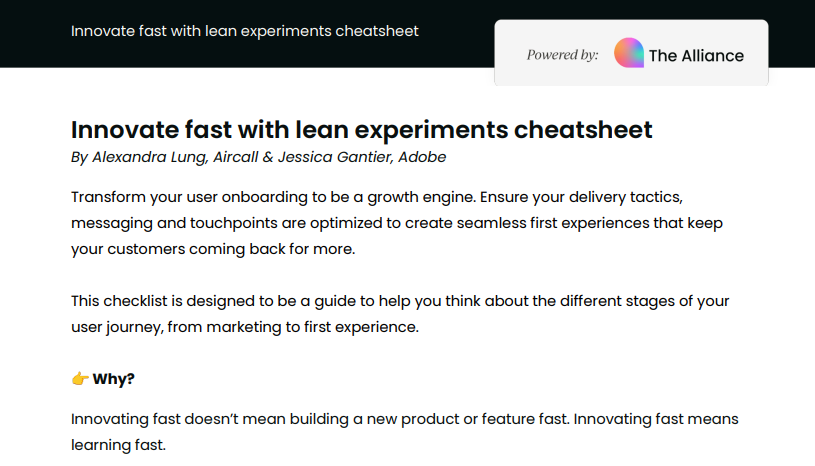
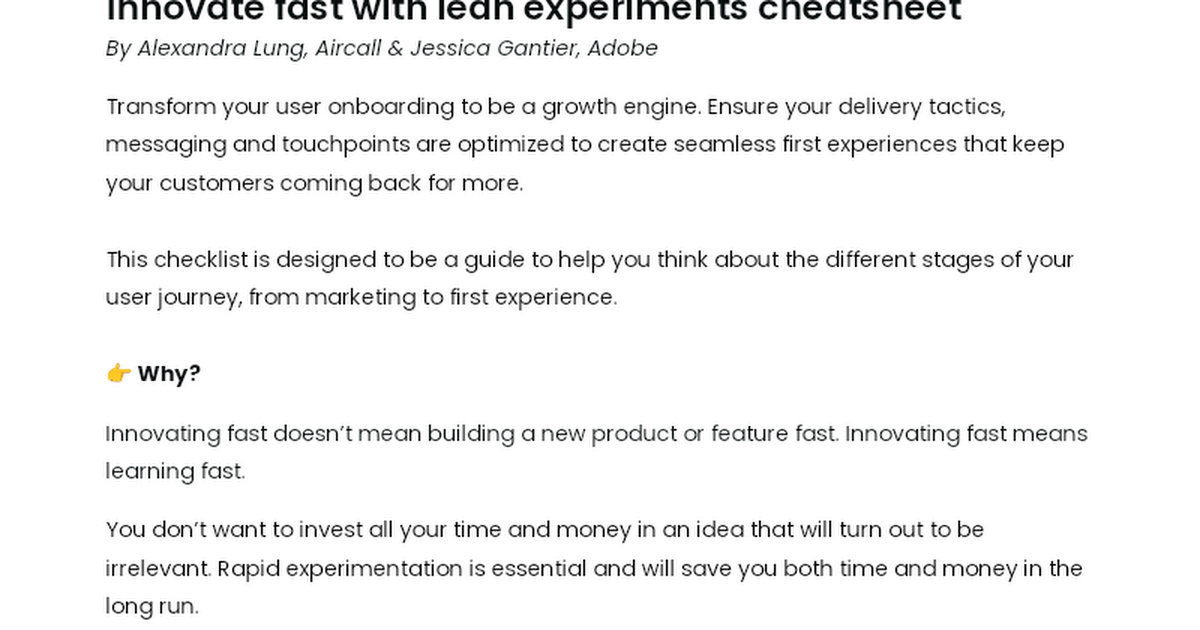
Innovating fast means learning fast. The longer you invest in an idea before testing it, the harder it becomes to let go when the evidence isn't there. Lean experimentation gives you a structured way to test your assumptions early, learn quickly, and avoid sinking time and resources into ideas that don't hold up.
This cheatsheet gives you everything you need to run those experiments consistently and confidently.
What is the lean experiments cheatsheet?
This cheatsheet is a concise, practical guide to running lean experiments across your user journey, from marketing through to first product experience. It covers the core questions you need to answer before running any experiment, and walks you through a five-step process:
- Write down your hypothesis.
- Choose the right type of experiment for your product at this moment in time.
- Define the objective, quantitative criteria that will validate or invalidate the hypothesis before you run it.
- Run the experiment.
- Measure the results objectively and make a decision based on what you find.
A worked example is included to show how the process looks in practice, using a hypothesis, a test approach, and a clear set of validation criteria.
Who is it for?
This cheatsheet is for product managers, product designers, and engineers who want a fast, repeatable way to test ideas without over-investing in them. It's useful any time you have a hypothesis – about your business model, your users' needs, or a specific solution – and want to validate it before committing to a full build.
How to use the cheatsheet
Before running any experiment, use the cheatsheet to write down your hypothesis in a clear "we believe that..." format, then define exactly how you'll test it and what success looks like.
Setting your validation criteria upfront is the critical step; it keeps the results objective and makes your decision easier once the experiment is done. Use the worked example as a reference for how a well-structured experiment comes together, and run experiments as early in the process as possible to maximize what you learn before you build.
Download the lean experiments cheatsheet



Become a PLA Insider
Thank you for subscribing
Get exclusive insights, frameworks, and strategies from product leaders driving real business impact.
An email has been successfully sent to confirm your subscription.
 Follow us on LinkedIn