







Created by:
 Product-Led Alliance
What is the Porter's Five Forces framework?
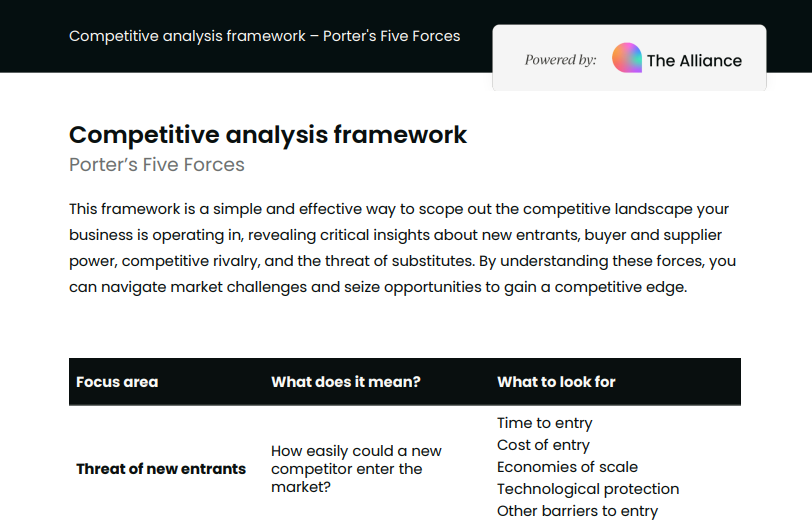
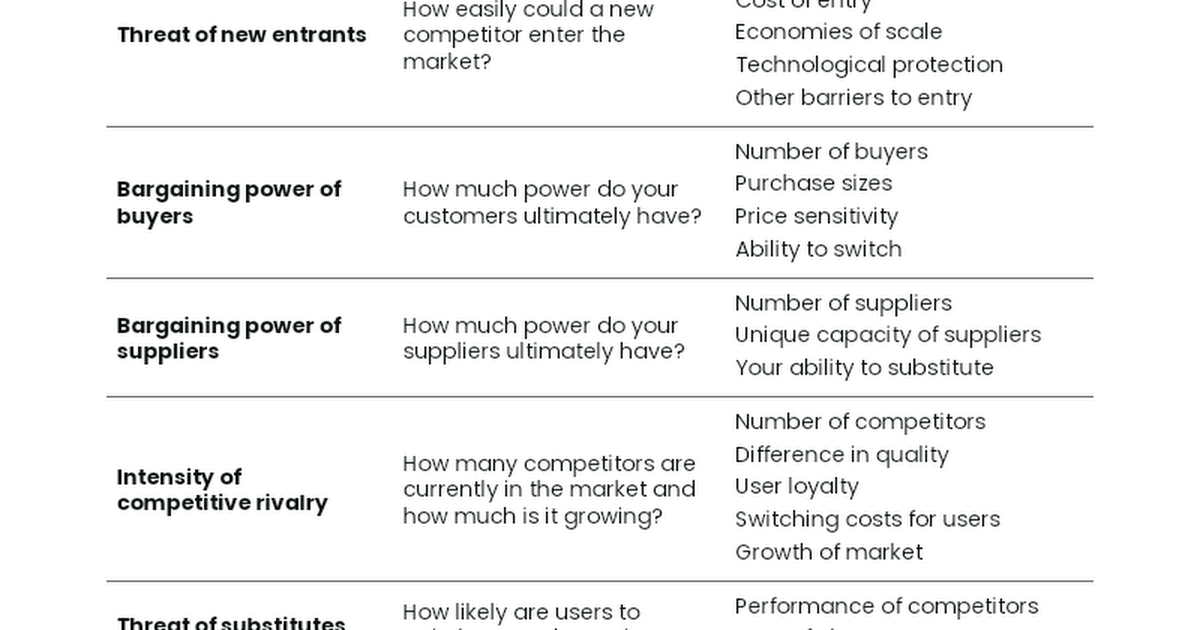
Porter's Five Forces is a popular framework used for analyzing the competitive forces within an industry. When used correctly, it provides insights into the dynamics that influence a company's profitability and competition.
Here's a rundown of the five forces from the template:
- Competitive rivalry: The intensity of competition among existing firms in the industry.
- Threat of new entrants: The ease with which new competitors can enter the market.
- Bargaining power of suppliers: The power suppliers have over the price and quality of inputs.
- Bargaining power of customers: The influence customers have on pricing and terms.
- Threat of substitutes: The likelihood of customers finding alternative solutions or products.
Who's this template for?
Our Porter's Five Forces template is ideal for:
- Product marketers and managers: To assess the competitive landscape and inform strategic decisions.
- Business analysts and strategists: To conduct in-depth market analysis and develop competitive strategies.
- Entrepreneurs and startups: To understand industry dynamics and identify potential challenges and opportunities.
- Investors and advisors: To evaluate the attractiveness and risks of different markets or industries.
How do I use the framework?
First time using the framework? Don't worry! Here’s a step-by-step guide to help you use it for your competitive analysis:
Competitive rivalry:
- Identify key competitors.
- Assess their strengths, weaknesses, market share, and competitive strategies.
Threat of new entrants:
- Evaluate barriers to entry such as capital requirements, technology, regulatory factors, and brand loyalty.
- Consider the likelihood and impact of new entrants on the market.
Bargaining power of suppliers:
- Identify major suppliers.
- Assess their ability to influence prices and terms, the availability of substitute inputs, and the importance of your business to them.
Bargaining power of customers:
- Analyze the concentration of customers, their price sensitivity, and the availability of alternative products.
- Determine how easily customers can switch to competitors.
Threat of substitutes:
- Identify alternative products or services that meet the same need.
- Assess the relative price and performance of these substitutes and their potential impact on your market.
Download your free framework



Become a PLA Insider
Thank you for subscribing
Get exclusive insights, frameworks, and strategies from product leaders driving real business impact.
An email has been successfully sent to confirm your subscription.
 Follow us on LinkedIn