







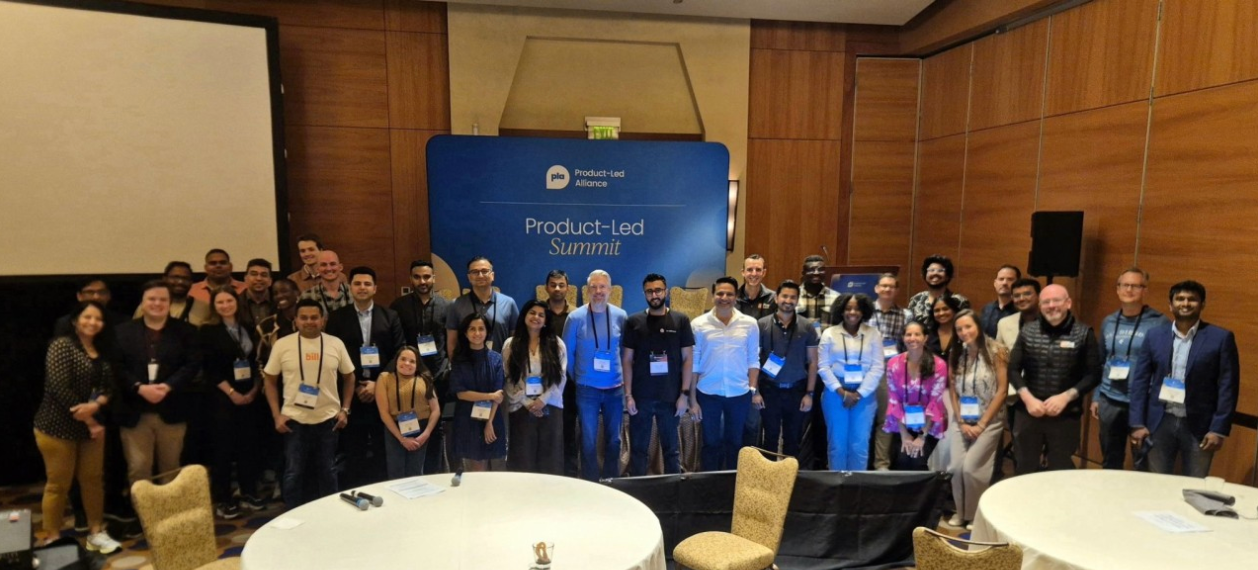
As part of my discovery work building a Cursor for Product Managers, I visited Seattle last month for the Product-Led Summit. I sat down with a dozen product leaders from Nvidia, Amazon, Microsoft, and a few enterprises to understand how they are reorganizing their teams.
The TL;DR? The playbook hasn't just changed; the underlying math is being completely rewritten.
The frontier playbook: Shifting the equation
Prior to generative AI, product management was governed by a predictable, deterministic formula focused on understanding users and execution speed.
The classic playbook:
Great product = problem understanding * good UX * feature velocity
The frontier playbook:
Great product = core intelligence * economics * speed of learning * risk management
With AI now exceptionally good at synthesizing user feedback, extracting core themes, and drafting technical requirements, basic execution tasks are becoming completely commoditized. A frontier capability (intelligence) that was a moat last quarter is just an API call this quarter.
Because raw intelligence is cheap, a PM's value must shift off the model and onto the operating system you wrap around that intelligence.
Here are the three core pillars of the new playbook where you need to build your superpowers:
1. Speed of learning: Continuous architecture loops
Your product moat is no longer a static feature list; it’s a technical feedback loop. If your model is the same one your competitor rents from the same provider, your feature is not a moat. It's a weekend project for them.
The best PMs are building systems where user telemetry and real-world edge cases are automatically captured and turned into updated evals. The moat is a flywheel, and your usage data is the one thing no competitor can buy:
Usage → data → better evals & routing → better answers → lower cost & latency → more usage.
Every customer who uses your product hands you data nobody else has. The faster this loop spins, the faster the product improves per unit of use, compounding an architectural advantage that competitors can't copy. The best PMs are building this loop to create a product that’s defensible in the long term.
2. Economics: The pricing crisis and token costs
Pricing is now a core PM function. Classic SaaS was built per-seat, on the assumption that compute was cheap enough that fat margins absorbed your power users. AI breaks that.
Token cost is a new line item, and now product teams have to engineer for economics directly: model choice, context length, caching, and retrieval – all while choosing pricing strategies that maintain margins.
Three strategies are emerging:
- Outcome-based: Most defensible long-term, but only works when the agent completes the full workflow and value is traceable. Sierra charges per successfully resolved support case; if it doesn't resolve, you don't pay.
- Pure usage: Aligns cost to tokens, but enterprise procurement hates unpredictable bills that wreck budget planning.
- Hybrid: A base subscription wrapped around credit bundles or soft limits. Even Anthropic moved its enterprise plans from a flat per-seat fee toward base seat plus metered usage, proof the model maker hasn't settled it either.
We’re staring down the barrel of a complete structural overhaul of software monetization. If you’re building right now, how are you balancing token cost and margins against predictable enterprise procurement? I'd love to hear what's working for your teams.
3. Risk management: From roadmaps to evals
The value of PMs building AI products has moved from roadmap clarity to designing evaluation frameworks (evals), model routing architectures, and specialized context boundaries to manage non-deterministic risk.
Traditional software either works or crashes. AI confidently gives you a reasonable-looking mistake. Because you are moving from a deterministic world to a non-deterministic one, shipping AI is a milestone, but operating AI safely is a core organizational capability.
PMs are using AI-assisted premortems to simulate disasters before they occur, building quality gates and specialized context boundaries directly into production systems. They’re also setting guidelines on when to use an agent: if a task has a known procedure and predictable output, it doesn't need an agent; it needs a well-engineered pipeline.
The fragmentation of the PM role
One pattern came up in almost every conversation: the single "PM" title is fracturing. This maps almost cleanly to the three superpowers above; leaders aren't hiring "generic product managers" anymore; they’re hiring a new breed of PM specialists:
- The PM who builds with AI lives in speed of learning. They use AI to prototype, synthesize feedback, and ship in hours instead of sprints. Most leaders described this less as a specialty and more as the new baseline everyone is expected to clear.
- The PM that builds AI products lives in risk management. They build products where the model is the product, so the job is evals, routing, and context boundaries – designing for outputs that can be trusted.
- The platform PM lives in economics. They own the model, eval, and cost layer everyone else builds on top of – the token costs, latency, and margins that used to be someone else's line item.
- And the forward-deployed PM doesn't get to pick one. Their focus is on the customer, turning one messy enterprise rollout into a repeatable product, and they need all three of the specialists above at once.
The pattern underneath all of it: the generalist who does a little of everything is the profile that leaders are worried about. The ones who go deep on a superpower are the ones they’re fighting to hire.
My biggest takeaway
As I continue to build Cursor for PMs, I’m beginning to lean towards this: the PM of the future doesn't need another tool that connects data sources, pulls user feedback, and clusters it into themes. That's table stakes now. The real bottlenecks are deeper. An AI-native workspace has to:
- Spin up the technical data flywheels that compound into an architectural advantage
- Maintain a clean organizational brain that surfaces the right context for every decision
- Navigate non-deterministic risk before it ships
- Model token economics and pricing as a first-class product concern


Become a PLA Insider
Thank you for subscribing
Get exclusive insights, frameworks, and strategies from product leaders driving real business impact.
An email has been successfully sent to confirm your subscription.
 Follow us on LinkedIn