






Most of us think we're building products for users. And we are, just not in the way we've always assumed.
We're now building for two fundamentally different types of users: humans and machines. Unfortunately, most products today are only designed for one of them.
Think about what that means in practice. Humans click, explore, hesitate, and learn over time. They follow onboarding guides, get lost in menus, and eventually figure things out.
AI agents do none of that. They don't follow your UI. They don't read your onboarding documentation. They don't just figure things out through trial and error.
Machines expect clean inputs, predictable outputs, and the ability to act instantly. When they don't get that, they don't complain or submit a support ticket. They silently fail. Or worse, they hallucinate and produce something that sounds completely believable but is entirely wrong.
This is known as the uncertainty paradox, and it's something every product leader needs to reckon with right now.
In this article, we'll break down what the uncertainty paradox is and what it takes to build for humans and machines at once. We’ll explore why copilots don't solve the underlying problem, how to shift from designing features to exposing capabilities, and what it means to design for agent experience alongside user experience.
The uncertainty paradox explained
Traditional software is deterministic. Input A always produces output B. You can test it, predict it, and ship it with confidence. In the world of AI, things work probabilistically. The same input can yield slightly different results, or sometimes wildly different ones.
This is the uncertainty paradox: humans expect reliability, but machines only ever offer their best guess. To bridge that gap, you have to design for graceful failure, and that's a lot harder than most people expect.
Consider what a graceful failure actually looks like. An interface that explains why a decision was made, and with what level of confidence, rather than just surfacing a result.
For example, if an AI agent executes a task at 60% confidence, the UX should automatically trigger a human-in-the-loop approval step. That's the kind of design thinking we need to be doing. And the challenge gets even more complex when the person on the other side of the prompt isn't a person at all.
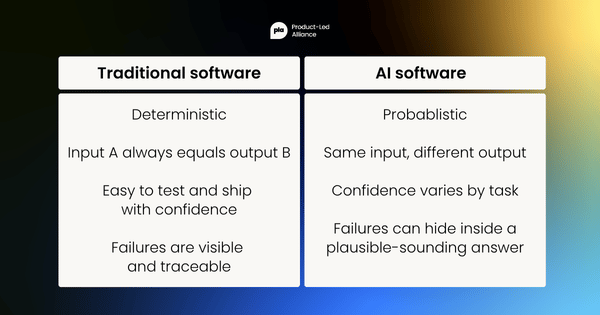
We should also consider the differences between humans and machines. Humans operate with soft logic: nuance, context, intuition, judgment. Machines operate with hard logic: rules, structure, repeatability.
Managing the confidence gap between those two ways of engaging with a product is quickly becoming one of the most important jobs in product management. The question isn't “how do we add AI to our product?” It's “how do we build a product that works for both humans and machines at the same time?”
For expert advice like this straight to your inbox twice a month, sign up for Pro+ membership.
You'll also get access to 10 certifications, a complimentary Summit ticket, and 100+ tried-and-true templates.
So, what are you waiting for?
Everything we've built has been optimized for humans
When you look at the building blocks of modern product design, it becomes obvious just how human-centric our thinking has always been.
Navigation menus exist to orient humans. Onboarding flows exist because humans need to learn. Dashboards exist because humans need to interpret information visually. Step-by-step workflows exist because humans are sequential thinkers who benefit from guided processes.
Every single one of those design patterns is built around human behavior. And for decades, that made complete sense. But now we have a second type of user, one that doesn't need any of those things, and we're still building as if the first type is the only one that matters.
So, what needs to shift?
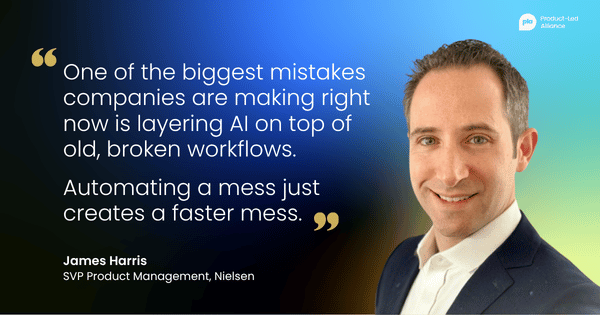
One of the biggest mistakes companies are making right now is layering AI on top of old, broken workflows. Automating a mess just creates a faster mess. Building for both humans and machines requires genuine workflow redesign, where tasks get unbundled from the processes that were designed around human limitations.
Take a ten-step workflow. In a traditional setup, AI might help the user move through those ten steps more efficiently. In an AI-first setup, you'd rebuild the process so the machine handles steps one through eight autonomously, and the human acts as editor-in-chief for steps nine and ten.
The human's role shifts from executor to decision-maker. That's a fundamentally different product, and it requires fundamentally different thinking to build.
In the past, software was a tool people used to do work. In an AI-first era, software is a teammate that does the work, and the human provides intent and quality control. The hardest part of making that shift is identifying the 80% of tasks a machine can handle autonomously, so your human users can focus their attention on the 20% that requires high-stakes judgment.
The copilot trap
You've probably sat in a meeting where someone said, “Let's add an AI chatbot to our existing workflows. We’ll call it AI-first!” Maybe you've said it yourself. There's nothing wrong with that instinct, but it's worth being honest about what it actually achieves.


Become a PLA Insider
Thank you for subscribing
Get exclusive insights, frameworks, and strategies from product leaders driving real business impact.
An email has been successfully sent to confirm your subscription.
 Follow us on LinkedIn