









Most of the time in product, we talk about customers as our champions. But what happens when your most important customers aren’t external entities at all – they’re your own sales team, sitting just a few desks away from you?
In this article, we dive into the delightful (and sometimes chaotic) relationship between sales and product, and uncover how to prioritize – and more importantly, what to measure – to truly help your sales team close deals.
The sales mindset: Behaviors that shape priorities
Before we dive into how to prioritize products for sales, we need to embrace a few core truths about how sales operates:
- Every salesperson is unique: No two will ever have the exact same “want.” Each rep comes with their own set of must-haves, deal contexts, and customer nuances. Now layer in cross-continent differences, and suddenly the diversity of asks doesn’t just grow; it explodes.
- The wishlist is endless: There’s no such thing as a final roadmap of “what sales wants.” The goalpost is always moving, shaped by market shifts, competitor moves, and evolving customer expectations.
- You won’t please everyone: Some sales reps will cheer your launches, others will question your priorities, and a few will do both in the same meeting. That’s not a problem; it’s the nature of the game.
Prioritization that actually works: The C2R framework
Whenever I prioritize, I anchor myself with a clear goal and a validation metric upfront, so I can objectively assess later whether the decision truly delivered value.
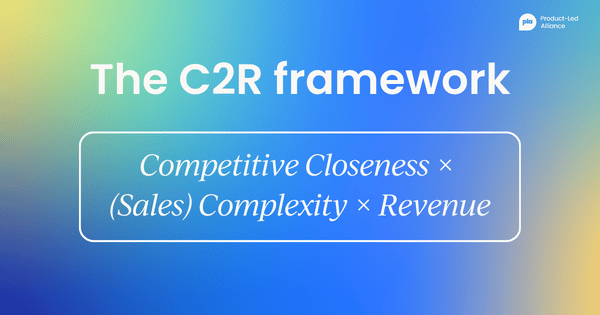
The framework I lean on is the C2R framework:
Competitive Closeness × (Sales) Complexity × Revenue
Let’s break it down.
Competitive closeness
If a product closes a meaningful competitive gap – or even better, creates a real, defensible differentiation – it deserves a higher spot on the priority list. Remember, even in the fiercest competitive battles, sales doesn’t need every gap closed; they need the right gaps closed at the right time.
- Goal: Empower sales to win more competitive deals
- How to validate: Use semantic search across quarterly win/loss reports to identify patterns and trends tied to your product’s impact
(Sales) complexity
The more complex a product is to size, position, and sell, the more attention it demands. Complexity doesn’t just slow things down; it introduces risk, confusion, and ultimately, lost deals.
- Goal: Enable sales to confidently sell the right-fit product – effortlessly, without friction, and without the risk of over-sizing or under-sizing
- How to validate: Look for reductions in deal closure time, along with a decline in CSAT issues and escalations tied to mis-sized solution
Revenue
At the end of the day, sales runs on quotas, not product narratives. If a product meaningfully contributes to revenue – either by expanding within existing accounts or unlocking net-new logos – it should rise to the top.
- Goal: Build products that directly translate into revenue growth
- How to validate: Track how your SOM (serviceable obtainable market) estimates align with pipeline generated post-announcement, and how much of that pipeline actually converts into bookings post-GA
Of course, there’s always the classic factor lurking in the background: Engineering effort. Yes, it matters. But don’t let it overshadow the real drivers – impact, usability, and revenue potential.
Pushing back on sales requests: Saying ‘no’ the right way
We all know the drill when it comes to engineering – push back, negotiate, debate priorities. But what about sales? Even with a strong prioritization framework, you won’t be able to say “yes” to everything. And that’s okay.
Here’s what actually works:
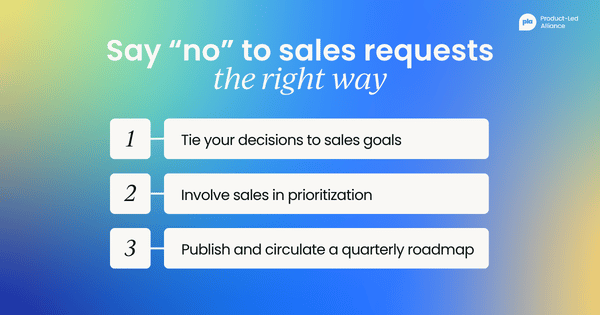
1. Tie your decisions to sales goals
When saying “no” to a request, anchor your reasoning in the sales organization’s yearly goals; this makes your prioritization bulletproof.
How do you uncover these goals? Attend sales all-hands or QSRs (quarterly sales reviews) – no, not the usual QBRs! These sessions provide direct visibility into the metrics and initiatives that truly drive sales.
2. Involve sales in prioritization
Don’t build in isolation. Bring in real sales users – account executives, sales engineers, frontline leaders – and make them part of the prioritization process.
Identify four or five strong voices across regions to act as early champions. They’ll validate your direction and provide grounded, real-world feedback.
3. Publish and circulate a quarterly roadmap
Sales lives and breathes in quarters. Keep them in the loop. Share what shipped last quarter, what’s coming next, and how it ties back to their goals. Use worldwide sessions to amplify this. The outcome? Better alignment, higher trust, and stronger engagement.
Saying “no” doesn’t have to damage relationships. When decisions are transparent, data-backed, and aligned to sales outcomes, you don’t lose trust; you build it.
The hidden deal killer: Friction
Sales teams don’t just lose deals because of product gaps; they lose them to friction. When every rep is juggling multiple deals, even a small delay in the selling process can quietly erode momentum.
I saw this firsthand while managing a product designed to help sales position the “optimal platform” to customers. One of the key requirements to sell with confidence was an assurance document – think of it as a commitment, almost like insurance when you’re making a high-stakes purchase.
On paper, it sounded like a strong differentiator. In reality? It was a bottleneck.
It took a couple of weeks for a sales lead to generate that assurance letter because our internal process was slow, clunky, and frankly, painful. The result? Many sales reps simply chose not to use it – even when it could have made the difference in winning the deal.
Once we streamlined and optimized the process, the impact was undeniable. Adoption didn’t just improve; it spiked. More reps began generating assurance documents, usage shifted from optional to habitual, and most importantly, we saw a clear, measurable lift in win rates. Removing friction wasn’t just an efficiency gain; it became a direct lever for revenue.
The bottom line
The bottom line is simple: no matter how great your product is, if the process to sell it is cumbersome, slow, or frustrating, it will hold you back. A brilliant product wrapped in a painful sales experience will always underperform.
Make your products easier to sell – not just by closing competitive gaps, but by empowering your champions and simplifying every step of the journey. Strip away friction wherever it hides.
Because at the end of the day, if selling your product feels hard, winning deals will be even harder.


Become a PLA Insider
Thank you for subscribing
Get exclusive insights, frameworks, and strategies from product leaders driving real business impact.
An email has been successfully sent to confirm your subscription.
 Follow us on LinkedIn