






Quick question: how long did you spend preparing for your last roadmap review? Not just the deck itself, but the meetings before the meeting. The pre-alignment conversations. The stakeholder check-ins. The rounds of feedback before you even walked into the room.
Ten hours? More?
Now here's the follow-up: how many people were in that review? Thirty? Forty? Did they all need to be there? Was all of their input helpful, or did some of it just slow you down?
If you're nodding with despair, you already know where this is going. Because when you step back and really look at it, the whole thing feels a little ridiculous.
It's what I call “the alignment trap”. You start out trying to make better decisions by bringing in more stakeholders. But somewhere along the way, all their "helpful" input ends up getting in the way of good work.
I've spent a lot of time thinking about why this happens and how to fix it. In this article, I want to walk you through what I've learned. Here's what's ahead:
- Why scaling naturally pushes organizations toward risk avoidance dressed up as process
- The warning signs that your team is optimizing for consensus instead of shipping product
- A framework for matching the right decision-making style to the right moment
- The shift from aligning on decisions to aligning on structure, and why it changes everything
- How building a flat information flow keeps your team informed without slowing them down
How companies drift from fast decisions to consensus overload
So how does a fast-moving team end up buried in stakeholder meetings? I've seen this play out firsthand at Ibotta, and the story is a pretty familiar one.
Ibotta was founded in 2012. Like most startups, we started small and scrappy, with a clear idea and a tight team. Our founder, Bryan Leach, spotted someone taking a picture of a receipt on an airplane and saw an opportunity in the grocery promotions space. That was the spark. From there, we built a consumer app that let people earn cash back on everyday purchases.
For a while, decisions were fast. Everyone knew the goal. Information moved freely because everyone was in the same room. The team was small enough that you didn't need a process for alignment because alignment just happened.
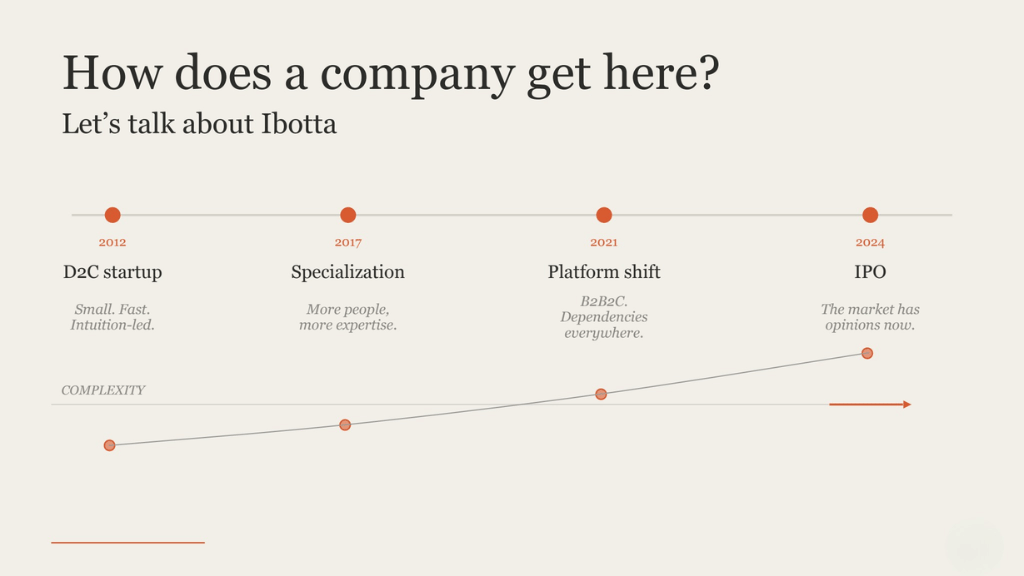
Then the company grew. We specialized. We brought in more people. Around 2021, we made a major strategic shift from a direct-to-consumer product company to a B2B2C platform model. That move introduced a whole new layer of complexity. Then, in 2024, we went public, which added yet another layer of stakeholders to the mix.
Every one of those changes was good. Growth is good. Specialization is good. Going public is a milestone worth celebrating. But each one also brought more opinions, more dependencies, more variables to manage. And as the complexity grew, something quietly started to break.
When risk avoidance starts to look like process
Here's what happens in most companies as they scale. The product gets more complex. The number of stakeholders increases. The consequences of any given decision become harder to predict and harder to control. As a result, the perceived risk of making a wrong call goes up.
When risk goes up, the natural instinct is to share the load. And so you start to hear things that, in isolation, sound completely reasonable.
"I need more data before I can make this call."
"I should get marketing to weigh in."
"Let me check on the downstream dependencies."
"We need to take the market's temperature on this."
But here's the question you have to ask yourself as a product leader: are your people saying these things to make better decisions, or are they saying them to avoid making a decision at all?
Risk avoidance masquerading as informed decision-making is one of the most common and most damaging patterns in scaling product organizations, and it's really hard to spot.
For expert advice like this straight to your inbox twice a month, sign up for Pro+ membership.
You'll also get access to 10 certifications, a complimentary Summit ticket, and 100+ tried-and-true templates.
So, what are you waiting for?
Is your alignment process helping or hindering you?
If you recognize any of the following in your own team, that's a sign something's off:
- Prioritization decisions are pulling in people from five or six different functions
- Your PMs are living in what one of our team members called "deck hell," spending more time building slide decks than building the product
- Nobody on the team has talked to a customer in weeks
- The team is burning out
- You, the product leader, are making trade-off calls that your PMs should be making themselves
And then there's the one sign that trumps everything else: you're not shipping product.
Velocity is the clearest signal. When decisions slow down, product slows down.
If you find yourself not shipping product, it's worth asking what you're actually optimizing for. Are you optimizing for alignment? Because if you are, your decision-making process is likely broken.
Let's explore what you can do about it.


Become a PLA Insider
Thank you for subscribing
Get exclusive insights, frameworks, and strategies from product leaders driving real business impact.
An email has been successfully sent to confirm your subscription.
 Follow us on LinkedIn