










Over more than twenty years leading product across legal tech, marketplaces, healthtech and fintech, I've seen the same moment arrive in every portfolio. Several products, often several countries and company cultures. Regulated markets, with licensing that varies by jurisdiction. Every function with its own legitimate targets: commercial wants the deal, delivery wants the go-live, technology wants the platform work done, and finance wants to protect the margin.
And one question on the table, with a quarter to answer it: what do we build, in what order, and why?
It never feels like a prioritization problem. It feels like being asked to referee a match where every player is right. Every request I've received in those moments was defensible from where the person making it stood. I couldn't say yes to all of them; I couldn't say no to any of them with an argument stronger than my own judgment, and judgment alone doesn't scale across a large portfolio.
That position turns out to be the default condition of the discipline rather than a local failure. Product-Led Alliance and ProductPlan's 2026 State of Product Management report treats roadmap decisions as capital allocation choices. It cites Bain research finding that only about a quarter of CTOs say their R&D investment meets the board's return expectations, and it links that gap to unclear prioritization logic.
I share that view. A roadmap is where a company decides what to do with its build capacity, and that decision deserves the same discipline as any other investment.
So, the lesson I keep coming back to is this: stop arguing about initiatives and build a system for deciding between them. This is that system, end to end, including the parts that still don't work.
Why the two obvious solutions both failed
The first solution most companies reach for is the annual plan. It looks responsible. It gives finance a number and the board a story. And it’s wrong within about six weeks, because a partnership shifts, a regulator publishes something, or a competitor turns up in a market you assumed was quiet.
The second solution is the opposite: decide continuously, and let the loudest voice carry it. That’s not agility; that's a roadmap that belongs to whoever asked last.
What works is something in between: a plan firm enough to execute against and loose enough to survive reality. The answer I've landed on is a quarterly cycle that gets formally re-examined every month. The quarterly plan is a starting point, not a frozen commitment. That single sentence has settled more arguments than any framework I have used.
Industry data shows that change is unavoidable, so you’re better off planning for it. Asked how often priorities change after being agreed, respondents to the State of Product Management survey average 3.3 out of 5. Meanwhile, nearly half of teams (47.5%) name short-term commitments as a leading cause of drift between strategy and roadmap. A planning system that treats the quarter as settled is designing for a world that does not exist.
Introducing the Product Roadmap Cycle
I call this process the Product Roadmap Cycle, a name that describes what it actually does rather than what a borrowed methodology says it should. That choice matters more than it seems. Borrowed vocabulary brings borrowed expectations.
Naming a process is a governance decision, not a branding decision. People behave according to what they believe the name promises.
The cycle, in four phases
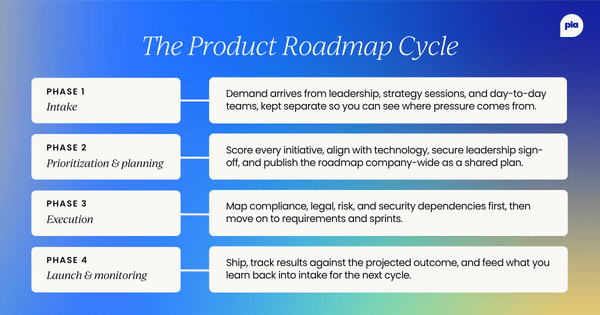
Phase 1: Intake
Demand arrives from three places, and we keep them separate on purpose: a monthly cross-functional forum with leadership, a monthly strategy and market session, and day-to-day demand from commercial, delivery, and support.
Keeping the channels distinct means we can see where roadmap pressure is actually coming from. When most of a quarter's intake arrives through one door, that says as much about the company as it does about the roadmap.
Phase 2: Prioritization and planning
Every initiative is scored. We build the quarterly view, align it with technology, size it together, take it to leadership for sign-off, and publish it company-wide. Publishing the roadmap matters. Until the whole company can see it, it’s only the product team’s view, not a shared plan.
Phase 3: Execution
Before anything gets built, we map dependencies: compliance, legal, risk, security. In a regulated business, those are constraints that determine whether the product is possible at all. Next come requirements, then sprints.
Phase 4: Launch and monitoring
We ship, then we track the initiative against the outcome we projected for it, and that result re-enters Phase 1 as intake for the next cycle. This is the loop most teams skip, and skipping it is why so many prioritization frameworks quietly become theater. If nobody ever checks whether the projected value showed up, the score was just a number that made a meeting end faster.
Underneath the quarterly rhythm, alignment runs monthly with leadership, weekly with stakeholders, and continuously against performance.
Two tracks, one board
This is the change I would recommend to almost any leader running a portfolio.
The product track holds roadmap initiatives, the things that change what the product is. These are scored, ranked, and compete against each other for capacity.
The implementation track holds client delivery and go-lives, the things that bring a specific customer onto what already exists. These are tracked with the same rigor and are not scored at all.
Put both in one backlog, and a large customer integration ends up fighting a platform capability for the same slot, judged against the same criteria. It makes both look bad: the integration wins on urgency and loses on strategic value, and the platform work stalls. They are different kinds of work with different success conditions, and once you stop pretending otherwise, both move faster.
The State of Product Management report puts the same pressure in numbers: 49.2% of teams name resource and capacity constraints as the single leading cause of drift between strategy and roadmap, the highest-ranked reason in the study. When delivery work and product investment draw from one pool and are judged by one set of criteria, the capacity constraint is not merely a symptom of misalignment; it's the mechanism that manufactures it.
The calculation: Five variables, one formula
People ask me about this part most.
First, some context. Only 13.5% of teams use a formal scoring or prioritization framework as a primary criterion, and just 5.7% say their roadmap process follows a structured framework at all. By comparison, 20.1% rely on intuition or expert judgment. That makes this a minority practice.
Every initiative in the product track carries a score from 0 to 100, calculated automatically from five variables:
- Value of the first 12 months (total gross profit), measured from the day the initiative goes live. Every initiative uses the same 12-month window, so where its launch falls on the calendar doesn't distort the comparison.
- Return on that investment, the gross profit of those same 12 months against the capital required to deliver it.
- Experience and retention, for value that is real but doesn't arrive as new revenue.
- Target-date urgency, how close the committed delivery date is.
- Strategic designation, an explicit statement from leadership that this matters for reasons the economics do not capture.
The mechanics are deliberately boring. Each financial variable is scored relative to the rest of the portfolio rather than on its absolute number, and that's what makes initiatives of very different sizes comparable at all.
Urgency is scored on a fixed, graded scale, so the result is the same no matter who does the scoring. Anything in the backlog drops off the roadmap view entirely.
Strategic designation is a simple yes or no. Experience and retention earn points only when there's evidence behind them: a named metric, a measured baseline, and a committed change. Even then, the score is capped.
One more mechanic sits on top of the two financial variables: a confidence multiplier. A number the commercial owner has co-signed counts in full. An estimate or an assumption counts for less, and so does an initiative with no committed date, because a 12-month window with no start date is just a wish.
Each variable carries a weight, and the score combines them.
That's the whole calculation. There's no bias in it. The same inputs produce the same ranking every time, regardless of who is in the room, who is presenting, or how the meeting is going. Nobody argues with the output, because the output is arithmetic. They argue with an input, which is a far better conversation to have: it's specific, it's checkable, and it usually ends with somebody going to find a real number.
Three choices inside the variables worth explaining
Score gross profit, not revenue. Revenue is a vanity input in a business with different margins across products. Two initiatives with identical revenue can differ by a wide factor in what they actually contribute. Changing the denominator changes the ranking, and it changes the conversation with commercial teams.
Separate how big a bet is from when the money lands. If you score only size, long-horizon initiatives look wonderful while nothing ships this year. If you score only what lands this year, you never fund anything that will matter in three years. So, size is measured over a fixed 12-month window from go-live, so a late start isn't penalized twice, and timing gets its own score through urgency.
If a date slips, the system moves the money out of the current year automatically, so nobody has to retype a forecast. That keeps the trade-off between immediate and medium-term revenue out in the open, where it can be argued about honestly.
Grade urgency rather than making it binary. An urgent-or-not checkbox will be gamed by lunchtime. A graded scale makes people commit to a date, and a date is something you can be held to.
The variable that reordered the queue
If I were starting again, the confidence multiplier is the variable I would add first. It looks like a tidy-up, but it can reorder a queue without touching a single weight, because it shows how much of any portfolio rests on numbers nobody has committed to yet.
The multiplier doesn't punish optimism, but it puts a price on it. A large number nobody has signed off on ranks below a smaller one a commercial owner has agreed to defend. That means the quickest way to climb the list is to go and get your number co-signed.
The ROI gap
There’s something uncomfortable buried in the State of Product Management survey data. Nearly half of teams (48.8%) say business impact or ROI is a primary criterion for how they prioritize, but only 13.5% use a formal scoring framework to produce one. That means many teams are stating an ROI without a process that actually calculates it.
The ROI is real in the sense that somebody sincerely believes it. But nobody can reconstruct how it was arrived at, which means in practice the decision defers to whoever is most senior in the room.
The weights are not universal, and that’s the point
This is where I would ask you to be careful, because it is where I most often see prioritization frameworks oversell themselves. They publish their weights as though they were physics. They are not. The weighting is a strategic statement about what your company values right now, and it should be argued over hard.
A business watching every dollar should weight urgency heavily and the size of the bet lightly. A business coming off a bad year of outages will want far more of the quarter's build capacity going to reliability work, which belongs in a queue of its own. A business with one dominant customer probably needs a concentration variable that penalizes anything that deepens the dependency. Your weights have to fit your business, so build them around your own priorities.
The weighting decision does not belong to the product team. Leave it to your executive team, set it with them in the open, and do it before looking at the ranking.
That order matters more than anything else in this section. If you adjust the weights after you've seen the ranking, that's rationalization. You'll tune the model until your preferred initiative lands on top, and you'll have built an elaborate machine for confirming what you already wanted. Set the weights, then look. Revisit them once per cycle, and don't let any single initiative change them.
Subjectivity doesn't disappear. It gets relocated, and that's the entire trick. Instead of showing up once per initiative, in a hundred separate conversations, it shows up once, at the top, as a deliberate and visible decision about what the company is optimizing for. Then the arithmetic runs, and it runs the same way for everyone.
Where leadership judgment fits
Here is the piece I would expect most frameworks to leave out: a weighted flag, applied by leadership, that can move an initiative up the list regardless of what the arithmetic says.
Some readers just winced. I did too, at first. The purist position is that if you trust the model, you do not override it – and if you override it, you never trusted it.
The data shows how often this comes up. The State of Product Management survey asked teams directly what most often overrides their prioritization framework. Leadership escalations and new directives came first at 60.2%, well ahead of sales escalations at 38.5% and revenue pressure at 38.1%. For six teams in ten, the strongest force acting on the prioritization framework is a force the framework does not model.
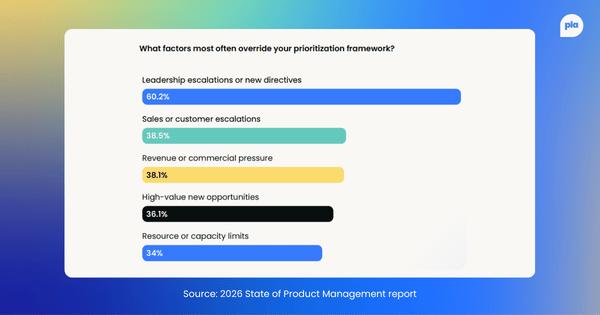
The report reads that as friction. I see it differently. Leadership judgment isn't going away, and it isn't because executives lack discipline. Often they're right, for reasons a model can't capture: a regulatory window that opens only once, a partnership that won't be available next quarter. If your model had no way to express those, it would be worse for it.
So, the real question is not whether leadership judgment shapes the roadmap. It's whether the model gives that judgment a clear, visible place. Giving it one does three things:
- It gives strategic priorities a defined weight, so they count alongside the economics rather than outside them.
- It gives every designation a named owner, so the whole company understands why an initiative moved up.
- It makes leadership priorities an explicit input that the model absorbs like any other, rather than a separate conversation.
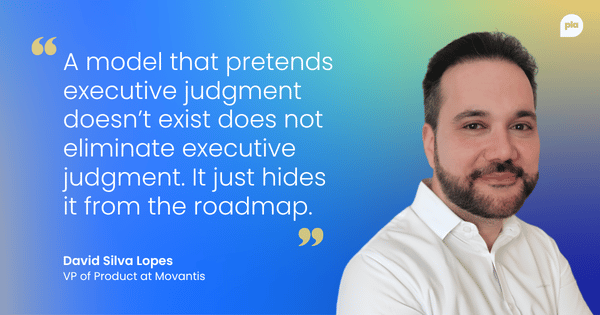
A model that pretends executive judgment doesn't exist does not eliminate executive judgment. It just hides it from the roadmap.
What the model filters out
You can tell a prioritization system is real by what it stops.
When an initiative's 12-month return comes out below 1, the case for taking it out of the development queue makes itself. Below 1 means delivering it would cost more than it would ever bring back, and that's not a matter of taste. The rule applies the same way to every initiative, so nobody has to lose an argument for it to work.
Without that visibility, those decisions get made the way they usually are by default: on partial, local, incomplete views, defended sincerely by people doing their jobs. Every initiative looks entirely reasonable from where the person proposing it stands, because each person can see their own case with complete clarity and nobody can see the portfolio. Nobody's at fault here. That's simply what happens when there's no shared yardstick.
What a shared model makes possible
The roadmap becomes something the company reads, not something product has to defend.
- Impact is explicit. Every item states what it does for the customer value proposition and what it returns to the business, whether that's margin, cost reduction, or reduced risk.
- Resources follow evidence. Allocation can be explained to the people who didn't get capacity, and they're the ones who matter most.
- Performance is tracked, and the route gets corrected. What was projected is compared against what happened, monthly, while it's still cheap to change course.
- One company, one language. Commercial, technology, delivery, and finance teams work from the same numbers, and the strategy and the choices behind it are visible to everyone.
- Communication and go-to-market get sharper. Because the roadmap names its bets by industry and value proposition, marketing and sales can target defined ideal customer profiles instead of everyone.
That fourth one is harder than it sounds, and the data explains why. Confidence that non-product teams understand the product strategy averages just 3 out of 5 across the industry, and 40% of teams say their strategy, discovery, roadmap, and launch plans live across multiple tools with limited or no integration. A shared language is not a cultural achievement you can exhort people into. It takes structure, and it won't last without a single place where the reasoning lives.
Three things the score cannot do
I don't want to oversell this, so let me share where the model falls short.
1. It can't find ideas nobody has proposed
A score is a comparison engine, not an idea engine. It will happily rank ten mediocre initiatives and tell you which one is least mediocre. Anything nobody proposed stays invisible. To close that gap, we use a separate market view that maps our footprint against the addressable market. Those figures are directional, and I label them that way, because an estimate that gets quoted three times starts to be treated as fact.
2. It can't value work that doesn't drive revenue
A fair question about any model like this: what about work whose return isn't revenue? Cost reduction, time savings, lower risk, fewer incidents, customer satisfaction, and loyalty are all real. If your model has no home for reliability work, that work will lose every quarter until it becomes an outage.
The answer is to give that work a second ranking rather than stretching the first one. Efficiency, risk, and reliability work carries its own score, built from what that work actually produces rather than from revenue.
The same confidence multiplier applies, because an efficiency claim with no measured baseline is worth no more than a revenue claim with no signature.
That gives two rankings and two owners, each held by the people closest to the value it measures. Both queues are reviewed in the same monthly cycle against an agreed split of build capacity. Nobody has to pit a chargeback tool against a client go-live. The share of the quarter each queue gets is decided once, in the open.
One limitation remains inside the product score. The experience and retention variable still covers work with real value but a soft number. It earns points only with evidence, and it's capped, so it can win a tie-break but never a whole quarter on its own.
3. It can't score what hasn't been sized
We keep a set of initiatives in discovery with no investment assigned, and we exclude them from the return calculation rather than inventing a number. A fabricated denominator produces a confident, precise, wrong answer. An empty field at least tells the truth.
And a note of humility that applies across all three: confidence in measuring business impact averages 3 out of 5 across the industry. Even the financial half of this is shakier than most models, mine included, would have you believe.
How to adapt this in 90 days
- Split delivery work from product work. Two tracks, one visible board. They have different success conditions, and mixing them makes both look like failures.
- Change your denominator to margin, not revenue. It changes the ranking, and it changes the conversation you have with sales.
- Separate the size of the bet from when it lands. Measure size over a fixed window from go-live, so a late start isn't penalized twice, and score timing separately.
- Discount the numbers nobody signed. A confidence multiplier on financial inputs orders the queue more honestly than any debate about weights.
- Give non-revenue work its own ranking and its own owner, not a corner of yours. Judged on a revenue scale, efficiency, risk, and compliance work loses quietly until it becomes an incident.
- Set the weights with your executive body before you see the ranking. Weights are a strategy statement, not a formula. Setting them afterwards is rationalization dressed up in a spreadsheet.
- Give leadership priorities a name, a defined weight, and an owner. Leadership judgment shapes every roadmap. Modeling it keeps it visible and explained.
- Grade urgency; never make it binary. Binary urgency fields get gamed immediately.
- Close the loop in public. Publish what you projected, then publish what happened. Without this step, prioritization is a ritual rather than a system.
- Pick a name that fits your company. People follow the expectations the name carries, not the process document nobody reads.
Closing thoughts
No prioritization model can hand you the right answer. No such machine exists, and anyone who claims otherwise is trying to sell you a spreadsheet.
What a good model produces is a defensible answer: one where every person affected by the decision can see the inputs, disagree with a specific number rather than with a person, and watch what happened after we shipped. In any portfolio that spans several products, markets and cultures, that shared, inspectable reason is worth more than any individual decision it produces.
Ship the system, not just the roadmap.
Industry figures cited throughout are from the State of Product Management 2026 report, published by Product-Led Alliance in partnership with ProductPlan, based on a Q4 2025 survey of nearly 250 product professionals.
The views in this article are my own and do not necessarily reflect those of my employer.


Become a PLA Insider
Thank you for subscribing
Get exclusive insights, frameworks, and strategies from product leaders driving real business impact.
An email has been successfully sent to confirm your subscription.
 Follow us on LinkedIn