








Most product managers are excellent at building. However, they’re not always excellent at sticking with a problem long enough to know what to build.
That gap is product myopia, and it’s more common than most teams like to admit. A team falls in love with a feature, a fix, or a solution before fully validating whether it solves the right customer problem. The work looks productive, the roadmap moves, but the customer pain doesn’t go away.
The fix is not to build less or slow down. It’s to think more like a problem manager: start with the customer outcome, not the solution. Stay with the problem before committing to the build. And measure whether the pain actually stopped, not just whether the feature shipped.
Product managers already own strategy, roadmap, prioritization, and delivery. They don’t need to become problem managers. However, they can borrow one discipline from problem management: staying with the customer problem long enough to understand its recurrence, root cause, impact, and desired outcome before deciding what to build.
Recurring customer friction isn’t just a support issue. It’s a product signal, a retention risk, and a prevention opportunity.
I've spent many years working as a problem manager at the intersection of product, support, engineering, and operations – the place where customer pain is more than just a hypothesis.
By the time recurring issues reach those teams, customers have already felt the friction. They've opened cases, built workarounds, escalated, lost trust, or quietly moved on. That experience taught me that many product failures are not execution failures. They’re problem-definition failures.
From solution-first to problem-first
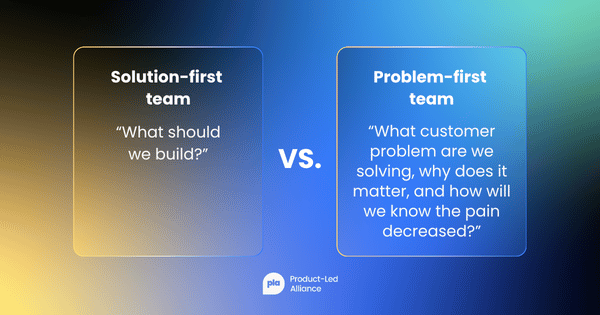
A solution-first team asks: What should we build?
A problem-first team asks: What customer problem are we solving, why does it matter, and how will we know the pain decreased?
That difference changes the quality of decisions. When teams start with the solution, they move quickly into design, delivery planning, launch messaging, and adoption targets.
Each step creates momentum – and momentum is useful, but it can also create false confidence. The team may begin refining the solution before it has confirmed the problem was the right one.
A problem-first mindset introduces a pause before that happens. Before committing to a feature, teams should ask:
- How often does this problem occur?
- Who feels it most?
- What’s the customer doing today instead?
- Is the solution meaningfully better than that workaround?
- What behavior would prove customers value it?
The last question is the hardest: What signal tells us we solved the problem and did not introduce a new problem – not just shipped the feature?
Adoption is a problem-definition question
When adoption is low, the instinct is to treat it as a funnel problem. Users drop off at step three, so the team tests new onboarding copy, tooltips, lifecycle emails, and in-product nudges. Sometimes that works. But sometimes the drop-off isn’t a messaging problem; it’s a problem-definition problem.
Maybe step three shouldn’t exist. Maybe the workflow doesn’t match how customers actually work. Maybe the customer has a workaround that’s easier than changing behavior. Maybe the feature is useful – but not useful enough.
Instead of asking only "How do we get more users through this flow?" teams should also ask "Why does this flow exist, and is it solving the problem we thought it would?" Customers don’t adopt products because teams are excited about them. They adopt when the value is clear enough to overcome friction, habits, switching costs, and competing priorities.
If adoption isn’t happening, go back to the problem. Was the root cause validated? Was the customer pain understood deeply enough? Is the feature better than the status quo?
That is the real mindset shift: not from product manager to problem manager, but from feature ownership to problem ownership.
In product-led growth, friction is often silent
This matters most in product-led growth, where the usual feedback channels break down.
Enterprise customers with contracts escalate. Product-led users leave. If they hit friction during onboarding, they may not open a ticket; they may just close the tab. A team that cannot reach activation stops logging in. A user who doesn't understand the value may never tell you why.
Low support volume can be misleading. Fewer tickets doesn’t always mean the product is working. Sometimes it means the people who struggled didn’t care enough to complain.
In product-led businesses, friction shows up as abandonment, low activation, shallow usage, repeated workarounds, or weak retention – often long before it shows up as a formal complaint.
Workarounds are product signals
Even when users don’t file tickets, they leave clues.
They keep a spreadsheet next to your product. They export data and finish the job elsewhere. They paste your output into another tool. They use one feature heavily and ignore the rest. They invite a teammate once and never bring them back.
None of this looks like a complaint. All of it is data.
A single workaround may be noise. A repeated workaround is a pattern. A pattern that persists across releases is a signal that the product is asking customers to carry extra effort – and that extra effort compounds into activation problems, trust problems, and churn.
The question product teams should ask is simple: what are customers doing that they shouldn't have to do?
Support, customer success, implementation, and operations teams often see these patterns before they surface in roadmap conversations. They know where customers get stuck, which features create confusion, and which fixes reduce pain versus which ones only move it somewhere else. Product teams should treat those inputs as part of the feedback loop, not downstream noise.
Stay with the feature after release
In many teams, launch is the finish line. The feature ships, the announcement goes out, and attention moves to the next priority. But customers don’t experience roadmaps. They experience the product inside real workflows, with real constraints and real workarounds.
Staying close after release doesn't mean staying forever; it means staying long enough to learn whether customers are getting value, where they are struggling, and what the feedback loop is telling you.
The questions matter:
- Are customers using the feature as expected?
- Where are they getting stuck?
- Are new workarounds appearing?
- Did the original pain decrease, or did it move somewhere else?
- What is support seeing that product analytics cannot show?
Without that loop, teams can mistake a successful launch for a solved problem. The real measure is whether customers are doing their work with less friction than before. And if a release introduces new problems, teams should have the honesty to recognize that something was not built right. The right questions were not asked early enough.
If customers and users repeatedly need to be taught how to use a feature, that’s not a training problem; it’s a design problem.
If support documentation keeps growing around a single feature, that’s not a documentation problem; it’s a signal that the product created a new burden instead of removing an old one.
Bad user experience doesn’t announce itself. It hides inside help articles, repeated support tickets, and customers who learn to work around the thing that was supposed to help them.
Listening after launch: A mini case study
In my work as a problem manager, I’ve seen how powerful this shift can be. A team had delivered a feature that looked complete from a roadmap perspective. The design was thoughtful, the release had gone out, and internally the work looked successful.
However, support and operations signals told a more complicated story. Customers were still asking for help, creating workarounds, and struggling to get the value we expected.
That was the moment to wear a problem manager hat – not to question the team's effort, but to shift the conversation. Instead of staying with "we shipped what we designed," we moved toward "what are customers actually telling us after release?"
That question changed everything. It brought the focus back to the customer problem, the remaining friction, and the outcome we wanted to improve. Support tickets for that feature dropped. Customers stopped needing the workaround. The team hadn’t built anything new – they’d just stuck with the problem long enough to solve it properly.
A feature isn’t successful because the deadline was met or users love the design. It’s successful when customers experience less pain, less effort, and more value.
Prioritize by impact, not by noise
Product teams hear from many sources: large customers, internal stakeholders, executives, sales, support, and highly engaged users. Those inputs matter, but they distort prioritization when teams confuse volume for importance.
A problem-first lens separates signal from noise by asking different questions:
- How many customers are affected?
- How often does the friction recur?
- Does it block activation or delay time-to-value?
- Does it force repeated manual work?
- Does it quietly reduce trust?
Not every customer issue belongs on the roadmap. Some are bugs. Some are documentation gaps. Some are edge cases. But when the same friction repeatedly slows adoption, generates workarounds, or prevents customers from reaching value, it deserves attention – because recurring friction doesn’t stay small. It becomes an activation problem, then a retention problem, then a growth problem.
Prevention as a product metric
Product teams measure whether something shipped. They measure adoption, conversion, retention, and revenue impact. Those metrics matter. But there is a simpler question teams should ask more often:
Did the customer pain stop repeating?
A feature is not successful because it launched. A fix is not complete because the ticket closed. The better test is whether the friction that prompted the work actually decreased.
Customers don’t experience shipping. They experience whether the product made their work easier, faster, clearer, or more reliable. If the same pain reappears after a release, the team may not have solved the problem – it may have only moved the work from one place to another.
The teams who prevent that outcome aren’t the ones who build fastest. They’re the ones who stay close to the problem before they build, stay close to the customer after they ship, and ask – consistently – whether the product is creating value or only the appearance of it.


Become a PLA Insider
Thank you for subscribing
Get exclusive insights, frameworks, and strategies from product leaders driving real business impact.
An email has been successfully sent to confirm your subscription.
 Follow us on LinkedIn