






A few years ago, I had the unique opportunity to join Butter Technologies as the first employee and a founding team member, building the company from the ground up. Along the way, I architected our foundational operating system – one that allowed us to grow sustainably and operate professionally even at an early stage.
I want to share that journey: the important decisions, the detours, the mistakes, and the potentially serious consequences of not having a strong operational structure early on. Hopefully, my experience offers some useful lessons on two fronts:
- How to balance product building with business operations
- How to build an operating system with the limited time and resources a startup actually has
Just because you’re small doesn’t mean you can skip the basics
Before I joined, the founders were laser-focused on refining their startup ideas and heads-down coding and building. I joined at a time when we were ready to evaluate Butter’s growth in several areas: hiring more employees, signing more customers, executing more product ideas, and fundraising. As such, I was immediately faced with a difficult trade-off: product building vs. operational system setup.
At first, it was tempting to believe that I could put the comprehensive operating setup on the back burner, dedicate all my efforts to product building, where growth matters the most, and only work on one-off business operational items when they are asked or required urgently. After all, startups are about speed, and finding the right product foundation and market fit fast.
That seemed like the right call at the time, and I was proud of what we achieved in shipping products faster and getting closer to the right market fit. But we soon couldn't sustain our growth, and the lack of a standardized operating structure nearly cost us the entire company. Things break and risks surface when startups scale without an operating layer, and it often takes a lot more to fix mistakes later than it would have to prevent them.
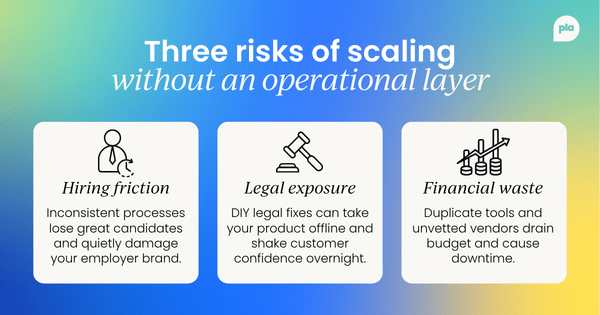
Risk 1: Hiring and retaining the right talent
We initially thought startup hiring would be easy. Talented people naturally gravitate toward startup environments, so we just needed to be passionate about our mission and emphasize our creative, high-autonomy culture. We were wrong.
Great candidates have plenty of options, and talent is tremendously important to a company's future. You need to do everything in your power, across the recruiting process, salary, and benefits, to convince them.
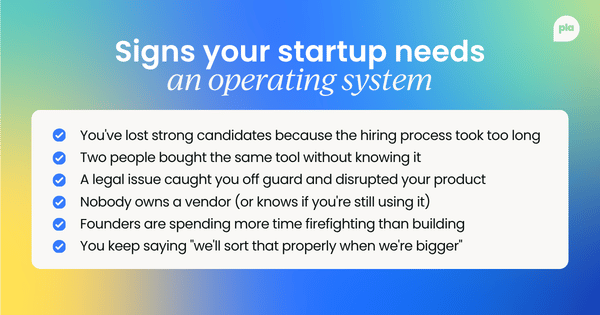
When I started interviewing for our first account executive and product managers, I had to scramble. We lost a lot of strong candidates because we had a few HR policies here and there, but not a comprehensive system:
- We didn't have an established recruiting process: no standardized interview framework for consistent evaluation, no salary benchmarking structure, no templates for communications or offer letters.
- We hadn't set up employee benefits or a comprehensive HR policy.
- We lacked the recruiting expertise to properly select talent, from resume screening through to background and reference checks.
We often either couldn't agree on the right candidate or couldn't convince our top choice to join. It hurt our product and customer goals and irrevocably damaged our brand. Worse, the founders and I ended up spending more time sourcing and interviewing candidates than if we'd built the infrastructure first.
Risk 2: Legal shortfalls can cost you your product or even your company operations
The second trade-off I ran into was legal. Legal is one of the most difficult and expensive operational functions to build because it requires legal counsel and cannot be handled cost-effectively in-house.
So, in an effort to spend consciously, I held off on legal consultation for as long as possible. Instead, I consulted legal friends, referenced general guidelines, and used templates for our website and product’s legal disclosures, customer contracts, and more. It worked for a while, and we are able to use the saved money where it mattered more at the time.
Then one day, our engineering lead flagged an emergency: our product had been pulled from the iOS App Store due to an improper privacy disclaimer. What’s worse, even though we could resolve and respond to the issue quickly, the iOS App Store could take an undetermined amount of time to review and release our app.
Meanwhile, customers who were in the early adoption phase and depended on the app daily faced disruptions to their core work – and risked losing faith in the product.
Risk 3: Financial discipline is the backbone of any company
Last but not least, finance. I come from a finance background, so I quickly took on the responsibilities of financial planning and analysis to help strengthen our financial strategy. As I recorded and reviewed our revenue and expenses, one issue became clear: vendor management. Without a proper financial process, we’d been making decisions and spending on vendors on an ad hoc basis.
For example, one team member was sending out customer contracts. He decided it would be easier if we had an electronic signature service, and purchased the first provider that showed up in the Google search. What he didn't know was that a colleague had recently had the same thought and already signed up for a different one. We ended up paying for two overlapping services for a year, neither of which had been properly evaluated or negotiated.
That pattern repeated across vendors: services purchased without a sourcing or approval process, at poor value, auto-renewed without anyone noticing, or causing operational issues due to a lack of oversight. Some vendors, brought in without proper due diligence, introduced system downtime that directly affected our product.
Solutioning: The balance between building and partnering
Once I knew where the main risk areas were, I set out to evaluate options case by case and design the basic and necessary operational system to reduce these friction points.
For HR, I was faced with two contradicting constraints: On the one hand, we were an early-stage startup with limited resources and too small a headcount to negotiate favorable terms for healthcare, payroll, and benefits. On the other hand, HR needs a comprehensive structure and policies that cover all potential employee situations, not just a few pieces barely stitched together, regardless of the number of employees.
Initially, I thought the only way was to negotiate and build each of these necessary components separately. I reached out to a number of benefits or healthcare providers, only to be rejected due to our low employee count or be quoted extremely high rates. It was also time-consuming to contract and integrate with each provider individually, and our hiring had already stalled long enough.
When the traditional route hit a wall, I had to get creative. That's when I discovered PEO (professional employer organization) partnerships – a more startup-friendly model:
- External vendors in this space typically offer pre-packaged, end-to-end solutions. For HR and payroll especially, they can provide competitive benefits packages, on-demand HR expertise, and policy frameworks at usage-based, startup-friendly pricing.
- Operational partners usually require minimal integration and customization, particularly when you bring them in early. They can also be great thought partners for building operations in a scalable and compliant way.
- Many vendors actively want to attract early-stage startups and offer promotions through government programs, VCs, or industry-specific initiatives. Some of these could cover the entire cost of the partnership.
It takes time to compare options, select the best fit for your requirements, and negotiate terms in an HR PEO partnership, but it’s worth it.
Switching HR providers later is painful. We learned that firsthand when I had to transition our payroll from a standalone vendor to our new PEO. Every employee had to re-onboard for direct deposit and paycheck setup, and many ended up filing two W-2s at year-end. It caused confusion, questions, and a real dip in trust. Each vendor transition has downstream consequences, so do your research early and find a partner that can grow with you.
Similarly for legal, I dedicated a lot of resources to not only find legal counsel who could resolve our product disclosure quickly so we could be back in business, but also the right comprehensive legal services who could collaborate with us on broader legal consultation. That relationship eventually tightened up our terms and conditions in ways that helped us avoid several legal disputes down the line.
For finance, I took a different approach. The issues didn't require external expertise, just better internal discipline. I used the vendor failures as a rallying point to establish new procurement and ownership guidelines. There is now a proper procurement and approval procedure in place, and each vendor has a named owner, who manages the subscription and tracks its value.
Above and beyond: Building, refining, and scaling a startup's operating rhythm
With that, we had the first version of Butter's operating system, with core functionality in HR, legal, and finance. But just like product and other parts of an early-stage startup, it's a starting point, not a finished state. It provides a strong foundation to kick-start our operations, where Butter can begin attracting future talent to join the mission and approach potential customers with a more standardized process.
Just like product building, the business operational system is living and breathing and needs to scale with the business. I set the proper business cadence to gather feedback and set priorities to scale by deepening our capabilities and value proposition in these established functions, as well as by expanding our operating system to other important areas, such as business review and reporting rhythm. I continued to iterate and refine our operating system to grow alongside our company, our product, our people, and our customers.
Final thoughts
In hindsight, I underestimated how quietly operational debt compounds in an early-stage startup. I assumed missing structure would slow us down much later down the line, and was a fair tradeoff for product and market fit now. Instead, it taxed us immediately – in hiring friction, legal exposure, and decision fatigue – while disguising itself as speed.
I learned an important lesson that a startup’s operating system doesn’t need to be perfect or heavy to be effective. It needs to be intentional. The right amount of structure at the right time protects your people and your momentum. Without it, you don’t actually move faster, and you just borrow time from a much more expensive future.


Become a PLA Insider
Thank you for subscribing
Get exclusive insights, frameworks, and strategies from product leaders driving real business impact.
An email has been successfully sent to confirm your subscription.
 Follow us on LinkedIn