






Created by:
 Amelia Wilson
What makes a great product manager? It's a deceptively hard question, and the answer looks different depending on who you ask. That's the problem this framework is designed to solve.
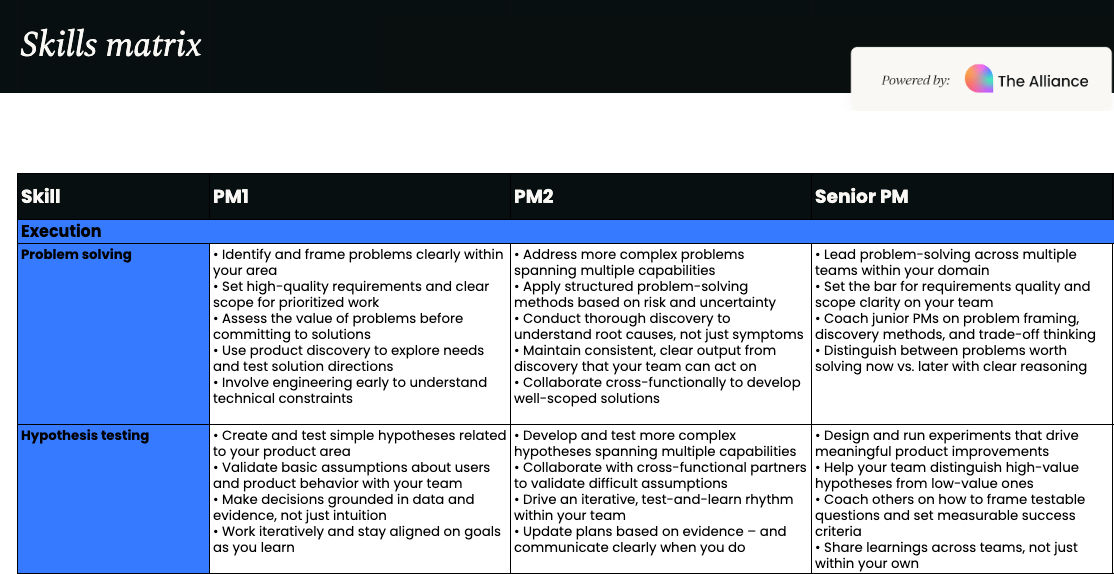
The product management skills framework provides a practical, structured way to define the PM craft across your organization. It covers 12 core skills, organized into four themes (Execution, Insights, Strategy, and Influence), and defines what great looks like at six career levels – from Associate PM all the way to VP of Product.
Inspired by the work of Matt Feczko, Director of Product Ops at Ocado Technology, this framework has been adapted to be broadly applicable across product contexts – B2B, B2C, B2B2C, and developer-facing products.
What is a product management skills framework?
A skills framework is a structured way of defining the behaviors and capabilities you expect from product managers at each level of seniority. Think of it as a shared map of what great PM work looks like – one that everyone on your team can read and navigate from.
Rather than vague descriptions like "strategic thinker" or "strong communicator," each of the 12 skills is defined with specific, observable behaviors at every career level, so it's always clear what good looks like in practice and how that evolves as someone grows.
Who’s it for?
This framework is useful for a lot of people, but here's who gets the most out of it:
- Product leaders and heads of product who want a consistent, organization-wide definition of PM craft. If you've ever noticed that different managers have wildly different expectations of what "senior" means, this is the tool that fixes that.
- Product ops practitioners who are building or formalizing the PM discipline in their organization. Whether you're building career ladders, redesigning the performance review process, or just trying to help your PMs grow faster, this gives you a solid foundation.
- People partners and HR teams working closely with product organizations. If you're designing leveling guides, calibrating job descriptions, or trying to understand what separates a PM from a senior PM, this framework speaks your language.
- Individual PMs who want to understand what's expected of them at their level and what they'd need to demonstrate to progress. You don't have to wait for your manager to show you this. Download it, read it, and bring it to your next one-on-one.
How to use the framework
Because every company is different, we'd encourage you to adapt the framework to fit your organization: rename levels to match your job architecture, adjust behavioral descriptors to reflect how your team works, and add or remove skills as needed. The goal is a framework that your PMs recognize as true to their experience.
With that in mind, here's how to get started.
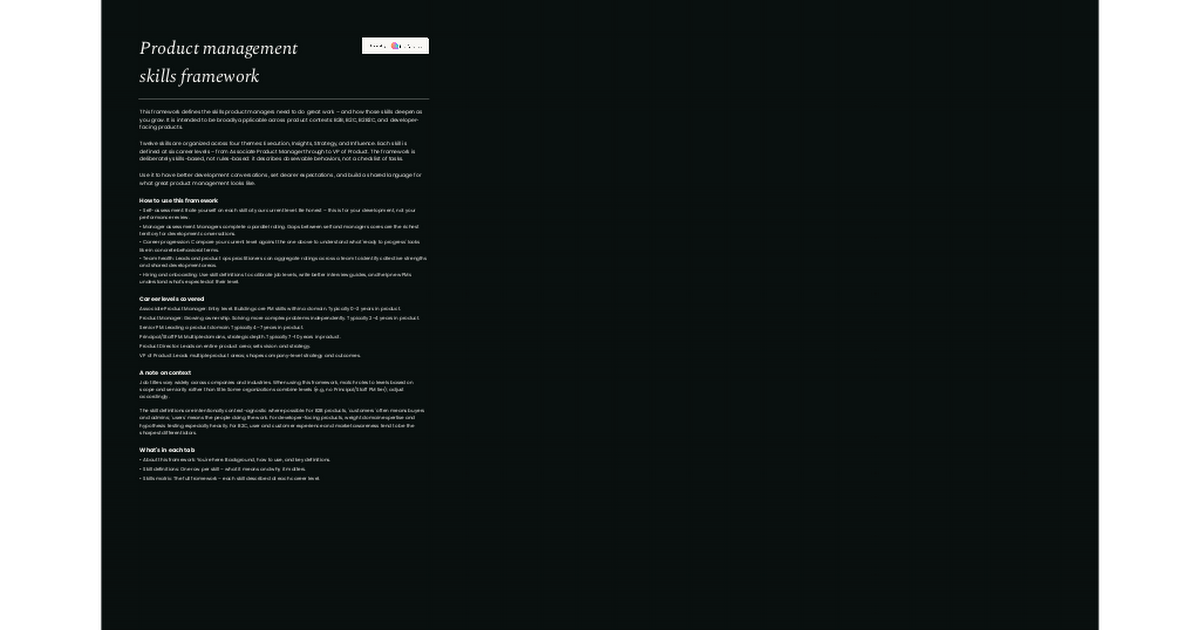
The framework has three tabs, and they're designed to build on each other.
- Start with "About this framework". It explains the structure, how the six career levels map to typical PM roles, and how to adapt it for different product contexts.
- Move to "Skill definitions" for a plain-English explanation of each of the 12 skills – what each one means, why it matters, and what distinguishes it from adjacent skills.
- Then use the "Skills matrix" as your main working tool. This is the full framework: every skill defined at every level with specific behavioral descriptors.
Depending on your role and goals, there are a few different ways to use it:
- For individual PMs: Rate yourself against each skill at your current level, then compare your level against the one above to see what "ready to progress" looks like in concrete terms. Bring it to your manager and ask them to rate you independently – the gaps are often where the most useful conversations happen.
- For people partners and HR teams: Use the skill definitions to write interview guides, calibrate job levels, or set clear expectations with new hires.
- For product leaders and product ops: Aggregate ratings across your team to spot collective strengths and shared development priorities.
Get your product management skills framework



Become a PLA Insider
Thank you for subscribing
Get exclusive insights, frameworks, and strategies from product leaders driving real business impact.
An email has been successfully sent to confirm your subscription.
 Follow us on LinkedIn