










Building KPIs for product operations is hard.
Having led product ops teams at Weight Watchers, Sprout Social, Noom, and now H1, I’ve spent a lot of time grappling with this very challenge. I’m here to share the lessons I’ve learned along the way.
Here's what we'll cover:
- Why product ops work is so hard to measure in the first place
- Three practical approaches for building KPIs that actually stick
- How to tell your story in a way that lands with leadership
- A lightweight framework to get you started this week
The challenge of measuring product ops’ impact
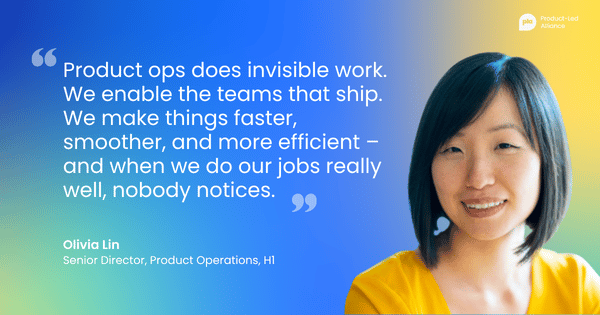
Product ops does invisible work. We enable the teams that ship. We make things faster, smoother, and more efficient – and when we do our jobs really well, nobody notices.
Think about going into McDonald's. Everything runs smoothly. You don't think about the coordination and operational systems running behind the scenes – but you definitely notice when you've been waiting twenty minutes for your Big Mac. That's us. We're the system that keeps things running, and we only become visible when something breaks.
That's a problem, especially right now.
Recent years have seen wave after wave of tech layoffs, and unfortunately, operational and enablement teams are often first on the chopping block. Instagram, Amazon, and Microsoft have all cut program managers and product managers over the last few years, and they've called it "removing bureaucracy," which is, frankly, BS.
For expert advice like this straight to your inbox twice a month, sign up for Pro+ membership.
You'll also get access to 10 certifications, a complimentary Summit ticket, and 100+ tried-and-true templates.
So, what are you waiting for?
When leaders and boards need to show they're spending wisely and getting lean, enablement and ops can become an easy place to start. That's not because our work isn't valuable. I think everyone in this space knows we put blood, sweat, and tears into what we do.
The issue is that we don’t always make our case clearly enough. We have to make ourselves impossible to cut – that's the mission.
This isn't about covering your butt or creating fake vanity metrics. It's about telling the right story to busy executives who context-switch every half hour, who don't remember a thing, and who are under constant pressure from boards to keep budgets tight.
How to set product ops KPIs
If we want to be a strategic function, we have to think, plan, and track like one. Let me share three approaches that have worked for me in previous roles. Take what resonates and adapt it.
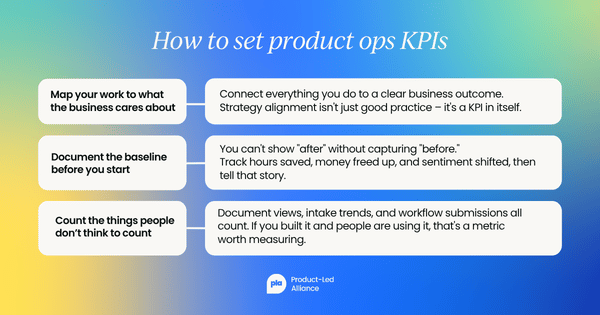
1. Map your work to what the business cares about
When you're four weeks into a new role with a laundry list of priorities, the question isn't what you should work on – it's what you can't risk not working on.
You have to understand your company's objectives and strategy and use that as a filter. Everything you take on should connect clearly to a business outcome. Strategy alignment is a KPI in itself – if you're working on the wrong things, even the strongest metrics won't save you.
Quick reality check: do you actually sit down with your product ops team and do quarterly planning? If not, it’s time to start. Look at your last company all-hands, connect the dots, and draft some OKRs.
Strategy doesn't come easy; it builds with experience over time. But we're in the best position to develop it because we talk across teams, we bridge gaps, and we often know more than executives do about how the work actually gets done.
If you have a strong point of view and understand why it matters to the business, your perceived value and executive presence go up. Through years of wrangling executives, I’ve learned that they just want you to tell them what to do. Build that muscle, especially as you level up.


Become a PLA Insider
Thank you for subscribing
Get exclusive insights, frameworks, and strategies from product leaders driving real business impact.
An email has been successfully sent to confirm your subscription.
 Follow us on LinkedIn