






Templates and frameworks to pair with this playbook
Your LinkedIn feed probably looks a lot like mine right now. Every day there's a new post declaring that product management is dead, followed by another saying it's just evolving, followed by another about how we're all becoming AI builder PMs and what that means for our careers.
Most of that conversation is focused on individual survival. How do I use AI? How do I stay relevant? While those questions matter, they're only part of the picture. The bigger, harder question – especially if you're working inside a large enterprise – is how do we survive and grow together as a product management team?
That's what I want to talk about here. At Sitecore, we've been working through this challenge with a team of around 40 product managers, more than 500 R&D people, and over 1,500 employees globally. We've had wins. We've had failures. And we've learned a lot about what it takes to move an enterprise PM team forward in the age of AI.
Getting an honest read on our team's AI habits
Before we built any new processes or rolled out any tools, we did something simple. We asked our PMs which AI tools they were reaching for.
The answer was all of them. People were experimenting with everything they could find, which is great in spirit but creates real problems at an enterprise level.
When you're working with internal company data, you can't just plug that into any tool you like. Governance and security matter. So, we selected a set of tools that everyone could use with confidence: Cursor for R&D work, and Microsoft Copilot and Atlassian for broader role-based use.
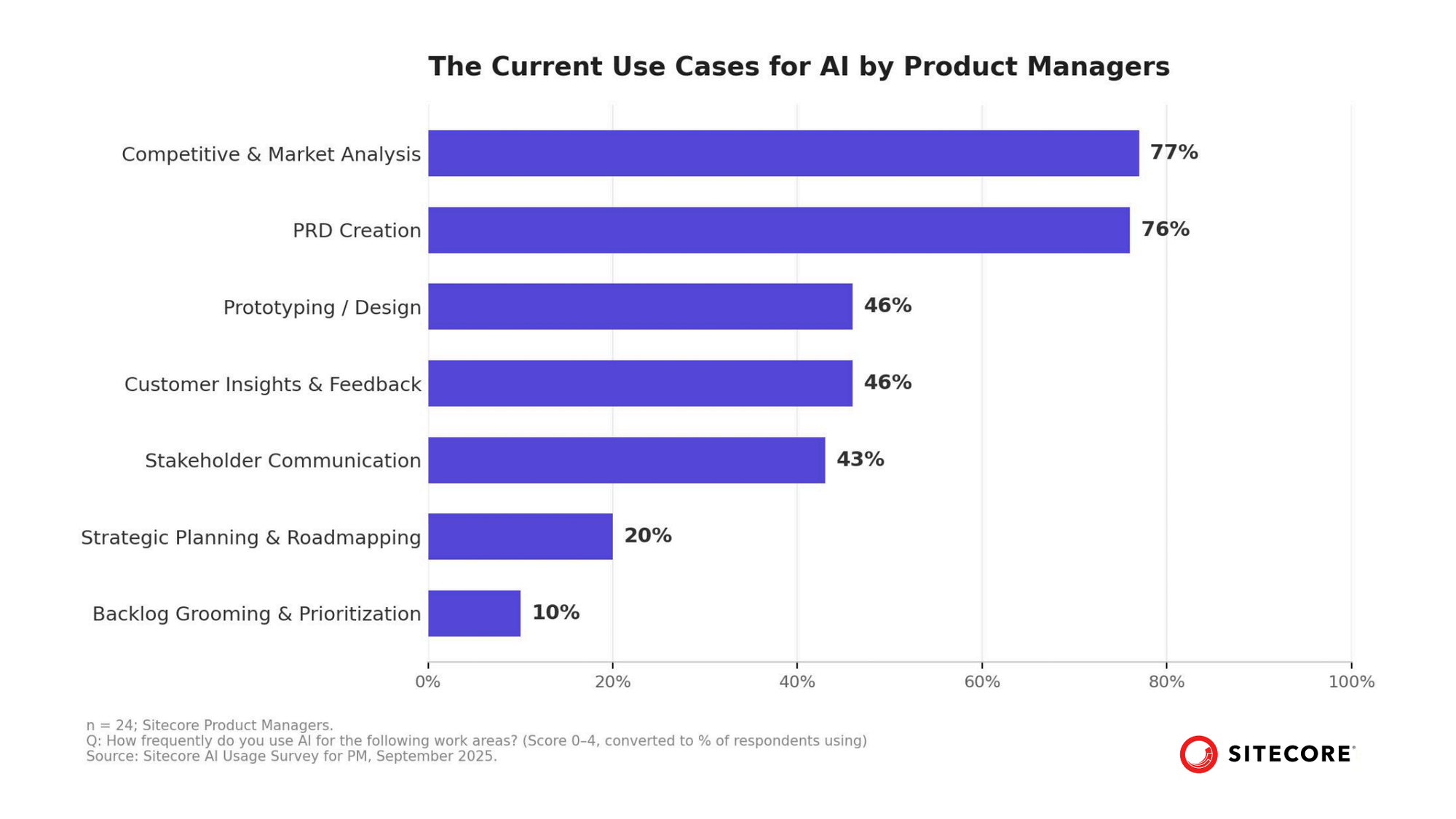
The second thing we asked was what kinds of tasks PMs were using AI for. The pattern that emerged was telling. Competitive analysis, market research, and product requirements document (PRD) creation were at the top of the list.
That makes sense. Those are tasks where you don't need to expose internal data. You can do competitive research without handing your proprietary information to an AI tool.
But further down the list, AI adoption dropped off sharply. Strategic planning, backlog grooming, and customer insights – these tasks require internal data, and without a proper enterprise strategy for managing that data, most PMs were simply avoiding them.
Gartner's 2025 State of Agile and Product Transformation Survey confirmed the same pattern. Individual productivity tasks, like documentation and day-to-day acceleration, had high adoption. More strategic, data-dependent tasks had much lower adoption. So, this wasn't a Sitecore problem. It was an industry-wide pattern.
For expert advice like this straight to your inbox twice a month, sign up for Pro+ membership.
You'll also get access to 10 certifications, a complimentary Summit ticket, and 100+ tried-and-true templates.
So, what are you waiting for?
Understanding where the team stands on the AI spectrum
Gartner describes four product manager profiles, ranging from AI naive to AI native:
- AI naive – "the legacy PM": Wary of AI, often actively avoiding it beyond the occasional chatbot experiment.
- AI assisted – "the copilot PM": Using general AI tools to speed up everyday tasks like drafting user stories or summarizing calls.
- AI augmented – "the enhanced PM": Weaving specialized AI tools into more of the role, with AI touching most day-to-day activities.
- AI native – "the intelligent PM": Treating AI as integral to every decision, working with autonomous agents and fast feedback loops.
We saw exactly this spread across our team. Some PMs were very excited. They wanted to experiment, and they were already finding ways to integrate AI into their daily work. Others were overwhelmed. They didn't know where to start, and the pace of change felt threatening rather than energizing.
Our goal wasn't to push everyone to the same level overnight. It was to meet people where they were and move them forward. Could we help an AI-naive PM become AI-assisted? Could we help an augmented PM become more native in their approach?
That framing changed how we thought about the whole initiative. It stopped being about rolling out tools and started being about building capability across a whole team.
Using the double diamond as an anchor
To structure our approach, we anchored everything to something familiar: the double diamond. We mapped AI opportunities to both the problem space and the solution space, which gave us a practical framework for thinking about where and how to invest.
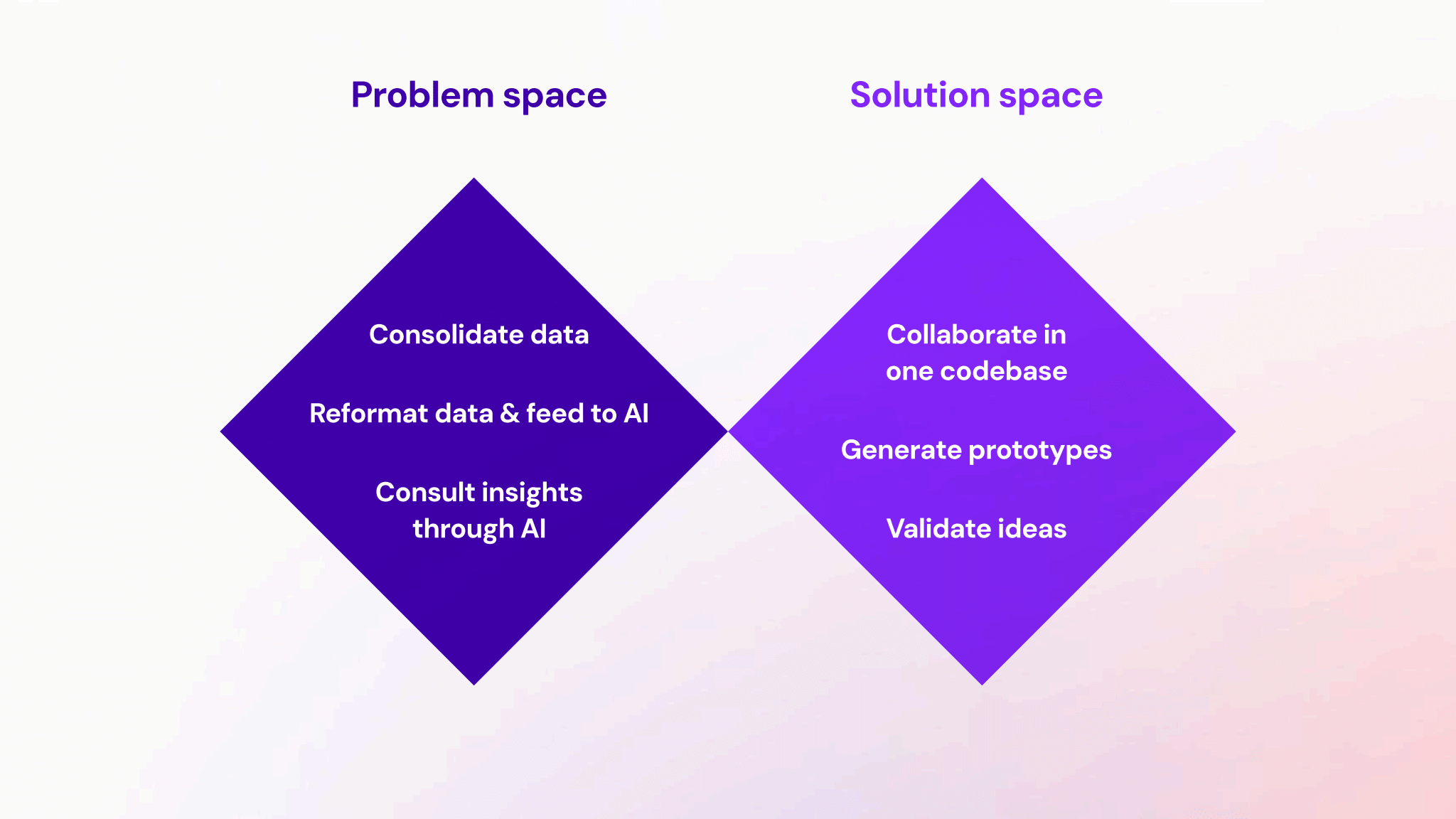
The problem space: Getting to the data
In the problem space, we want PMs to gather data from multiple sources, synthesize it, and create something they can actually have a conversation with. Sounds straightforward in theory. In practice, it's much more complicated.


Become a PLA Insider
Thank you for subscribing
Get exclusive insights, frameworks, and strategies from product leaders driving real business impact.
An email has been successfully sent to confirm your subscription.
 Follow us on LinkedIn