






For decades, the manager title was the gold medal of Silicon Valley. If you weren't managing a team of ten by year five, your career was considered stagnant.
Progression was built on a paradoxical pyramid: you proved you could build things so that eventually, you would never have to build anything again. You became a coordinator of people, a translator of requirements, and a manager of what people now call the "coordination tax."
But in 2026, the pyramid is collapsing. This began with the 2023 "Year of Efficiency," where tech companies began aggressively removing layers. Since then, Meta has flattened its org charts, Google has eliminated 35% of its managerial roles, Amazon has increased its manager-to-IC ratio by 15%, and Shopify has introduced the dual-track for crafters.
A fundamental shift is occurring. As AI moves from chatbot to agentic workforce, the most valuable asset in a tech company is no longer the person who manages a large headcount – it’s the Super IC.
The past: Management as the only safe path
Historically, the management track was the only way to scale impact. An individual, no matter how talented, had a ceiling. To build a product, whether you were in big tech or a growth startup, you needed a squad. That squad needed a lead PM, who needed a director, who needed a VP.
In this model, product management often devolved into process management. Senior PMs spent 60% of their day on the coordination tax – writing status updates, alignment docs, and navigating executive escalations. The more senior you became, the further you drifted from the actual product.
The "safe" career move was to stop being a player and start being a coach. Because that was where the equity and the influence lived.
What’s changed: The AI productivity multiplier
The emergence of generative AI and agentic workflows has broken the historical link between impact and headcount. We’re witnessing two fundamental shifts that are redefining organizational structures and the very nature of career progression:
1. AI as a productivity multiplier
In the pre-AI era, if a senior PM wanted to test a zero-to-one bet, they required a dedicated pod of engineers, designers, and researchers. The PM’s primary output was a document (the PRD), followed by weeks of waiting for mockups and months of waiting for a build.
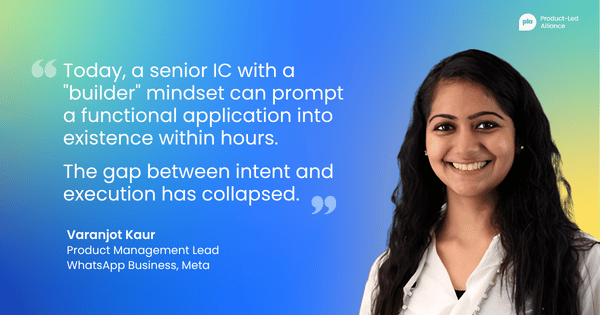
Today, a senior IC with a "builder" mindset can prompt a functional application into existence within hours. The gap between intent and execution has effectively collapsed.
2. Eliminating the coordination tax
The primary role of middle management has traditionally been information routing. AI agents are now assuming this "work about work" – syncing Jira tickets to roadmaps, summarizing disparate Slack threads into executive briefs, and predicting resource bottlenecks. When the coordination is automated, the coordinator becomes redundant.
So, how does this increase in individual capacity impact organization structures? As individual capacity expands, the need for siloed specialists diminishes. Previously, shipping a product required 10+ distinct functions – spanning engineering, design, data, and legal – each creating a 'handoff' that required massive coordination.
Now, we are moving toward a world of Super Generalists. Instead of managing handoffs, one person can touch several specialties simultaneously – moving to higher-order roles like setting vision, designing systems, and validating outputs.
Taken together, these two shifts produce a flatter org chart with fewer layers, fewer people, and a more sophisticated operating system beneath it. AI is leading the path from more productive people to more productive, leaner organizations
The new playbook: From "span of control" to "span of impact"
Historically, headcount was the ultimate proxy for power. Leadership was measured by your span of control – the number of humans reporting to you.
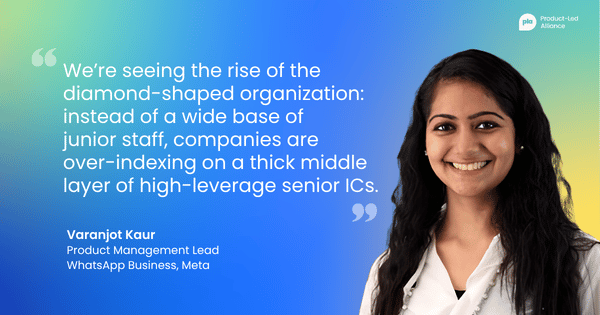
In AI-native organizations, this is being replaced by span of impact. We’re seeing the rise of the diamond-shaped organization: instead of a wide base of junior staff, companies are over-indexing on a thick middle layer of high-leverage senior ICs.
These individuals may have zero direct reports, yet they drive more revenue than a 50-person department did five years ago. A prime example is Meta’s recently announced Applied AI organization, which operates with a staggering 50:1 IC-to-Manager ratio.
The natural pushback to this flatter world, something I hear from other managers all the time: “If everyone is an IC, how do I stand out and progress?” In this era, career progression is redefined by the complexity of your leverage rather than the size of your team. You differentiate yourself in two ways:
- Mastering high-stakes ambiguity: AI can optimize the known, but it cannot navigate the unknown. The ultimate differentiator for a staff or principal IC is the ability to own problems with a high risk of failure and complex, cross-functional dependencies.
- Orchestrating agentic leverage: We’re still in the early days of AI adoption. True differentiation doesn't come from just using AI, but from orchestrating it. The Super IC doesn't manage people; they build and deploy digital agents to multiply their own output, freeing themselves up for high-order strategy.
So, how do you position yourself for this shift?
Whether you’re currently a manager or an IC, the builder era requires a tactical pivot.
- For the "pure manager": Transition to player-coach. The manager who spends 100% of their time on status updates and budget meetings is becoming an endangered species.
If you love the human element of coaching, you must reengineer your role to become a player-coach. Seek positions where you can still mentor, but also own a specific product surface where you keep your skills sharp.
If your "secret sauce" is purely empathy and judgment, pivot toward high-trust domains like enterprise sales or culture leadership – areas where human trust remains the ultimate premium. - For the "stuck" manager: The strategic return to craft. If you entered management for the pay bump but find the admin draining, this is your exit ramp. In AI-native orgs, a principal IC can out-earn and out-influence the director they report to. Moving back to an IC role is no longer a demotion; it’s a strategic move to where the leverage actually lives.
- For the IC: Scale your superpower. There has never been a better time to remain an IC. The tools at your disposal now allow you to have the impact of a CEO on a specific domain. Focus on becoming AI-native and using agents to multiply your output. Your goal is to be the person who can identify a market gap, build the prototype, and scale the strategy solo.
The bottom line
The future doesn't belong to those who can manage the most people. It belongs to those who can build the most value with the fewest people.
The Super IC has arrived.


Become a PLA Insider
Thank you for subscribing
Get exclusive insights, frameworks, and strategies from product leaders driving real business impact.
An email has been successfully sent to confirm your subscription.
 Follow us on LinkedIn