






Shubham Anandani, Engineering Manager at LinkedIn, presented this session at the AI-Native Product Summit 2026, sharing a practical framework for integrating AI agents into product and engineering workflows without losing human accountability.
Is AI just a tool bolted onto how your team already works, or has it become an actual team member with a role, a job, and a place in the room?
My argument in this article is that for a growing number of companies, it's already the second one. The evidence for that comes from three companies you know well: Shopify, Netflix, and Klarna. Each of them has gone through this shift in a different way, and each contains a concrete lesson you can take back to your own team.
I'll also walk you through five human skills that can’t be automated, four agent roles you can deploy on Monday, and a practical playbook to help you move forward without becoming a cautionary tale.
Let's get into it.
Three shifts in how AI-native teams work
AI-native teams move faster, not because they've eliminated review cycles or reduced accountability, but because they've reduced coordination tax – the time spent passing work between people, losing context at every handoff, waiting for the next person in the chain to pick things up.
When that coordination layer shrinks, speed goes up, but something else happens too – judgment becomes the bottleneck. The question shifts from "how do we get this work done?" to "who decides what's worth doing, and how do we know if it worked?"
That shift shows up clearly in three areas: how workflows are structured, how experiments run, and how decisions get made.
For expert advice like this straight to your inbox twice a month, sign up for Pro+ membership.
You'll also get access to 10 certifications, a complimentary Summit ticket, and 100+ tried-and-true templates.
So, what are you waiting for?
Shift 1: Workflows
The old model looked like a relay race. A PM wrote a spec, handed it to design, and design handed it to engineering. Every handoff lost time and context.
The new model looks more like a small cross-functional team where an agent absorbs routine analysis, drafts first-pass code, and handles repetitive reviews, while humans take care of the judgment calls.
Shopify is the clearest example of this at scale. Shopify routes its AI requests through one internal gateway. One in every eight merged pull requests is now co-authored by an agent they call River, which lives inside their Slack.
Every one of those pull requests still goes through human review before it merges. River proposes; a human decides to ship. The agent handles volume; the human handles taste and accountability.
The result is that smaller teams handle bigger workloads – not because reviews have disappeared, but because the coordination tax has decreased.
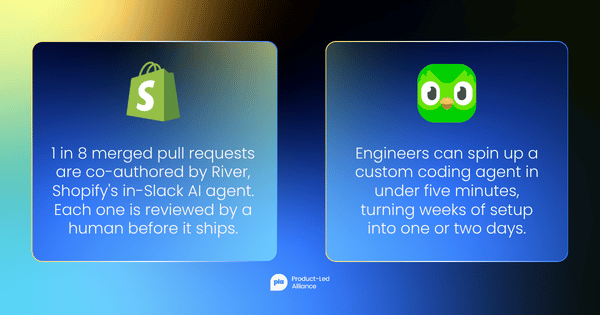
Duolingo uses a similar approach. Their employees can spin up a custom coding agent through a simple form in under five minutes. Building a custom workflow typically takes one or two days. Their CEO even told the company in a public all-hands email that they'd gradually stop using contractors for work AI could already handle.
Across different companies, the pattern is the same: the coordination layer contracts, and teams produce higher output without growing in size.
Shift 2: Experimentation
Netflix built its entire culture around a specific discipline: instead of executives deciding what's good, millions of members vote through their behavior. That's what gave them the confidence to commit to two full seasons of House of Cards with no pilot; the data showed enough overlap between a director, an actor, and a genre with an underserved audience. The confidence came from evidence, not gut feel.
You can apply this lesson to how you run AI-assisted experiments. There's a difference between a vague hypothesis like "Version A is better," and a specific one like "this increases activation within seven days." The first one is guessing. The second one is learning. If you can't build a clear hypothesis, a metric, and a timeframe for your last AI-assisted change, you’re not really experimenting.
Shift 3: Decision-making
AI generally expands what's possible: more prototypes, more variants, more options in the same sprint - but humans still make the final call. Klarna's story is the most instructive example of what happens when that line gets blurred.


Become a PLA Insider
Thank you for subscribing
Get exclusive insights, frameworks, and strategies from product leaders driving real business impact.
An email has been successfully sent to confirm your subscription.
 Follow us on LinkedIn