








If you asked a product manager five years ago what feature flags were for, the answer was simple: a way for engineering to ship code defensively.
In my experience, the organizations with the most operationally sophisticated products have elevated feature flags beyond mere deployment tools. Feature flags have become the horizontal control layer through which product teams manage releases, run experiments, orchestrate rollouts, and increasingly govern AI-specific concerns like prompt versions, model variants, and runtime safety controls.
Flags are more than an engineering infrastructure today. And most product leaders are still treating them like they belong to the engineering team.
Here's a useful test: think of the last meaningful product decision your team made… a pricing tweak, a copy change, a model swap, a risk mitigation. How long did it take to go from "we should do this" to "it's live for the right users"? Hours? Days? A sprint?
At the top end of the industry, that number is closer to minutes. Booking.com runs in excess of 1,000 concurrent experiments at any given moment across different products and target groups, and according to one analysis of their practice, they collectively run more than 25,000 A/B tests annually, roughly 70 new tests launched every single day.
Amazon's deployment cadence tells a similar story from the engineering side: a reported 50 million deployments a year, equivalent to roughly 1.6 deployments every second, possible only because code shipment and feature release are decoupled by flags.
The gap between those organizations and everyone else is whether flags are treated as a product capability or an engineering convenience. So before reading on, a quick gut check:
- Do your product managers know which flags are currently live in production, or does that knowledge sit with engineering?
- When you ran your last experiment, did a PM configure it, or did it require an engineering ticket?
- If a model output went wrong tomorrow, could a non-engineer narrow the blast radius in under five minutes?
- Do you know how many of your active flags are experiments, permanent configuration, or forgotten technical debt?
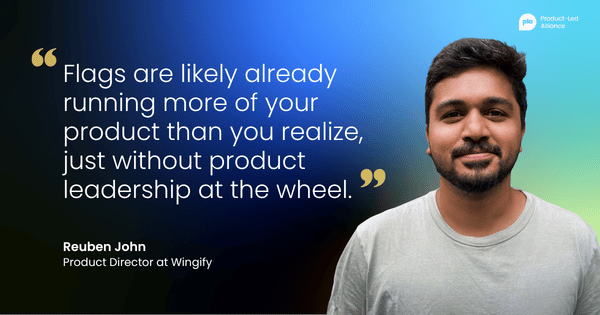
If you answered "no" or "I'm not sure" to more than one question above, the rest of this piece is for you. Flags are likely already running more of your product than you realize, just without product leadership at the wheel.
The kill switch
Teams used to ship a feature to everyone and hope for the best. Today, they use flags to release to 5% initially, then 20%, and then 50%, monitoring metrics at each stage before going to 100%. That's primarily a product decision about risk tolerance, customer segmentation, and rollout strategy.
Eventually, experimentation got added to the mix. A/B tests were run across product experiences, pricing models, and onboarding flows using feature flags. The flag wasn't just controlling whether a feature was on or off; it was controlling which version of the product a specific user segment experienced and measuring the impact.
Then operational toggles emerged: maintenance mode, regional compliance controls, and seasonal features that needed to be activated on a schedule. Entitlement management for different customer tiers. Each of these is a product operations concern, but because flags originated in engineering, that's where the ownership and the access stayed.
The impact of the AI layer
If moving from kill switches to rollout controls, experimentation, and operational toggles still keeps feature flags mostly in engineering’s hands, AI will change that.
Every product team building with AI is now managing a new set of variables that change faster than traditional feature cycles. Instructions specifying how an AI model behaves within your product need to be tested, compared, and rolled back without code deploys. Model variants need to be swapped or A/B tested across user segments to evaluate performance, cost, and quality trade-offs.
Safety controls, or guardrails as they are popularly known, prevent harmful, off-brand, or hallucinated outputs. They need to be toggled at runtime, sometimes in response to incidents that unfold in minutes.
All of these are product decisions. Which prompt version should this user segment see? Which model should power this workflow? What safety threshold is acceptable for this use case? Yet in most organizations, making any of these changes requires filing a ticket with engineering and waiting for a deploy.
Today, a single feature flag can:
- control which prompt version a user segment receives.
- route 10% of traffic to a new model variant while monitoring quality metrics.
- instantly tighten safety controls when a new risk is identified.
The teams that are shipping AI products fastest are already using flags this way. The teams that aren't are bottlenecked on deploy cycles for decisions that should be made in real time.
Product ops opportunity
This is where product operations comes in. In organizations that have a product ops function, the mandate is typically to create the systems, processes, and infrastructure that allow product teams to operate more effectively. Feature flags, as they exist today, are exactly the kind of horizontal capability that product ops should own, or at least co-own with engineering.
Product ops already manage the tooling layer around product analytics, experimentation governance, and release coordination. Flags now become integral to all three. Leaving them entirely in engineering's domain creates a dependency bottleneck where product decisions, such as what to release, to whom, and under what conditions, require engineering execution for every change, which is not a practical solution every time.
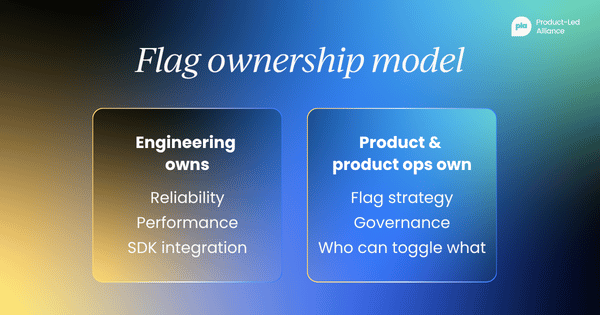
In a mature model, engineering owns the flag infrastructure: reliability, performance, and SDK integration. Product and product ops own the flag strategy: which flags exist, who can toggle them, what governance applies, and how flags connect to experimentation and rollout decisions. This is about recognizing that flags have outgrown their original scope, and the ownership model needs to evolve with them.
What should product leaders do?
If you lead a product team and you don't have direct visibility into your feature flag layer, you’re operating with a gap in your product ops capability. Here's how to close it.
1. Audit your flags
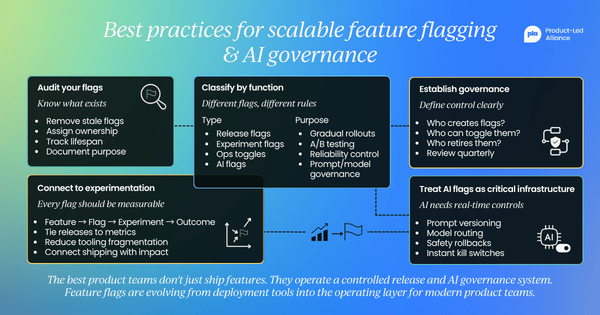
Audit what you actually have. Most companies have hundreds of flags. Many of them are stale, undocumented, and owned by no one in particular. Before you can manage flags strategically, you need a catalog: what's active, what each flag is for, who owns it, and how long it's supposed to live.
2. Classify by function
Flags are different, and hence, it is important to classify them by function. Release flags, experiment flags, operational toggles, and AI governance flags perform different jobs and need different ownership and lifecycle rules.
A release flag should have an expiration date, while an operational toggle might be permanent on purpose. On the other hand, an AI safety flag needs real-time accessibility for the people who would respond to a quality incident.
Treating them all the same is how flag debt accumulates.
3. Establish governance
Who can create, toggle, and retire flags and under what conditions has to be clearly defined.
Engineering should keep control of infrastructure-level flags, while product and product ops should have direct access to flags governing user experience, experimentation, and AI behavior. These need to be documented and reviewed quarterly.
4. Connect flags to your experimentation program
If your team runs experiments through one system and manages flags through another, that’s a recipe for fragmentation that will cost you on every launch.
Effective product teams treat flags as the execution layer for experimentation itself because every experiment is a flag, every flag is measurable, and the connection between "what we shipped" and "what it did" stays seamless.
VWO's Feature Experimentation, for example, uses the One Flag infrastructure for both controlled rollouts and personalization, so the link between what shipped and what it did remains intact, and product teams can self-serve variations, traffic allocation, and targeting rules without an engineering ticket for each test.
The specific tool matters less than the principle, so pick something that closes the loop rather than widens it.
“As businesses continue adopting feature flagging and controlled rollouts, experimentation is no longer just a phase in product development; it’s a fundamental capability that drives confident decision-making and minimizes risk.”
Dom Light, Product Manager at Xero
5. Treat AI flags as a first-class concern
If your product uses AI in any meaningful way, you need a flag strategy for prompt versions, model routing, and safety controls now – not after the first incident. Industries with regulatory oversight – healthcare, finance, legal services – already need comprehensive audit trails documenting what prompts the model received, when it changed, and who authorized the change.
Teams that proactively build this infrastructure will iterate faster and recover from issues within minutes. The teams that don't will learn the hard way that AI governance at deploy speed isn't fast enough.
Closing thoughts
Feature flags are one of those rare pieces of infrastructure that started tactical and became strategic without most organizations noticing the transition. They began as a developer tool. They are now the layer through which product teams control what users experience, when, and under what conditions, including, increasingly, how AI behaves inside the product.
Product leaders who recognize this shift and take on the appropriate level of ownership will operate with greater speed, precision, and control. Those who continue to treat flags as someone else's tool will keep filing tickets for decisions they should make themselves.
The flag layer is the product operations layer. The only question is whether your organization has caught up to that reality yet.


Become a PLA Insider
Thank you for subscribing
Get exclusive insights, frameworks, and strategies from product leaders driving real business impact.
An email has been successfully sent to confirm your subscription.
 Follow us on LinkedIn