






Templates and frameworks to pair with this playbook
Product management has won, at least on paper. We fought for a seat at the leadership table, and we got it. We own the roadmap, we have an operations function, and there are product folks in the C-suite.
But here's what I keep noticing, both in my own organization and in conversations with product leaders across the industry: even with all this clout, we still move slowly. We're running steering committees, waiting for guidance, and filling our calendars with alignment sessions and check-ins until there's no space left to think.
We escaped the project management trap, but in a lot of organizations, we just renamed it. Backlogs became opportunity trees. Status meetings became alignment sessions. The words changed; the structure barely did.
And commercial accountability? That still sits with “the business people” in too many companies. Product got empowerment. Financial ownership stayed elsewhere. It’s time to change that.
In this article, I'll cover:
- How AI is reshaping product management’s role
- The convenient deal product management made with the business, and why it's due for renegotiation
- Why the old product model is breaking, and what's replacing it
- The five things that will define the next generation of product leaders: the business builders
- One question worth asking yourself about where your value really comes from
How AI is changing product management
This is, above all, a story about people. However, I do need to mention a little side character in our story: AI.
Is AI replacing product managers? Not exactly. But it is replacing the activities that many of us have used to prove our value.
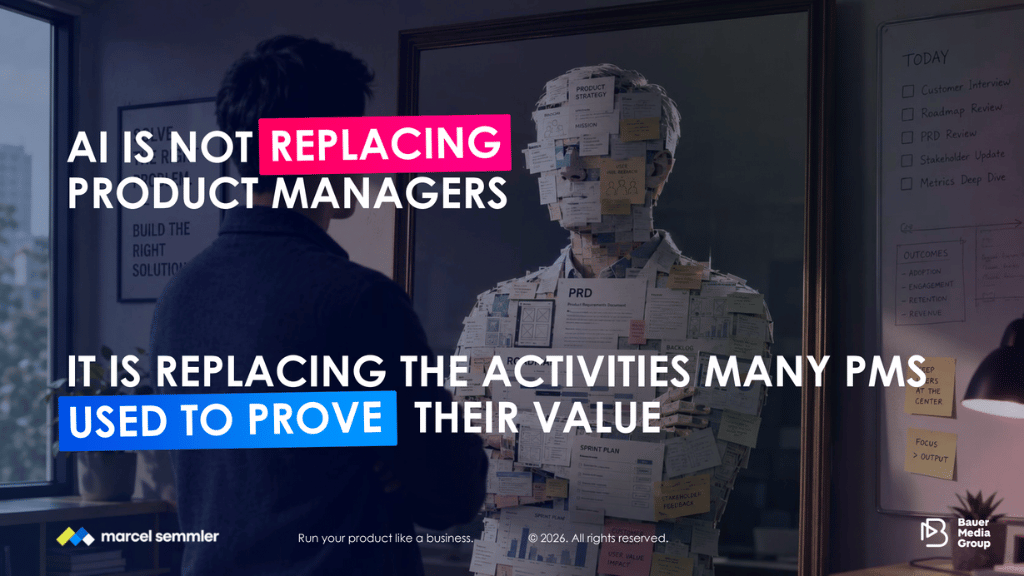
Think about what's becoming commoditized. Product requirements documents can be generated in seconds. Research summaries can be whipped up in minutes. Roadmap drafts can be created from existing documentation. Rough prototypes can be assembled in hours. Stakeholder updates can be tailored and produced at scale.
These used to be the artifacts that demonstrated a product manager's worth. They took skill, time, and experience to produce well. Now they're cheap and easy to produce. When the artifacts become cheap, the accountability behind them becomes visible. And if that accountability doesn't extend very far, that's a problem.
So, ask yourself honestly: if AI is handling the documents, what do you actually own? What's your superpower when the deliverables take care of themselves?
For expert advice like this straight to your inbox twice a month, sign up for Pro+ membership.
You'll also get access to 10 certifications, a complimentary Summit ticket, and 100+ tried-and-true templates.
So, what are you waiting for?
The convenient deal we made with our businesses
When product people started pushing for more empowerment, ten or fifteen years ago, we were right to do so. We needed freedom from fixed roadmaps. Freedom from delivery pressure that left no room for discovery. Freedom from stakeholders who treated product teams like order-takers. When we got that freedom, it was long overdue.
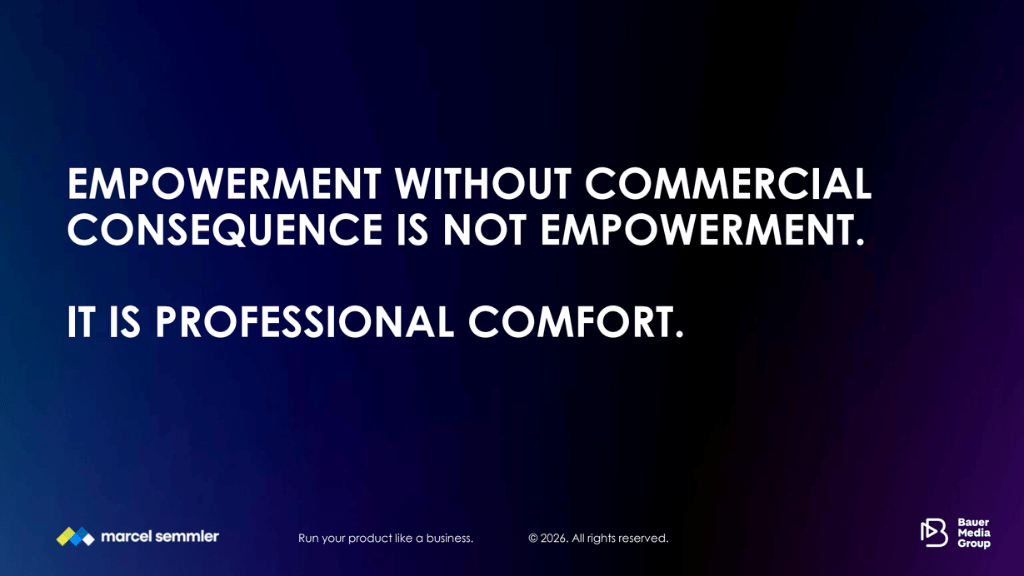
But somewhere along the way, that empowerment became too comfortable. We got the right to decide which problems matter, which customer needs deserve attention, and which solutions get built. That's real power. However, while we now own a whole raft of decisions, we rarely own the consequences of those decisions.
When something ships and the business outcome is disappointing, responsibility tends to diffuse very quickly. Sales didn't sell it right. Marketing didn't position it well. Leadership changed priorities. Engineering was too slow. The market moved. Customers weren't ready.
We've all heard these explanations – we may even have used some of them – and sometimes they're true. But the pattern of shared blame, where nobody fully owns the outcome, is something product management has to reckon with.
If you want to own the roadmap, you can't refuse to own the results. And I don't mean NPS scores or engagement metrics. I mean the real commercial levers: revenue, margin, retention, cost to serve. The things that show up in the P&L.
So, ask yourself: what business consequence are you prepared to own? Where are you willing to say “I drove this outcome”?
The old product model is breaking
The model that most of us have been working inside was built on an assumption: building software is expensive, so we need guardrails.
That assumption shaped everything. Product managers became the bottleneck between business demand and engineering capacity. The business produced demand. Product translated it. Design visualized it. Engineering built it. Steering committees governed the whole thing. Ownership got distributed across so many people that, in practice, nobody fully owned anything.


Become a PLA Insider
Thank you for subscribing
Get exclusive insights, frameworks, and strategies from product leaders driving real business impact.
An email has been successfully sent to confirm your subscription.
 Follow us on LinkedIn